What is the minimum number of straight lines required to construct the following figure?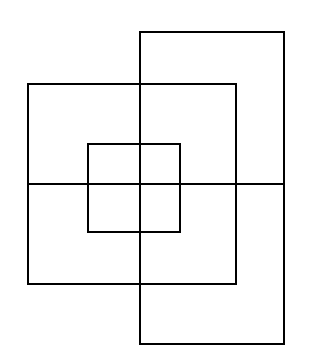
The problem requires us to determine the minimum number of straight lines needed to construct the given figure, which consists of overlapping squares.
Correct Option: B) 13
To determine the number of complete rotations the minute hand makes in a week, we need to calculate the rotations per hour, then per day, and finally per week. We know that the minute hand completes one full rotation in 60 minutes (1 hour).
A) 168 is the correct answer. The minute hand makes 1 rotation per hour, 24 rotations per day, and therefore 168 rotations in a week.
The question asks to identify the CEO of Infosys who took charge at the beginning of 2018. This is a factual question related to current affairs and business leadership changes in major Indian IT companies.
Correct Option: B) Salil Parekh was appointed as the CEO and MD of Infosys and assumed office on January 2, 2018.
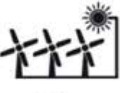
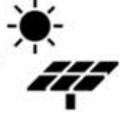
Select the missing figure based on the given related pair of figures.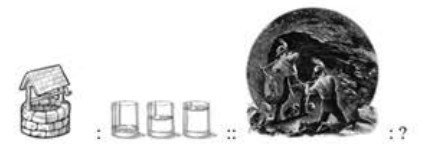
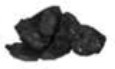
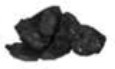
The question requires identifying the missing figure based on a relationship between given pairs of figures. The first pair involves a well and glasses of water, suggesting a source and its product. The second pair involves coal miners, indicating a source of energy. We need to find a figure that represents a product related to coal mining.
Correct Option: C) Coal is the product related to coal miners, similar to how water is the product related to a well.
The question asks to identify the instrument used for measuring electric current. We need to recall the functions of the given options: Rheostat, Ammeter, Galvanometer, and Voltmeter.
Correct Option: B) Ammeter is the instrument used to measure electric current. It is connected in series in a circuit and has a very low resistance to minimize its impact on the circuit's current.
From the top of a platform 5 m high, the angle of elevation of a tower was 30°. If the platform was positioned 40\(\sqrt{3}\) m away from the tower, how tall was the tower?
This problem involves trigonometry, specifically the tangent function, to find the height of the tower. We will use the given angle of elevation, the height of the platform, and the distance from the platform to the tower to calculate the unknown height.
Let the height of the platform be \(P = 5 \text{ m}\). Let the distance from the platform to the tower be \(D = 40\sqrt{3} \text{ m}\). Let the total height of the tower be \(H\). Let the angle of elevation from the top of the platform to the top of the tower be \(\theta = 30^\circ\).
Imagine a right-angled triangle formed by:
In the right-angled triangle, we know the adjacent side (distance \(D\)) and we want to find the opposite side (height \(h\)). The tangent function relates these two:
\[ \tan(\theta) = \frac{\text{Opposite}}{\text{Adjacent}} \]We know that \(\tan(30^\circ) = \frac{1}{\sqrt{3}}\).
\[ \frac{1}{\sqrt{3}} = \frac{h}{40\sqrt{3}} \]Multiply both sides by \(40\sqrt{3}\):
\[ h = \frac{1}{\sqrt{3}} \times 40\sqrt{3} \] \[ h = 40 \text{ m} \]The total height of the tower \(H\) is the sum of the height of the platform \(P\) and the height \(h\) calculated above.
\[ H = P + h \] \[ H = 5 \text{ m} + 40 \text{ m} \] \[ H = 45 \text{ m} \]Correct Option: D) 45 m
The problem asks us to find the weight of a boy on Earth, given his weight on the Moon. We need to understand the relationship between weight, mass, and the acceleration due to gravity on the Moon and Earth. The acceleration due to gravity on the Moon is approximately one-sixth of that on Earth.
Understand Weight and Mass: Weight is the force exerted on an object due to gravity and is given by the formula \(W = m \times g\), where \(m\) is the mass of the object and \(g\) is the acceleration due to gravity. Mass is an intrinsic property of an object and remains constant regardless of its location (Earth, Moon, space).
Given Information:
Weight of the boy on the Moon (\(W_M\)) = 300 N
Relationship between Earth's and Moon's Gravity: The acceleration due to gravity on the Moon (\(g_M\)) is approximately one-sixth of the acceleration due to gravity on Earth (\(g_E\)).
\[ g_M = \frac{1}{6} g_E \]
Calculate Mass of the Boy: We can find the mass of the boy using his weight on the Moon:
\[ W_M = m \times g_M \]
\[ 300 \, \text{N} = m \times \frac{1}{6} g_E \]
From this, we can express \(m \times g_E\):
\[ m \times g_E = 300 \, \text{N} \times 6 \]
\[ m \times g_E = 1800 \, \text{N} \]
Calculate Weight on Earth: The weight of the boy on Earth (\(W_E\)) is given by:
\[ W_E = m \times g_E \]
From the previous step, we found that \(m \times g_E = 1800 \, \text{N}\).
Therefore,
\[ W_E = 1800 \, \text{N} \]
A) 1800 N. This is the calculated weight of the boy on the surface of the Earth, as the acceleration due to gravity on Earth is six times that on the Moon.
The question asks to identify the Human Resource Development Minister in Prime Minister Modi's cabinet as of February 2018. This requires knowledge of the cabinet portfolios during that specific period.
As of February 2018, Prakash Javadekar was the Union Minister for Human Resource Development.
B) Prakash Javadekar was indeed the Union Minister for Human Resource Development in Prime Minister Modi's cabinet as of February 2018. He held this portfolio from July 2016 to May 2019.
The problem involves calculating the amount of sugar added to a dough mixture. We are given the initial ratio of sugar to flour, the total initial quantity of dough, and the final ratio after adding more sugar. The key is to determine the initial quantities of sugar and flour, then use the final ratio to find the new quantity of sugar, keeping the flour quantity constant.
Calculate initial quantities of sugar and flour:
The initial ratio of sugar to flour is \(2:7\). The total parts in the ratio are \(2 + 7 = 9\) parts.
The total quantity of dough is \(13.5 \text{ kg}\).
Initial quantity of sugar:
\[ \text{Sugar}_{\text{initial}} = \frac{2}{9} \times 13.5 \text{ kg} = 2 \times 1.5 \text{ kg} = 3 \text{ kg} \]Initial quantity of flour:
\[ \text{Flour}_{\text{initial}} = \frac{7}{9} \times 13.5 \text{ kg} = 7 \times 1.5 \text{ kg} = 10.5 \text{ kg} \]Alternatively, \(\text{Flour}_{\text{initial}} = 13.5 \text{ kg} - 3 \text{ kg} = 10.5 \text{ kg}\).
Determine the final quantity of sugar:
John adds more sugar, but the quantity of flour remains constant at \(10.5 \text{ kg}\).
The new ratio of sugar to flour is \(2:5\).
Let the final quantity of sugar be \(\text{Sugar}_{\text{final}}\).
We can set up a proportion:
\[ \frac{\text{Sugar}_{\text{final}}}{\text{Flour}_{\text{initial}}} = \frac{2}{5} \] \[ \frac{\text{Sugar}_{\text{final}}}{10.5 \text{ kg}} = \frac{2}{5} \] \[ \text{Sugar}_{\text{final}} = \frac{2}{5} \times 10.5 \text{ kg} = 2 \times 2.1 \text{ kg} = 4.2 \text{ kg} \]Calculate the amount of sugar added:
The amount of sugar added is the difference between the final and initial quantities of sugar.
\[ \text{Sugar added} = \text{Sugar}_{\text{final}} - \text{Sugar}_{\text{initial}} \] \[ \text{Sugar added} = 4.2 \text{ kg} - 3 \text{ kg} = 1.2 \text{ kg} \]A) 1.2 kg is the correct amount of sugar added by John.
The question asks to identify which of the given animals does NOT belong to the class Reptilia. To answer this, we need to recall the classification of the listed animals.
Correct Option: B) Toad. Toads are amphibians, characterized by their moist skin and a life cycle that often involves both aquatic (larval) and terrestrial (adult) stages. They do not possess the scales or scutes typical of reptiles.