The question asks to identify the metal that does not react with oxygen even at high temperatures. This relates to the reactivity series of metals and their affinity for oxygen.
Correct Option: C) Silver
We need to find Jeremy's present age. We can set up a system of linear equations based on the given information about the age difference between Jeremy and his father, and their ages eight years hence. We will use variables to represent their current ages and then solve for Jeremy's age.
Define variables:
Let Jeremy's present age be \(J\) years.
Let his father's present age be \(F\) years.
Formulate the first equation from the first statement:
"Jeremy is 26 years younger than his father."
This means the father is 26 years older than Jeremy.
\[ F = J + 26 \quad \text{(Equation 1)} \]
Determine their ages eight years hence:
Jeremy's age eight years hence: \(J + 8\)
Father's age eight years hence: \(F + 8\)
Formulate the second equation from the second statement:
"Eight years hence his father's age will be two years less than twice his age."
\[ F + 8 = 2(J + 8) - 2 \]
Simplify the second equation:
\[ F + 8 = 2J + 16 - 2 \]
\[ F + 8 = 2J + 14 \]
\[ F = 2J + 14 - 8 \]
\[ F = 2J + 6 \quad \text{(Equation 2)} \]
Solve the system of equations:
Now we have two expressions for \(F\):
From Equation 1: \(F = J + 26\)
From Equation 2: \(F = 2J + 6\)
Set them equal to each other:
\[ J + 26 = 2J + 6 \]
Isolate \(J\):
Subtract \(J\) from both sides:
\[ 26 = 2J - J + 6 \]
\[ 26 = J + 6 \]
Subtract 6 from both sides:
\[ 26 - 6 = J \]
\[ J = 20 \]
Verify the answer (optional but recommended):
If Jeremy's present age is 20, then his father's present age is \(20 + 26 = 46\).
Eight years hence:
Jeremy's age will be \(20 + 8 = 28\).
Father's age will be \(46 + 8 = 54\).
Check the condition: "father's age will be two years less than twice his age".
Twice Jeremy's age eight years hence is \(2 \times 28 = 56\).
Two years less than twice Jeremy's age is \(56 - 2 = 54\).
This matches the father's age eight years hence, so the answer is correct.
D) Jeremy's present age is 20 years.
This problem involves understanding the relative directions on a clock face. We need to establish the mapping between clock positions and cardinal directions based on the given information (6 p.m. hour hand pointing East) and then determine the direction of the minute hand at 9.15 p.m.
At 6 p.m., the hour hand is exactly at the '6' mark on the clock face. The problem states that at this time, the hour hand points East.
Therefore, the '6' mark on the clock corresponds to East.
A standard clock face has 12 numbers, representing 12 hours. The total angle of a circle is \(360^\circ\). Each hour mark is separated by \(360^\circ / 12 = 30^\circ\).
If '6' is East, we can deduce other directions:
Let's verify the standard cardinal directions:
At 9.15 p.m., the minute hand is exactly at the '3' mark on the clock face (since 15 minutes is \(15/60 = 1/4\) of an hour, and \(1/4\) of 12 hours is 3 hours, so it points to the '3').
From our established mapping in Step 2, the '3' mark on the clock corresponds to South.
Correct Option: B) South
The question asks about the reason for Thumba's fame in Kerala. This requires knowledge of significant geographical and scientific locations in India, particularly in Kerala.
Correct Option: A) it is a rocket launching station.
Thumba, near Thiruvananthapuram in Kerala, is famous for the Thumba Equatorial Rocket Launching Station (TERLS). This station was established by India in 1963 and is operated by the Indian Space Research Organisation (ISRO). It is strategically located close to the Earth's magnetic equator, which makes it ideal for atmospheric research and launching sounding rockets.
Diluting a concentrated acid is a highly exothermic process, meaning it releases a significant amount of heat. To ensure safety and prevent accidents like splashing or boiling, the dilution must be performed carefully. The key principle is to control the heat generated and ensure it dissipates safely.
Correct Option: D) concentrated acid into water
Adding concentrated acid slowly into water, with constant stirring, is the safest method. The larger volume of water can absorb the heat generated, preventing dangerous boiling and splashing.
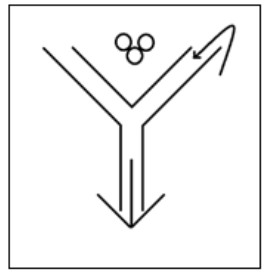
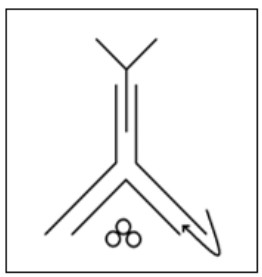
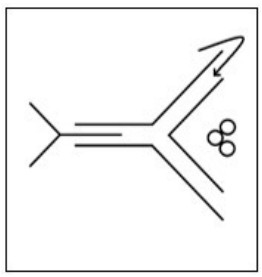
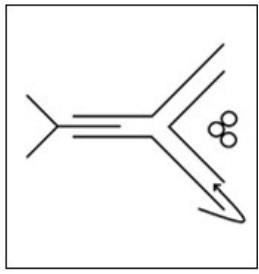
Select the option that can replace the question mark (?) in the Problem Figure.
Problem Figure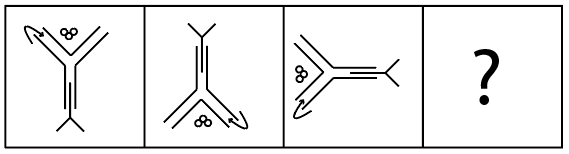
To solve this problem, we need to identify the pattern or rule governing the sequence of figures. Each figure in the sequence seems to involve a rotation and repositioning of elements, specifically the arrow and the circle group.
Correct Option: C) The arrow points left, and the circle group is at the top.
To find the work done when a charge moves between two points with a given potential difference, we use the fundamental definition of potential difference. Potential difference is defined as the work done per unit charge.
The potential difference (\(V\)) between two points is defined as the work done (\(W\)) in moving a unit positive charge from one point to the other.
\[ V = \frac{W}{Q} \]Correct Option: A) 10 J
The problem involves finding an unknown number given the HCF (Highest Common Factor), LCM (Least Common Multiple) of two numbers, and one of the numbers. We will use the fundamental relationship between HCF, LCM, and the product of two numbers.
\[ A \times B = \text{HCF}(A, B) \times \text{LCM}(A, B) \]
\[ 24 \times B = 12 \times 72 \]
First, calculate the product of HCF and LCM:
\[ 12 \times 72 = 864 \]
So, the equation becomes:
\[ 24 \times B = 864 \]
Now, divide both sides by 24 to find \(B\):
\[ B = \frac{864}{24} \]
Perform the division:
\[ B = 36 \]
C) 36
To find the equivalent resistance of the combination, we need to first calculate the equivalent resistance of the two resistors connected in parallel. Then, we will add this equivalent resistance to the resistance of the resistor connected in series with the parallel combination.
Calculate the equivalent resistance of the two identical resistors connected in parallel:
When two resistors, \(R_1\) and \(R_2\), are connected in parallel, their equivalent resistance (\(R_p\)) is given by the formula:
\[ \frac{1}{R_p} = \frac{1}{R_1} + \frac{1}{R_2} \]Given \(R_1 = 40 \, \Omega\) and \(R_2 = 40 \, \Omega\).
\[ \frac{1}{R_p} = \frac{1}{40 \, \Omega} + \frac{1}{40 \, \Omega} = \frac{2}{40 \, \Omega} = \frac{1}{20 \, \Omega} \]Therefore, the equivalent resistance of the parallel combination is:
\[ R_p = 20 \, \Omega \]Calculate the total equivalent resistance:
This parallel combination (\(R_p\)) is then connected in series with a \(10 \, \Omega\) resistor. When resistors are connected in series, their equivalent resistance (\(R_{eq}\)) is the sum of individual resistances.
\[ R_{eq} = R_p + R_{series} \]Given \(R_p = 20 \, \Omega\) and \(R_{series} = 10 \, \Omega\).
\[ R_{eq} = 20 \, \Omega + 10 \, \Omega = 30 \, \Omega \]C) 30 Ω is the correct equivalent resistance of the entire combination.
The question asks to identify the chemical process where acids and bases react to form salt and water. We need to recall the definitions of the given options to find the correct one.
Correct Option: C) Neutralisation is the process in which acids and bases react to form salts and water.