
This problem involves the Angle Bisector Theorem. The theorem states that if a ray bisects an angle of a triangle, then it divides the opposite side into two segments that are proportional to the other two sides of the triangle.
Identify the given information:
Apply the Angle Bisector Theorem:
According to the Angle Bisector Theorem, for a triangle \(\Delta ABC\) where \(AD\) bisects \(\angle A\), the ratio of the sides containing the angle is equal to the ratio of the segments into which the bisector divides the opposite side.
Substitute the given values into the theorem:
We have \(AB = 8 \text{ cm}\), \(BD = 6 \text{ cm}\), and \(DC = 7.5 \text{ cm}\). Let \(AC = x\).
Solve for \(x\) (the length of \(CA\)):
Cross-multiply to solve for \(x\):
State the result:
Therefore, the length of \(CA\) is \(10 \text{ cm}\).
C) 10 cm — The calculation using the Angle Bisector Theorem yields \(CA = 10 \text{ cm}\).
The question asks to determine the colour of the granite in the kitchen based on two given statements. We need to evaluate each statement individually and then in combination to see if they provide enough information to definitively identify the colour.
This statement tells us that the granite and the wall share the same colour. However, it does not specify what that colour is. The wall could be any colour (e.g., red, blue, white, green). Therefore, Statement 1 alone is not sufficient to determine the colour of the granite.
This statement describes a characteristic of the granite's colour (it is bright). Many colours can be described as bright (e.g., bright red, bright yellow, bright blue). This statement does not narrow down the specific colour. Therefore, Statement 2 alone is not sufficient to determine the colour of the granite.
If we combine both statements, we know that the granite's colour is the same as the wall's colour, and this colour is very bright. Still, we don't know the specific colour. For example, the granite could be bright red (and the wall is bright red), or it could be bright yellow (and the wall is bright yellow). The combination of statements still does not provide a unique, definitive colour for the granite.
D) Neither 1 nor 2 is sufficient to answer the given question.
As established in the step-by-step analysis, neither statement alone nor both statements together provide enough specific information to identify the exact colour of the granite. Both statements offer only descriptive characteristics or relationships without specifying the actual colour.
To find the last word when arranged in dictionary order, we need to compare the given words letter by letter from left to right. The word that comes latest alphabetically will be the last word.
B) MABUSE is the last word when arranged in dictionary order because its fourth letter 'U' comes latest alphabetically compared to the fourth letters of the other words ('E' and 'L').
Ammonium nitrate, on thermal decomposition, produces:
This question asks about the products formed when ammonium nitrate undergoes thermal decomposition. Thermal decomposition is a chemical reaction where a compound breaks down into simpler substances when heated. For ammonium nitrate, this is a specific reaction that produces particular gases.
This reaction is exothermic and can be explosive under certain conditions, but at controlled temperatures, it yields these specific products.
A) N₂O and H₂O
As explained in the step-by-step analysis, the thermal decomposition of ammonium nitrate yields dinitrogen monoxide (N₂O) and water (H₂O).
The amount of BaSO4 formed on mixing an aqueous solution of 2.08 gm of BaCl2 and excess of dilute H2SO4 is _____.
(atomic weights: Ba = 137, Cl = 35.5, S = 32, O = 16)
The problem asks us to calculate the mass of barium sulfate (BaSO₄) formed when barium chloride (BaCl₂) reacts with excess dilute sulfuric acid (H₂SO₄). This is a stoichiometry problem that involves writing a balanced chemical equation, calculating the molar mass of reactants and products, and using mole ratios to find the mass of the product.
Barium chloride reacts with sulfuric acid to form barium sulfate and hydrochloric acid.
\[ \text{BaCl}_2 (\text{aq}) + \text{H}_2\text{SO}_4 (\text{aq}) \rightarrow \text{BaSO}_4 (\text{s}) + 2\text{HCl} (\text{aq}) \]Given atomic weights: Ba = 137, Cl = 35.5
\[ \text{Molar mass of BaCl}_2 = 137 + 2 \times 35.5 = 137 + 71 = 208 \text{ g/mol} \]Given mass of BaCl₂ = 2.08 gm
\[ \text{Moles of BaCl}_2 = \frac{\text{Mass}}{\text{Molar mass}} = \frac{2.08 \text{ g}}{208 \text{ g/mol}} = 0.01 \text{ mol} \]From the balanced chemical equation, 1 mole of BaCl₂ reacts to form 1 mole of BaSO₄. Since H₂SO₄ is in excess, BaCl₂ is the limiting reactant.
\[ \text{Moles of BaSO}_4 = \text{Moles of BaCl}_2 = 0.01 \text{ mol} \]Given atomic weights: Ba = 137, S = 32, O = 16
\[ \text{Molar mass of BaSO}_4 = 137 + 32 + 4 \times 16 = 137 + 32 + 64 = 233 \text{ g/mol} \]Correct Option: D) 2.33 g
The given Problem Figure is embedded in one of the given Answer Figures. Which is that Answer Figure?
Problem Figure:
Answer Figure: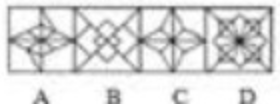
To solve this problem, we need to identify which of the given Answer Figures contains the Problem Figure embedded within it. This involves visually comparing the shapes and patterns in each option.
Correct Option: B) The Problem Figure is embedded within this Answer Figure.
The question asks about a specific high-speed rail project deal signed between India and Japan, connecting Mumbai to another major city, as of 2018. This requires knowledge of major infrastructure projects and international agreements.
Correct Option: C) Ahmedabad. The Mumbai-Ahmedabad High-Speed Rail Corridor is India's first high-speed rail project, being built with significant financial and technical assistance from Japan. The deal for this project was a major bilateral agreement between India and Japan, and it connects Mumbai with Ahmedabad.
The question asks to determine the possible state(s) of hydrogen when stored in a cylinder. We need to consider the common ways hydrogen is stored and transported.
D) Either argument 1 or 2 is correct. This option correctly reflects that hydrogen can be stored in a cylinder in either a liquid state (as liquid hydrogen, LH2) or a gaseous state (as compressed gas), depending on the storage technology and conditions.
The question asks about the type of mirror used in vehicle headlights. Headlights are designed to produce a strong, parallel beam of light to illuminate the road ahead. We need to recall the properties of different types of mirrors, especially how they reflect light rays originating from their focal point.
A) Concave mirror — A concave mirror is used in vehicle headlights because when the light bulb is placed at its principal focus, the mirror reflects the light rays as a strong, parallel beam. This parallel beam is essential for illuminating the road ahead effectively and over a long distance.
To solve this direction-based problem, we need to visualize X's path step-by-step. We will track his movements from the starting point and determine his final position relative to the origin.
Correct Option: D) North west