
We need to determine if Z is positive based on the given statements. We are given that U, V, and W are negative numbers. We will analyze each statement individually to see if it provides sufficient information to conclude whether Z is positive or not.
Given Information:
Question: Is Z positive? (i.e., Is \(Z > 0\)?)
Analyzing Statement 1: \(Z = V - W\)
Analyzing Statement 2: \(Z \times V = U\)
D) 2 alone is sufficient while 1 alone is not sufficient to answer the question.
Statement 1 does not uniquely determine the sign of Z, as Z can be positive or negative. Statement 2, however, definitively shows that Z must be positive because the division of two negative numbers results in a positive number.
The problem presents a coding-decoding question where letters are mapped to numbers. We need to identify the pattern in the given pair (RAT : 18120) and apply the same pattern to find the missing term for GOD.
D) 7154 is the correct answer because applying the pattern of concatenating the alphabetical positions of each letter to the word GOD results in 7154.
Select the option that can replace the question mark (?) in the following equation.
2 + 5 ÷ [5 + 8 ÷ (1 + \( \frac{1}{3} \)) - 1] = ?
\( \frac{5}{2} \)
2
\( \frac{1}{2} \)
\( \frac{3}{2} \)
To solve this problem, we need to follow the order of operations, often remembered by the acronym BODMAS/PEMDAS (Brackets/Parentheses, Orders/Exponents, Division and Multiplication, Addition and Subtraction). We will simplify the expression step-by-step, starting from the innermost parentheses and working outwards.
The innermost part is \( \left(1 + \frac{1}{3}\right) \).
\[ 1 + \frac{1}{3} = \frac{3}{3} + \frac{1}{3} = \frac{4}{3} \]The expression becomes:
\[ 2 + 5 \div \left[5 + 8 \div \left(\frac{4}{3}\right) - 1\right] \]Next, we evaluate \( 8 \div \left(\frac{4}{3}\right) \).
\[ 8 \div \frac{4}{3} = 8 \times \frac{3}{4} = \frac{24}{4} = 6 \]The expression becomes:
\[ 2 + 5 \div \left[5 + 6 - 1\right] \]Now, we evaluate \( 5 + 6 - 1 \).
\[ 5 + 6 - 1 = 11 - 1 = 10 \]The expression becomes:
\[ 2 + 5 \div 10 \]Next, we evaluate \( 5 \div 10 \).
\[ 5 \div 10 = \frac{5}{10} = \frac{1}{2} \]Finally, we evaluate \( 2 + \frac{1}{2} \).
\[ 2 + \frac{1}{2} = \frac{4}{2} + \frac{1}{2} = \frac{5}{2} \]Thus, the value of the expression is \( \frac{5}{2} \).
A) \( \frac{5}{2} \) is the correct result obtained after following the order of operations.
To find the HCF (Highest Common Factor) of a set of numbers, we can use the prime factorization method. This involves finding the prime factors of each number and then multiplying the common prime factors raised to their lowest powers.
The prime factors common to all three numbers (42, 63, and 105) are 3 and 7.
So, the HCF is \(3 \times 7 = 21\).
Select the figure that does NOT belong in the following group.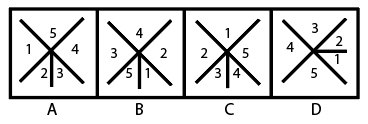
To identify the figure that does not belong, we need to analyze the patterns in each figure and determine the rule or sequence that applies to the majority of them.
Correct Option: B) The numbers do not follow the same sum pattern as the others.
This is a blood relation question. We need to deduce the relationship between Y's father and X by carefully breaking down the statement made by Y.
A) Grandfather — As derived from the step-by-step analysis, Y's father is the father of X's father (who is Y or Y's brother), making Y's father X's grandfather.
The question asks to identify the type of element given its atomic number. To answer this, we need to recall the periodic table and the classification of elements based on their atomic numbers and electron configurations.
C) a halogen gas. An element with atomic number 17 (Chlorine) has 7 valence electrons and belongs to Group 17, which is the halogen group. Halogens exist as diatomic gases at room temperature (e.g., \(Cl_2\)).
The question asks us to find a pair of words that shares the same relationship as the given pair: "Lawyer : Cross-examine". We need to identify the nature of the relationship between a lawyer and cross-examining, and then find an option where the first word performs the action described by the second word as a primary function.
C) Police : Interrogate. This pair exhibits the same 'Agent : Action' relationship as 'Lawyer : Cross-examine'. A police officer's professional duty includes interrogating, just as a lawyer's duty includes cross-examining.
The question asks to identify the part of the brain responsible for the precision of voluntary actions, as well as maintaining posture and balance. This requires knowledge of the functions of different parts of the human brain.
Correct Option: D) The Cerebellum is crucial for coordinating voluntary movements such as posture, balance, coordination, and speech, resulting in smooth and balanced muscular activity. It is also vital for motor learning.
To find the kinetic energy of an object, we need to use the formula for kinetic energy, which depends on the object's mass and velocity. We will substitute the given values into this formula and calculate the result.
Identify the given values:
Recall the formula for kinetic energy:
The kinetic energy (\(KE\)) of an object is given by the formula:
\[ KE = \frac{1}{2}mv^2 \]where \(m\) is the mass and \(v\) is the velocity.
Substitute the given values into the formula:
\[ KE = \frac{1}{2} \times (15 \text{ kg}) \times (4 \text{ ms}^{-1})^2 \]Calculate the square of the velocity:
\[ (4 \text{ ms}^{-1})^2 = 16 \text{ m}^2\text{s}^{-2} \]Perform the multiplication:
\[ KE = \frac{1}{2} \times 15 \times 16 \] \[ KE = 15 \times 8 \] \[ KE = 120 \text{ J} \]The unit for kinetic energy is Joules (J).
Correct Option: D) 120 J