
Which of the following is not a double displacement reaction?
NaOH + HCl → NaCl + H2O
BaCl2 + H2SO4 → BaSO4 + 2HCl
CuSO4 + H2S → CuS + H2SO4
Zn + CuSO4 → ZnSO4 + Cu
The question asks to identify the reaction that is NOT a double displacement reaction. We need to recall the definition of a double displacement reaction and then analyze each given option.
D) Zn + CuSO4 → ZnSO4 + Cu — This is a single displacement reaction where zinc displaces copper from copper sulfate. Only one element displaces another element from its compound, which is the definition of a single displacement reaction.
The question asks to identify the statement that is NOT true regarding the reaction of calcium with water. We need to analyze each option based on the chemical properties of calcium and its reaction with water, comparing it to sodium where relevant.
Correct Option: A) The statement that the reaction of calcium with water is more violent than that of sodium is incorrect. Sodium is more reactive than calcium, and its reaction with water is significantly more violent and exothermic.
The question asks to identify the word that is least like the others in the given group. This is a classification type of question where we need to find the common characteristic among some items and identify the one that doesn't share that characteristic.
Correct Option: D) Duck is the correct answer because, unlike the Squirrel, Crow, and Monkey which are primarily land/tree/air dwelling creatures, a Duck is primarily an aquatic bird, spending much of its time in water.
Select the option that represents the number of triangles in the given figure.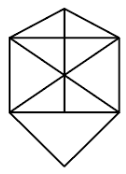
To find the total number of triangles in the given figure, we need to systematically count all possible triangles formed by the intersecting lines.
Correct Option: C) 18
This question tests the understanding of fundamental set theory identities, specifically the distributive law of union over intersection. We need to identify the equivalent expression for \(A \cup (B \cap C)\).
A) \((A \cup B) \cap (A \cup C)\)
This option correctly applies the distributive law of union over intersection. The union operation \(\cup\) distributes over the intersection operation \(\cap\), meaning that elements in \(A \cup (B \cap C)\) are either in A, or in both B and C. This is equivalent to saying that an element is in A or B, AND it is also in A or C. This is precisely what \((A \cup B) \cap (A \cup C)\) represents.
The power of a lens is a measure of its ability to converge or diverge light rays. It is defined as the reciprocal of its focal length. For a convex lens, the focal length is positive, and for a concave lens, it is negative. The focal length must be expressed in meters to obtain the power in diopters (D).
D) The power of the lens is \(2 \text{ D}\), which matches the calculated value.
The question asks to identify materials that are bad conductors of electricity. We need to recall the basic properties of the given materials regarding their electrical conductivity.
Therefore, only option A lists materials that are both bad conductors of electricity.
B) A only
If 3tanθ=2, find the value of \(\frac{2\sin\theta-\cos\theta}{2\cos\theta-\sin\theta}\)
0
\( \frac{1}{3} \)
\( \frac{1}{4} \)
\( \frac{1}{2} \)
The problem provides a relationship between \(\tan\theta\) and asks us to find the value of an expression involving \(\sin\theta\) and \(\cos\theta\). The most straightforward approach is to express \(\tan\theta\) in terms of \(\sin\theta\) and \(\cos\theta\), or to divide the numerator and denominator of the given expression by \(\cos\theta\) to convert it into an expression involving \(\tan\theta\).
We are given the equation \(3\tan\theta = 2\).
From the given equation, we can find the value of \(\tan\theta\):
\[ \tan\theta = \frac{2}{3} \]The expression we need to evaluate is \[\frac{2\sin\theta-\cos\theta}{2\cos\theta-\sin\theta}\]. To relate this to \(\tan\theta\), we can divide both the numerator and the denominator by \(\cos\theta\). This is valid as long as \(\cos\theta \neq 0\).
\[ \frac{2\sin\theta-\cos\theta}{2\cos\theta-\sin\theta} = \frac{\frac{2\sin\theta}{\cos\theta} - \frac{\cos\theta}{\cos\theta}}{\frac{2\cos\theta}{\cos\theta} - \frac{\sin\theta}{\cos\theta}} \] \[ = \frac{2\left(\frac{\sin\theta}{\cos\theta}\right) - 1}{2 - \left(\frac{\sin\theta}{\cos\theta}\right)} \]Since \(\tan\theta = \frac{\sin\theta}{\cos\theta}\), we can substitute this into the simplified expression:
\[ = \frac{2\tan\theta - 1}{2 - \tan\theta} \]Now, substitute the value \(\tan\theta = \frac{2}{3}\) into the expression:
\[ = \frac{2\left(\frac{2}{3}\right) - 1}{2 - \frac{2}{3}} \] \[ = \frac{\frac{4}{3} - 1}{2 - \frac{2}{3}} \]Calculate the numerator:
\[ \frac{4}{3} - 1 = \frac{4}{3} - \frac{3}{3} = \frac{1}{3} \]Calculate the denominator:
\[ 2 - \frac{2}{3} = \frac{6}{3} - \frac{2}{3} = \frac{4}{3} \]Now, divide the numerator by the denominator:
\[ = \frac{\frac{1}{3}}{\frac{4}{3}} = \frac{1}{3} \times \frac{3}{4} = \frac{1}{4} \]Correct Option: C) \( \frac{1}{4} \)
The question asks about the type of flame observed during the combustion of unsaturated compounds. This relates to the concept of complete versus incomplete combustion, which is influenced by the carbon-to-hydrogen ratio in the fuel and the availability of oxygen.
Correct Option: D) yellow flame
Unsaturated compounds have a higher carbon content. During their combustion, especially in a limited oxygen supply, they undergo incomplete combustion, producing unburnt carbon particles (soot). These incandescent carbon particles emit yellow light, resulting in a yellow, sooty flame.
The reciprocal of the value of 3\( \frac{1}{12} \) - [1 - \( \frac{3}{4} \) + {2\( \frac{1}{2} \) - (1\( \frac{1}{2} \) - \( \frac{1}{3} \))}] is
To solve this problem, we need to evaluate the given expression by following the order of operations (BODMAS/PEMDAS: Brackets, Orders/Exponents, Division/Multiplication, Addition/Subtraction). We will start from the innermost bracket and work our way outwards, then find the reciprocal of the final value.
A) \( \frac{2}{3} \) is the reciprocal of the evaluated expression, \( \frac{3}{2} \).