
This problem involves the concept of work done by pipes, which is directly proportional to the flow rate and the time taken. The flow rate of a pipe is proportional to the cross-sectional area of its opening. Since the pipes are circular, the area is proportional to the square of the diameter. We will calculate the total 'filling capacity' in the first scenario and then use it to find the time required in the second scenario.
The flow rate of a pipe is proportional to its cross-sectional area. For a circular pipe, the area \(A\) is given by \(A = \pi r^2\), where \(r\) is the radius. Since the diameter \(D = 2r\), the radius \(r = D/2\). So, the area \(A = \pi (D/2)^2 = \frac{\pi D^2}{4}\). This means the flow rate is proportional to the square of the diameter.
Let the original diameter be \(D_1\). The flow rate of one original pipe is proportional to \(D_1^2\).
The new pipes have double the original diameter, so \(D_2 = 2D_1\). The flow rate of one new pipe is proportional to \(D_2^2 = (2D_1)^2 = 4D_1^2\).
Therefore, one new pipe has 4 times the flow rate of one original pipe.
In the first scenario, 15 pipes, each with a flow rate proportional to \(D_1^2\), fill the cistern in 12 minutes.
Total work units = (Number of pipes) \(\times\) (Flow rate per pipe) \(\times\) (Time)
Total work units = \(15 \times D_1^2 \times 12 = 180 D_1^2\) units.
In the second scenario, there are 6 pipes, each with a flow rate proportional to \(4D_1^2\).
Let the time taken be \(T\) minutes.
Total work units = (Number of pipes) \(\times\) (Flow rate per pipe) \(\times\) (Time)
Total work units = \(6 \times (4D_1^2) \times T = 24 D_1^2 T\) units.
Since the same cistern is being filled, the total work units are the same.
\[ 180 D_1^2 = 24 D_1^2 T \]\[ T = \frac{180 D_1^2}{24 D_1^2} \]\[ T = \frac{180}{24} \]\[ T = \frac{30}{4} \]\[ T = 7.5 \text{ minutes} \]D) 7.5 minutes
This problem involves the relationship between wave velocity, wavelength, and frequency. The distance between consecutive crests of a wave is its wavelength. The wave velocity is given, and we need to find the frequency of the rocking motion, which is the frequency of the waves.
The formula connecting these quantities is:
\[ v = \lambda \times f \]where \(v\) is the wave velocity, \(\lambda\) is the wavelength, and \(f\) is the frequency.
Since \(1 \text{ s}^{-1} = 1 \text{ Hz}\), the frequency is \(0.25 \text{ Hz}\).
A) \(0.25 \text{ Hz}\) is the calculated frequency of the waves, which corresponds to the frequency of rocking of the boat.
The question asks for the term that describes the sum of potential energy and kinetic energy. This is a fundamental concept in physics, specifically in the study of mechanics and energy conservation.
D) Mechanical energy is the sum of potential energy and kinetic energy. It represents the energy associated with the motion and position of an object.
The question asks to identify the specific pilot project launched by the Union Environment Ministry for beach clean-up and development. This requires knowledge of recent environmental initiatives by the Indian government.
Correct Option: A) The Union Environment Ministry launched a pilot project to develop 13 beaches across India to meet the 'Blue Flag' certification standards. The 'Blue Flag' is an internationally recognized eco-label awarded to beaches that meet stringent criteria for water quality, environmental education and management, safety, and services. This initiative directly involves beach clean-up and overall development to achieve global environmental standards.
To determine the physical state of water at a given temperature, we need to recall the standard melting and boiling points of water at atmospheric pressure. These critical temperatures define the ranges for its solid, liquid, and gaseous states.
Correct Option: C) Liquid
This problem involves the concept of work and time, specifically how the number of workers, hours per day, and days taken to complete a task are related. We can use the formula for total work, which is constant for the same task, to find the unknown number of days.
Given:
Total work in the first scenario (\(T_1\)) is:
\[ T_1 = W_1 \times H_1 \times D_1 = 4 \times 6 \times 21 \]Given:
Total work in the second scenario (\(T_2\)) is:
\[ T_2 = W_2 \times H_2 \times D_2 = 7 \times 4 \times D_2 \]Since the work is the same, \(T_1 = T_2\):
\[ 4 \times 6 \times 21 = 7 \times 4 \times D_2 \]Divide both sides by \(7 \times 4\):
\[ D_2 = \frac{4 \times 6 \times 21}{7 \times 4} \]Cancel out common terms:
\[ D_2 = \frac{\cancel{4} \times 6 \times 21}{7 \times \cancel{4}} \]\[ D_2 = \frac{6 \times 21}{7} \]\[ D_2 = 6 \times \frac{21}{7} \]\[ D_2 = 6 \times 3 \]\[ D_2 = 18 \]Therefore, 7 workers working 4 hours per day will finish the same work in 18 days.
D) 18 — The calculation shows that 18 days are required to complete the work under the new conditions.
The question asks for the term that defines the rate of change of displacement. This is a fundamental definition in kinematics, a branch of physics that describes the motion of points, bodies, and systems of bodies without considering the causes of their motion.
Where \(\Delta \vec{x}\) is the change in displacement and \(\Delta t\) is the change in time.
Therefore, the rate of change of displacement is velocity.
Correct Option: D) Velocity
Select the option that will correctly fit in the blank space of the following figure.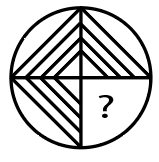
To solve this problem, we need to identify the pattern in the given figure and select the option that completes it correctly. The diagram is divided into four quadrants, each containing a specific pattern. The missing quadrant must match the visual style and pattern of the others.
Correct Option: B) The pattern in Option B completes the symmetry and matches the style of the other quadrants.
The problem presents a coding-decoding puzzle. We need to identify the pattern in how words are transformed into their coded versions. Once the pattern is found, we apply it to the given word "SWIZZLED" to find its code.
Let's observe the transformation:
So, the word is split into two halves, each half is reversed, and then the reversed first half is followed by the reversed second half.
This word has 8 letters. Let's split it into two halves: JIPI and JAPA.
Now, combine them: IPIJAPAJ. This matches the given coded word. The pattern holds.
D) ZIWSDELZ — This matches our derived coded word by applying the identified pattern.
This problem involves calculating the time gained by a faulty watch over a specific period. We need to determine the total time elapsed in correct time, then calculate how much time the watch gains during this period, and finally add the gained time to the correct time to find what the watch shows.
D) 2.40 PM is the correct answer. The watch gains 40 minutes over 8 hours, so it will show 2:40 PM when the correct time is 2 PM.


