
From the options given, select the rotated version of the following image.
Image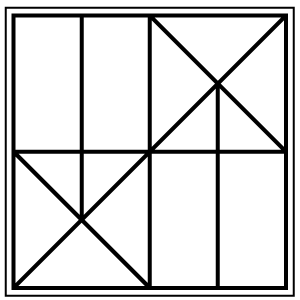
Options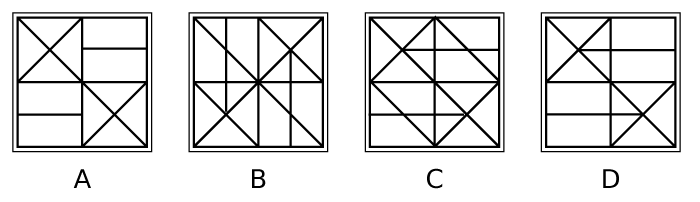
To solve this problem, we need to identify the option that matches the rotated version of the given image. This involves visualizing the rotation and comparing the resulting pattern with the options provided.
Correct Option: C) The rotated version matches option C.
The question asks for the SI unit of electrical resistance. To answer this, one needs to recall the fundamental SI units for various electrical quantities.
C) Ohm is the SI unit of resistance, named after Georg Simon Ohm.
The question asks about the direction of negative acceleration. To answer this, we need to understand the definition of acceleration and how its direction relates to other physical quantities like velocity, force, momentum, and distance.
Therefore, negative acceleration is in the opposite direction of velocity, causing the object to slow down.
Correct Option: A) Negative acceleration is in the opposite direction of velocity. When acceleration is opposite to velocity, it means the object is slowing down or decelerating.
1 kWh = ?
To convert 1 kilowatt-hour (kWh) to Joules (J), we need to understand the definitions of kilowatt and hour in terms of standard SI units (Watts and seconds). Energy is power multiplied by time. We will convert kilowatts to watts and hours to seconds, then multiply them to get the energy in Joules.
1 kilowatt is equal to 1000 watts.
\[ 1 \text{ kW} = 1000 \text{ W} \]1 hour is equal to 60 minutes, and 1 minute is equal to 60 seconds.
\[ 1 \text{ h} = 60 \text{ minutes} \]\[ 1 \text{ minute} = 60 \text{ s} \]\[ 1 \text{ h} = 60 \times 60 \text{ s} = 3600 \text{ s} \]Energy (E) is given by the product of Power (P) and Time (t).
\[ E = P \times t \]\[ 1 \text{ kWh} = 1 \text{ kW} \times 1 \text{ h} \]By definition, 1 Watt-second is equal to 1 Joule.
\[ 1 \text{ Ws} = 1 \text{ J} \]D) 3.6 × 10⁶ J — This is the correct conversion of 1 kilowatt-hour to Joules, as derived from the fundamental definitions of power and time units.
The question asks to identify the last element in Newlands' Law of Octaves classification. This requires knowledge of the historical development of the periodic table, specifically Newlands' arrangement of elements.
C) Thorium is the correct answer. Newlands' Law of Octaves was applicable only up to calcium, and his table concluded with Thorium, which was the 56th element known at the time.
The question asks for the President of the Indian Olympic Association (IOA) as of February 2018. This requires knowledge of current affairs and sports administration at that specific time.
Correct Option: B) Narinder Dhruv Batra
A triangular number is the sum of all positive integers up to a given integer. We can find triangular numbers using the formula \(T_n = \frac{n(n+1)}{2}\) or by summing consecutive integers. We will check each option to see if it fits this definition.
We need to see if 3 can be expressed as \(\frac{n(n+1)}{2}\) for some positive integer \(n\).
\[ 3 = \frac{n(n+1)}{2} \]\[ 6 = n(n+1) \]\[ n^2 + n - 6 = 0 \]\[ (n+3)(n-2) = 0 \]The positive integer solution is \(n=2\). So, 3 is the 2nd triangular number (\(1+2=3\)).We need to see if 16 can be expressed as \(\frac{n(n+1)}{2}\) for some positive integer \(n\).
\[ 16 = \frac{n(n+1)}{2} \]\[ 32 = n(n+1) \]\[ n^2 + n - 32 = 0 \]Using the quadratic formula \(n = \frac{-b \pm \sqrt{b^2 - 4ac}}{2a}\):\[ n = \frac{-1 \pm \sqrt{1^2 - 4(1)(-32)}}{2(1)} \]\[ n = \frac{-1 \pm \sqrt{1 + 128}}{2} \]\[ n = \frac{-1 \pm \sqrt{129}}{2} \]Since \(\sqrt{129}\) is not an integer, \(n\) is not an integer. Therefore, 16 is not a triangular number.We need to see if 10 can be expressed as \(\frac{n(n+1)}{2}\) for some positive integer \(n\).
\[ 10 = \frac{n(n+1)}{2} \]\[ 20 = n(n+1) \]\[ n^2 + n - 20 = 0 \]\[ (n+5)(n-4) = 0 \]The positive integer solution is \(n=4\). So, 10 is the 4th triangular number (\(1+2+3+4=10\)).We need to see if 6 can be expressed as \(\frac{n(n+1)}{2}\) for some positive integer \(n\).
\[ 6 = \frac{n(n+1)}{2} \]\[ 12 = n(n+1) \]\[ n^2 + n - 12 = 0 \]\[ (n+4)(n-3) = 0 \]The positive integer solution is \(n=3\). So, 6 is the 3rd triangular number (\(1+2+3=6\)).B) 16 — As determined in step 3, 16 cannot be formed by the sum of consecutive positive integers starting from 1, nor does it satisfy the formula \(T_n = \frac{n(n+1)}{2}\) for an integer \(n\).
The question asks about the gas released when water is added to bleaching powder. This involves understanding the chemical composition of bleaching powder and its reaction with water.
B) Chlorine — As explained above, bleaching powder (\( \text{CaOCl}_2 \)) reacts with water, especially in the presence of traces of acid or carbon dioxide, to release chlorine gas (\( \text{Cl}_2 \)).
Which of the following is true?
\( \frac{29}{6} \) > \( \frac{43}{12} \)
\( \frac{29}{6} \) < \( \frac{43}{12} \)
\( \frac{29}{6} \) = \( \frac{53}{12} \)
\( \frac{29}{6} \) = \( \frac{43}{12} \)
To compare fractions or determine their equality, it is best to convert them to a common denominator. Once they have the same denominator, we can directly compare their numerators.
Correct Option: A) \( \frac{29}{6} \) > \( \frac{43}{12} \)
The problem presents a series of two-letter terms. We need to identify the pattern in the given terms and apply it to find the missing term.
A) WX is the correct term as it follows the established alphabetical pattern for both the first and second letters of the two-letter sequence.