
The question asks about Oparin's theory regarding the 'Origin of life'. We need to identify which type of evolution his theory primarily describes.
Correct Option: A) chemical evolution
Oparin's theory, also known as the Oparin-Haldane hypothesis, posits that life originated from non-living matter through a process of gradual chemical reactions. This process, termed 'chemical evolution' or 'abiogenesis', describes how simple inorganic molecules combined to form complex organic compounds, which then organized into self-replicating structures, eventually leading to the first living cells. This concept was experimentally supported by the Miller-Urey experiment.
The question asks to identify the Indian economist who authored the book 'I Do What I Do' published in 2017. This requires knowledge of prominent Indian economists and their literary works.
D) Raghuram Rajan is the author of the 2017 book 'I Do What I Do: On Reform, Rhetoric & Resolve'. He is a renowned Indian economist and was the 23rd Governor of the Reserve Bank of India from 2013 to 2016. The book compiles his speeches and articles from his time as RBI Governor and earlier, offering insights into economic policy and India's financial landscape.
The question asks to find the code for "PQR" based on the given statements. We need to determine which statement(s) provide enough information to deduce the coding pattern and then apply it to "PQR".
In this statement, the coding pattern is that each letter is shifted forward by one position in the English alphabet. For example, A becomes B, B becomes C, and C becomes D. Similarly, D becomes E, E becomes F, and F becomes G.
If we apply this pattern to "PQR":
So, according to Statement I, the code for PQR would be QRS.
Therefore, Statement I alone is sufficient to answer the question.
In this statement, the coding pattern is also that each letter is shifted forward by one position in the English alphabet. For example, L becomes M, M becomes N, and N becomes O. Similarly, O becomes P, P becomes Q, and Q becomes R.
If we apply this pattern to "PQR":
So, according to Statement II, the code for PQR would be QRS.
Therefore, Statement II alone is sufficient to answer the question.
Both Statement I and Statement II individually provide enough information to determine the coding pattern and find the code for PQR. Since either statement alone is sufficient, the correct option is D.
D) Either I or II is sufficient to answer the question.
The given graph shows the distribution of minerals in the human body. Based on the given data, what is the ratio of calcium to sodium found in the human body?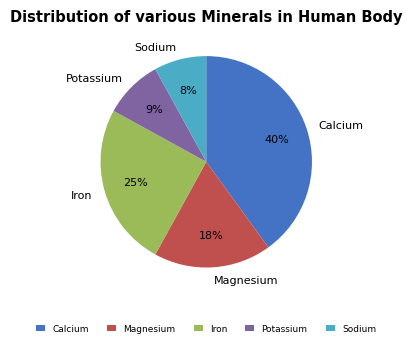
To find the ratio of calcium to sodium in the human body, we need to compare their respective percentages as shown in the pie chart.
Correct Option: D) 5:1
The problem involves compound interest. We are given the principal amount, the annual interest rate, and the total compound interest earned. We need to find the number of years (n) for which the investment was made. We will use the compound interest formula to solve this.
The total amount received is the principal plus the compound interest.
\[ A = P + \text{CI} \]\[ A = \text{₹}5000 + \text{₹}1655 \]\[ A = \text{₹}6655 \]The formula for the amount (A) under compound interest is:
\[ A = P \left(1 + \frac{R}{100}\right)^n \]Divide both the numerator and the denominator by 5:
\[ \frac{1331}{1000} = \left(\frac{11}{10}\right)^n \]We know that \(1331 = 11^3\) and \(1000 = 10^3\).
\[ \left(\frac{11}{10}\right)^3 = \left(\frac{11}{10}\right)^n \]Since the bases are equal, the exponents must be equal.
\[ n = 3 \]Correct Option: B) 3 years
The question asks about the biological process essential for maintaining the population of a species and preventing its extinction. We need to evaluate each given option in the context of species survival and continuity.
Correct Option: A) Reproduction — Reproduction is the fundamental biological process by which new individual organisms are produced from their parents. It is essential for the continuity of life, ensuring that a species can replace its dying members and maintain its population size over generations, thereby preventing its extinction.
This question asks about the products formed during the electrolysis of an aqueous solution of sodium chloride. This process is known as the chlor-alkali process. We need to identify the main product formed in the solution.
Dissociation of Sodium Chloride: When sodium chloride (\(\text{NaCl}\)) is dissolved in water, it dissociates into sodium ions (\(\text{Na}^+\)) and chloride ions (\(\text{Cl}^-\)). Water itself also dissociates to a small extent into hydrogen ions (\(\text{H}^+\)) and hydroxide ions (\(\text{OH}^-\)).
\[ \text{NaCl}(\text{aq}) \rightarrow \text{Na}^+(\text{aq}) + \text{Cl}^-(\text{aq}) \]\[ \text{H}_2\text{O}(\text{l}) ightleftharpoons \text{H}^+(\text{aq}) + \text{OH}^-(\text{aq}) \]Electrolysis Process: During electrolysis, an electric current is passed through the solution. Cations (\(\text{Na}^+\) and \(\text{H}^+\)) move towards the cathode (negative electrode), and anions (\(\text{Cl}^-\) and \(\text{OH}^-\)) move towards the anode (positive electrode).
Reactions at Cathode (Reduction): At the cathode, reduction occurs. Both \(\text{Na}^+\) and \(\text{H}^+\) ions are present. However, hydrogen ions (or water) have a higher reduction potential than sodium ions. Therefore, water is reduced to hydrogen gas and hydroxide ions.
\[ 2\text{H}_2\text{O}(\text{l}) + 2\text{e}^- \rightarrow \text{H}_2(\text{g}) + 2\text{OH}^-(\text{aq}) \]Reactions at Anode (Oxidation): At the anode, oxidation occurs. Both \(\text{Cl}^-\) and \(\text{OH}^-\) ions are present. Chloride ions have a lower oxidation potential than hydroxide ions (in concentrated solutions), so chloride ions are oxidized to chlorine gas.
\[ 2\text{Cl}^-(\text{aq}) \rightarrow \text{Cl}_2(\text{g}) + 2\text{e}^- \]Overall Reaction and Product in Solution: As hydrogen gas and chlorine gas are produced and escape, the sodium ions (\(\text{Na}^+\)) and hydroxide ions (\(\text{OH}^-\)) remain in the solution. These combine to form sodium hydroxide.
\[ 2\text{NaCl}(\text{aq}) + 2\text{H}_2\text{O}(\text{l}) \xrightarrow{\text{Electrolysis}} 2\text{NaOH}(\text{aq}) + \text{Cl}_2(\text{g}) + \text{H}_2(\text{g}) \]B) Sodium hydroxide is formed in the aqueous solution as a primary product, along with chlorine gas at the anode and hydrogen gas at the cathode. This process is industrially significant for producing sodium hydroxide.
The problem asks us to find the angle between the force and displacement given the magnitude of the force, the displacement, and the work done. We can use the formula for work done by a constant force, which is the dot product of the force and displacement vectors.
Recall the formula for work done:
Work done (\(W\)) by a constant force (\(F\)) causing a displacement (\(d\)) is given by the formula:
where \(\theta\) is the angle between the force vector and the displacement vector.
Identify the given values:
Substitute the values into the formula:
\[ 20 \text{ J} = (20 \text{ N}) \cdot (2 \text{ m}) \cdot \cos(\theta) \]Simplify the equation:
\[ 20 = 40 \cdot \cos(\theta) \]Solve for \(\cos(\theta)\):
\[ \cos(\theta) = \frac{20}{40} \]\[ \cos(\theta) = \frac{1}{2} \]Find the angle \(\theta\):
We know that \(\cos(60^\circ) = \frac{1}{2}\).
D) 60° is the correct angle between the force and displacement.
This problem involves setting up and solving a system of linear equations based on the given age conditions. We will define variables for the present ages of A and B, form equations from the difference in their ages and their ages 6 years ago, and then solve for the younger person's present age.
Let the present age of A be \(A\) years and the present age of B be \(B\) years.
From the first statement, "The ages of A and B differ by 16 years", we can write:
\[ |A - B| = 16 \]Without loss of generality, let's assume A is the elder one and B is the younger one. So, \(A - B = 16\). This means \(A = B + 16\).
Now, consider their ages 6 years ago:
From the second statement, "If 6 years ago, the elder one was 3 times as old as the younger one", we have:
\[ A - 6 = 3(B - 6) \]Substitute the expression for \(A\) from step 3 into the equation from step 5:
\[ (B + 16) - 6 = 3(B - 6) \]Simplify and solve for \(B\):
\[ B + 10 = 3B - 18 \]\[ 10 + 18 = 3B - B \]\[ 28 = 2B \]\[ B = \frac{28}{2} \]\[ B = 14 \]Since we assumed B is the younger one, the present age of the younger one is 14 years.
To verify, if \(B = 14\), then \(A = B + 16 = 14 + 16 = 30\).
6 years ago: A's age = \(30 - 6 = 24\). B's age = \(14 - 6 = 8\).
Is \(24 = 3 \times 8\)? Yes, \(24 = 24\). The conditions are satisfied.
Correct Option: D) 14 years
We are given information about the change in volume of a cube when its edge length is increased. We need to find the original edge length. We can set up an equation based on the formula for the volume of a cube and solve for the original edge length.
Let the original length of each edge of the cube be \(x\) cm.
The original volume of the cube, \(V_1\), is given by the formula for the volume of a cube:
\[ V_1 = x^3 \]If the edge of the cube is increased by 3 cm, the new edge length will be \((x + 3)\) cm.
The new volume of the cube, \(V_2\), will be:
\[ V_2 = (x + 3)^3 \]We are given that the volume increases by 513 cm³. This means the difference between the new volume and the original volume is 513 cm³:
\[ V_2 - V_1 = 513 \]\[ (x + 3)^3 - x^3 = 513 \]Expand \((x + 3)^3\) using the algebraic identity \((a + b)^3 = a^3 + b^3 + 3ab(a + b)\):
\[ (x + 3)^3 = x^3 + 3^3 + 3 \cdot x \cdot 3 (x + 3) \]\[ (x + 3)^3 = x^3 + 27 + 9x(x + 3) \]\[ (x + 3)^3 = x^3 + 27 + 9x^2 + 27x \]Substitute this back into the equation from step 5:
\[ (x^3 + 9x^2 + 27x + 27) - x^3 = 513 \]\[ 9x^2 + 27x + 27 = 513 \]Rearrange the equation to form a quadratic equation:
\[ 9x^2 + 27x + 27 - 513 = 0 \]\[ 9x^2 + 27x - 486 = 0 \]Divide the entire equation by 9 to simplify:
\[ x^2 + 3x - 54 = 0 \]Solve the quadratic equation by factoring. We need two numbers that multiply to -54 and add to 3. These numbers are 9 and -6.
\[ (x + 9)(x - 6) = 0 \]This gives two possible values for \(x\):
\[ x + 9 = 0 \implies x = -9 \]\[ x - 6 = 0 \implies x = 6 \]Since the length of an edge cannot be negative, we discard \(x = -9\).
Therefore, the original length of each edge of the cube is 6 cm.
B) 6 cm is the correct answer, as derived from the calculations.