
To find the gain percent, we first need to establish a relationship between the Selling Price (S.P.) and the Cost Price (C.P.). The problem states that S.P. is \(1 \frac{1}{3}\) of C.P. We will convert this mixed fraction to an improper fraction, then calculate the gain, and finally the gain percentage using the formula: \[\text{Gain Percent} = \frac{\text{Gain}}{\text{C.P.}} \times 100\].
Convert the mixed fraction to an improper fraction:
The given relationship is S.P. \( = 1 \frac{1}{3} \) of C.P.
First, convert the mixed fraction \(1 \frac{1}{3}\) to an improper fraction:
\[ 1 \frac{1}{3} = \frac{(1 \times 3) + 1}{3} = \frac{3 + 1}{3} = \frac{4}{3} \]Express S.P. in terms of C.P.:
So, the Selling Price (S.P.) is \(\frac{4}{3}\) times the Cost Price (C.P.).
\[ \text{S.P.} = \frac{4}{3} \times \text{C.P.} \]Calculate the Gain:
Gain is the difference between the Selling Price and the Cost Price:
\[ \text{Gain} = \text{S.P.} - \text{C.P.} \]Substitute the expression for S.P.:
\[ \text{Gain} = \frac{4}{3} \text{C.P.} - \text{C.P.} \]To subtract, find a common denominator:
\[ \text{Gain} = \frac{4}{3} \text{C.P.} - \frac{3}{3} \text{C.P.} \]Now, subtract the fractions:
\[ \text{Gain} = \left( \frac{4}{3} - \frac{3}{3} \right) \text{C.P.} = \frac{1}{3} \text{C.P.} \]Calculate the Gain Percent:
The formula for gain percent is:
\[ \text{Gain Percent} = \frac{\text{Gain}}{\text{C.P.}} \times 100 \]Substitute the value of Gain we found:
\[ \text{Gain Percent} = \frac{\frac{1}{3} \text{C.P.}}{\text{C.P.}} \times 100 \]The C.P. terms cancel out:
\[ \text{Gain Percent} = \frac{1}{3} \times 100 \]Perform the multiplication:
\[ \text{Gain Percent} = \frac{100}{3} \% \]Convert the improper fraction to a mixed number:
\[ \frac{100}{3} = 33 \frac{1}{3} \% \]Thus, the gain percent is \(33 \frac{1}{3}\) %.
Correct Option: D) 33 \( \frac{1}{3} \)%
The question asks for the name of the Android app launched by Sachin Tendulkar in 2017. This is a factual question related to current affairs and sports personalities.
Correct Option: A) 100MB
This question tests the fundamental concept of density and buoyancy. An object floats in a fluid if its density is less than the density of the fluid. Conversely, it sinks if its density is greater than the fluid's density.
Correct Option: D) less than water
To find the other fraction, we need to subtract the given fraction from the sum of the two fractions. This is a basic arithmetic problem involving fractions, requiring finding a common denominator.
Let the two fractions be \(F_1\) and \(F_2\).
We are given that the sum of the two fractions is \( \frac{3}{4} \). So, \(F_1 + F_2 = \frac{3}{4}\).
We are also given that one of the fractions is \( \frac{2}{3} \). Let's assume \(F_1 = \frac{2}{3}\).
To find the other fraction, \(F_2\), we can rearrange the equation: \(F_2 = \frac{3}{4} - F_1\).
Substitute the value of \(F_1\):
\[ F_2 = \frac{3}{4} - \frac{2}{3} \]To subtract these fractions, we need to find a common denominator. The least common multiple (LCM) of 4 and 3 is 12.
Convert each fraction to an equivalent fraction with a denominator of 12:
\[ \frac{3}{4} = \frac{3 \times 3}{4 \times 3} = \frac{9}{12} \] \[ \frac{2}{3} = \frac{2 \times 4}{3 \times 4} = \frac{8}{12} \]Now subtract the fractions:
\[ F_2 = \frac{9}{12} - \frac{8}{12} = \frac{9 - 8}{12} = \frac{1}{12} \]Thus, the other fraction is \( \frac{1}{12} \).
Correct Option: A) \( \frac{1}{12} \)
This problem involves calculating the time taken to fill a cistern using multiple tankers. We need to determine the work rate of a single tanker and then calculate the time taken for the first half and the remaining half of the cistern, considering the increased number of tankers.
A single tanker fills the entire cistern in 4 hours. Therefore, to fill half the cistern, it will take half the time.
\[ \text{Time to fill half cistern} = \frac{1}{2} \times 4 \text{ hours} = 2 \text{ hours} \]Initially, there is 1 tanker. After half the cistern is filled, three more similar tankers are opened. So, the total number of tankers becomes:
\[ \text{Total tankers} = 1 + 3 = 4 \text{ tankers} \]If one tanker fills the cistern in 4 hours, its work rate is \(\frac{1}{4}\) of the cistern per hour. With 4 similar tankers, the combined work rate will be 4 times that of a single tanker.
\[ \text{Combined work rate} = 4 \times \frac{1}{4} = 1 \text{ cistern per hour} \]The remaining portion to be filled is \(\frac{1}{2}\) of the cistern. Since the 4 tankers can fill 1 cistern in 1 hour, they can fill half a cistern in half an hour.
\[ \text{Time for remaining half} = \frac{\text{Remaining portion}}{\text{Combined work rate}} = \frac{1/2}{1} = \frac{1}{2} \text{ hour} \]\[ \frac{1}{2} \text{ hour} = 30 \text{ minutes} \]The total time is the sum of the time taken to fill the first half and the time taken to fill the remaining half.
\[ \text{Total time} = 2 \text{ hours} + 30 \text{ minutes} = 2 \text{ hours } 30 \text{ minutes} \]B) 2 h 30 min is the correct answer, as calculated by summing the time for the first half and the second half of the cistern filling.
The question asks to identify the gas responsible for making bread and cake soft and spongy. This effect is achieved through a leavening process, where gas bubbles are produced within the dough or batter, causing it to rise.
A) CO₂ — Carbon dioxide (\(\text{CO}_2\)) is the gas produced by yeast fermentation or chemical reactions involving baking soda/powder. This gas gets trapped in the dough/batter, expands upon heating, and creates the characteristic soft and spongy texture of bread and cakes.
Select the option that does NOT belong in the following figure series.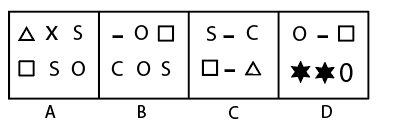
To identify the option that does not belong in the series, we need to analyze the patterns and elements in each box and determine which one breaks the sequence or pattern.
The presence of two stars and a number in option D is inconsistent with the other boxes, which use only shapes and letters.
Correct Option: D) Option D does not belong as it breaks the pattern of alternating shapes and letters.
The problem asks for the amount of work done when a force acts on a body, causing it to move a certain distance in the direction of the force. We need to use the definition of work done in physics.
Correct Option: B) 1 Joule
This problem involves logical deduction based on given statements. We will use Venn diagrams or a direct logical chain to determine which conclusions necessarily follow from the premises.
From Statement 1, we have: Boys \(\subset\) Girls
From Statement 2, we have: Girls \(\subset\) Monkeys
Combining these, we get a chain: Boys \(\subset\) Girls \(\subset\) Monkeys.
This implies that the set of 'boys' is entirely contained within the set of 'monkeys'.
From our logical chain (Boys \(\subset\) Girls \(\subset\) Monkeys), we know that all boys are monkeys. However, it does not necessarily mean that all monkeys are boys. There could be monkeys that are not girls, and therefore not boys. For example, if there are 10 boys, 20 girls (including the 10 boys), and 50 monkeys (including the 20 girls), then not all 50 monkeys are boys.
As established in step 2, since all boys are girls and all girls are monkeys, it logically follows that all boys must also be monkeys. The set of 'boys' is a subset of 'girls', which in turn is a subset of 'monkeys'. Therefore, 'boys' is a subset of 'monkeys'.
C) Only conclusion 2 follows.
This question tests the understanding of Newton's First Law of Motion, specifically the concept of inertia. We need to identify which type of inertia applies to a sprinter continuing to run after crossing the finish line.
Correct Option: B) Inertia of motion keeps him moving.