
The question asks to identify the winner of the 2016 Champions Trophy Men's Hockey tournament, specifically the team that defeated India in the final. This requires knowledge of major international hockey tournament results.
Correct Option: C) Australia
The question asks about the function of the zig-zag line in the Modern Periodic Table. This line is a common feature used to visually distinguish between different categories of elements based on their properties.
Correct Option: A) metals from non-metals
To find the sum of two fractions with different denominators, we need to find a common denominator, which is typically the Least Common Multiple (LCM) of the denominators. Once the fractions have the same denominator, we can add their numerators.
Identify the given fractions:
\[ \frac{5}{8} \text{ and } \frac{8}{5} \]Find the Least Common Multiple (LCM) of the denominators, which are \(8\) and \(5\).
Since \(8\) and \(5\) are coprime (they have no common factors other than \(1\)), their LCM is their product:
\[ \text{LCM}(8, 5) = 8 \times 5 = 40 \]Convert each fraction to an equivalent fraction with the common denominator \(40\).
For the first fraction \( \frac{5}{8} \):
To change the denominator from \(8\) to \(40\), we multiply \(8\) by \(5\). We must also multiply the numerator by \(5\) to keep the fraction equivalent:
\[ \frac{5}{8} = \frac{5 \times 5}{8 \times 5} = \frac{25}{40} \]For the second fraction \( \frac{8}{5} \):
To change the denominator from \(5\) to \(40\), we multiply \(5\) by \(8\). We must also multiply the numerator by \(8\) to keep the fraction equivalent:
\[ \frac{8}{5} = \frac{8 \times 8}{5 \times 8} = \frac{64}{40} \]Add the two equivalent fractions:
\[ \frac{25}{40} + \frac{64}{40} \]Since the denominators are now the same, add the numerators and keep the common denominator:
\[ \frac{25 + 64}{40} = \frac{89}{40} \]B) \( \frac{89}{40} \) is the correct sum of \( \frac{5}{8} \) and \( \frac{8}{5} \).
A) \( \frac{80}{40} \): This simplifies to \(2\). This would be the result if one mistakenly added the numerators and denominators directly (e.g., \(5+8=13\) and \(8+5=13\), which is not \(80/40\)), or if there was a calculation error after finding a common denominator.
C) \( \frac{13}{13} \): This simplifies to \(1\). This is obtained by incorrectly adding the numerators \(5+8=13\) and the denominators \(8+5=13\). Fractions cannot be added this way.
D) \( \frac{13}{40} \): This would be the result if only the numerators were added (\(5+8=13\)) while correctly using the common denominator \(40\), but without converting the numerators to their equivalent forms first. This is a common error when adding fractions.
This problem involves work and time, specifically calculating individual work rates from combined work rates. We will use the concept that if a person can complete a task in \(N\) days, their one-day work rate is \(1/N\). We'll set up equations based on the given combined work rates and solve for individual rates.
Correct Option: B) 48 and 80
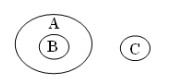
The Venn diagram consists of two circles, labeled A and B, with B inside A, and a separate circle labeled C. This suggests a hierarchical relationship where B is a subset of A, and C is an entirely separate category.
Correct Option: C) Flesh-eating animals, tigers, cows
This problem involves calculating a person's rank from the bottom (last) given their rank from the top and the total number of people in a class. The key is to understand that the sum of ranks from both ends, minus one, equals the total number of people.
The general formula to find the rank from the other end is:
\[ \text{Rank from last} = (\text{Total number of students} - \text{Rank from top}) + 1 \]Substitute the given values into the formula:
\[ \text{Rank from last} = (42 - 23) + 1 \]First, perform the subtraction:
\[ 42 - 23 = 19 \]Then, add 1:
\[ 19 + 1 = 20 \]So, Nitin's rank from the last is 20th.
Correct Option: C) 20 th
The question asks for the term that describes the persistence of sound due to repeated reflections. We need to understand the definitions of the given options in the context of sound phenomena.
Correct Option: A) Reverberation is the phenomenon of persistence of sound in an enclosed space due to repeated reflections, which causes the sound to decay gradually rather than stopping abruptly.
Assuming that the numbers in each of the following figures follow a similar pattern, select the option that can replace the question mark (?) in figure C.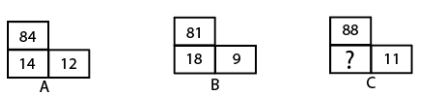
To solve this problem, we need to identify the pattern used in figures A and B and apply it to figure C to find the missing number.
Correct Option: C) 16
A fraction will yield a recurring decimal if, after simplifying the fraction to its lowest terms, the prime factorization of its denominator contains prime factors other than 2 or 5. If the denominator, in its simplest form, only has prime factors of 2 and/or 5, then it will yield a terminating decimal.
Simplify: The GCD of 21 and 90 is 3.
\[ \frac{21 \div 3}{90 \div 3} = \frac{7}{30} \]Prime factorization of the denominator (30):
\[ 30 = 2 \times 3 \times 5 \]Since the prime factor 3 is present in the denominator, this fraction will yield a recurring decimal.
Simplify: The GCD of 21 and 120 is 3.
\[ \frac{21 \div 3}{120 \div 3} = \frac{7}{40} \]Prime factorization of the denominator (40):
\[ 40 = 2 \times 2 \times 2 \times 5 = 2^3 \times 5 \]Since the prime factors are only 2 and 5, this fraction will yield a terminating decimal.
Simplify: The GCD of 21 and 30 is 3.
\[ \frac{21 \div 3}{30 \div 3} = \frac{7}{10} \]Prime factorization of the denominator (10):
\[ 10 = 2 \times 5 \]Since the prime factors are only 2 and 5, this fraction will yield a terminating decimal.
Simplify: The GCD of 21 and 60 is 3.
\[ \frac{21 \div 3}{60 \div 3} = \frac{7}{20} \]Prime factorization of the denominator (20):
\[ 20 = 2 \times 2 \times 5 = 2^2 \times 5 \]Since the prime factors are only 2 and 5, this fraction will yield a terminating decimal.
Based on the analysis, only \( \frac{21}{90} \) (which simplifies to \( \frac{7}{30} \)) has a prime factor other than 2 or 5 in its denominator (the factor 3).
A) \( \frac{21}{90} \) will yield a recurring decimal because its simplified denominator (30) has a prime factor of 3, which is not 2 or 5.
The question asks about the professional field of Gurinder Chadha, who was honored with the Sikh Jewel Award in 2017. To answer this, one needs to identify her well-known profession.
A) Film-making is the correct answer because Gurinder Chadha is a renowned film director, producer, and screenwriter.