
To determine the day of the week for a specific date, we use the concept of "odd days". Odd days are the remainder when the number of days is divided by 7. We will calculate the total number of odd days from a known reference date (e.g., 1 January 0001 or 1 January 2000) up to the given date and then map the final odd day count to a day of the week.
Therefore, 1 January 2020 would be Saturday + 3 days = Tuesday.
Total odd days for months: \(3 + 1 + 3 + 2 + 3 + 2 + 3 + 3 + 1 = 21\) odd days.
Equivalent odd days: \(21 \div 7 = 0\) remainder. So, 0 odd days.
So, Tuesday + 0 days = Tuesday.
A) Tuesday — Based on our calculation, 1 September 2020 falls on a Tuesday.
This is a blood relation problem. We need to establish the relationships between the individuals mentioned and then deduce how Shonal is related to Amit. We can use a family tree or simply trace the connections step by step.
Correct Option: C) Brother-in-law
If a² + \( \frac{1}{a^2} \) = 3, then a³ + \( \frac{1}{a^3} \) = ?
2\(\sqrt{3}\)
2\(\sqrt{5}\)
3\(\sqrt{3}\)
3\(\sqrt{5}\)
The problem asks us to find the value of \(a^3 + \frac{1}{a^3}\) given that \(a^2 + \frac{1}{a^2} = 3\). We can use algebraic identities to solve this. Specifically, we know the identity \((x+y)^2 = x^2 + y^2 + 2xy\) and \((x+y)^3 = x^3 + y^3 + 3xy(x+y)\). We will first find the value of \(a + \frac{1}{a}\) from the given equation and then use it to find \(a^3 + \frac{1}{a^3}\).
Find \(a + \frac{1}{a}\):
We are given \(a^2 + \frac{1}{a^2} = 3\).
Consider the identity \[\left(a + \frac{1}{a}\right)^2 = a^2 + \left(\frac{1}{a}\right)^2 + 2 \cdot a \cdot \frac{1}{a}\].
This simplifies to \[\left(a + \frac{1}{a}\right)^2 = a^2 + \frac{1}{a^2} + 2\].
Substitute the given value \(a^2 + \frac{1}{a^2} = 3\):
\[ \left(a + \frac{1}{a}\right)^2 = 3 + 2 = 5 \]
Taking the square root of both sides:
\[ a + \frac{1}{a} = \pm\sqrt{5} \]
For competitive exams, typically the positive root is considered unless specified. So, we take \(a + \frac{1}{a} = \sqrt{5}\).
Find \(a^3 + \frac{1}{a^3}\):
We use the identity \((x+y)^3 = x^3 + y^3 + 3xy(x+y)\).
Let \(x = a\) and \(y = \frac{1}{a}\). Then \(xy = a \cdot \frac{1}{a} = 1\).
So, \[\left(a + \frac{1}{a}\right)^3 = a^3 + \left(\frac{1}{a}\right)^3 + 3 \cdot a \cdot \frac{1}{a} \left(a + \frac{1}{a}\right)\].
This simplifies to \[\left(a + \frac{1}{a}\right)^3 = a^3 + \frac{1}{a^3} + 3 \left(a + \frac{1}{a}\right)\].
We want to find \(a^3 + \frac{1}{a^3}\), so rearrange the equation:
\[ a^3 + \frac{1}{a^3} = \left(a + \frac{1}{a}\right)^3 - 3 \left(a + \frac{1}{a}\right) \]
Substitute the value \(a + \frac{1}{a} = \sqrt{5}\) into this equation:
\[ a^3 + \frac{1}{a^3} = (\sqrt{5})^3 - 3(\sqrt{5}) \]
Calculate \((\sqrt{5})^3\):
\[ (\sqrt{5})^3 = \sqrt{5} \cdot \sqrt{5} \cdot \sqrt{5} = 5\sqrt{5} \]
Now substitute this back:
\[ a^3 + \frac{1}{a^3} = 5\sqrt{5} - 3\sqrt{5} \]
\[ a^3 + \frac{1}{a^3} = (5-3)\sqrt{5} = 2\sqrt{5} \]Thus, \(a^3 + \frac{1}{a^3} = 2\sqrt{5}\).
Correct Option: B) \(2\sqrt{5}\)
This problem involves kinematics, specifically motion with constant acceleration. We need to find the final speed of an object given its initial state (starting from rest), constant acceleration, and the time elapsed. We can use the first equation of motion to solve this problem.
The first equation of motion relates initial speed, final speed, acceleration, and time:
\[ v = u + at \]B) 32 m/s – This is the correct final speed calculated using the first equation of motion.
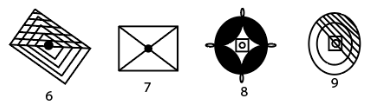
If three groups could be formed using the given figures only once, these groups would be ______.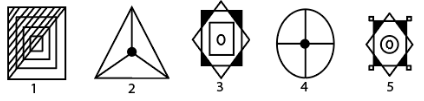
(1,9,6), (2,4,8) and (3,5,7)
(1,9,6), (2,4,7) and (3,5,8)
(1,5,6), (3,4,7) and (2,9,8)
(1,9,6), (2,5,7) and (3,4,8)
The given problem involves grouping figures based on visual patterns or characteristics. We need to identify the correct grouping of figures into three distinct sets.
In this case, the correct grouping is based on the symmetry and pattern of the figures:
Correct Option: B) (1, 9, 6), (2, 4, 7) and (3, 5, 8)
This problem involves work and time. We need to find the individual time taken by A, B, and C to complete a job, given their relative efficiencies and their combined working time. We will use the concept that work rate is the reciprocal of the time taken to complete a job.
Let the time taken by A, B, and C to complete the work individually be \(T_A\), \(T_B\), and \(T_C\) days, respectively.
Their respective daily work rates will be \(\frac{1}{T_A}\), \(\frac{1}{T_B}\), and \(\frac{1}{T_C}\).
From the first condition: "A can work twice as fast as B". This means A's work rate is twice B's work rate.
\[ \frac{1}{T_A} = 2 \times \frac{1}{T_B} \implies T_B = 2T_A \]From the second condition: "A and C together can work three times as fast as B". This means the combined work rate of A and C is three times B's work rate.
\[ \frac{1}{T_A} + \frac{1}{T_C} = 3 \times \frac{1}{T_B} \]Substitute \[\frac{1}{T_A} = \frac{2}{T_B}\] from step 3 into the equation from step 4:
\[ \frac{2}{T_B} + \frac{1}{T_C} = \frac{3}{T_B} \]Rearrange the equation to find the relationship between \(T_B\) and \(T_C\):
\[ \frac{1}{T_C} = \frac{3}{T_B} - \frac{2}{T_B} = \frac{1}{T_B} \]Thus, \(T_C = T_B\).From steps 3 and 6, we have \(T_B = 2T_A\) and \(T_C = T_B\). This implies \(T_C = 2T_A\).
From the third condition: "A, B and C complete a job in 30 days working together". Their combined daily work rate is \(\frac{1}{30}\).
\[ \frac{1}{T_A} + \frac{1}{T_B} + \frac{1}{T_C} = \frac{1}{30} \]Substitute \(T_B = 2T_A\) and \(T_C = 2T_A\) into the combined work rate equation:
\[ \frac{1}{T_A} + \frac{1}{2T_A} + \frac{1}{2T_A} = \frac{1}{30} \]Combine the terms on the left side:
\[ \frac{2}{2T_A} + \frac{1}{2T_A} + \frac{1}{2T_A} = \frac{1}{30} \]\[ \frac{2+1+1}{2T_A} = \frac{1}{30} \]\[ \frac{4}{2T_A} = \frac{1}{30} \]\[ \frac{2}{T_A} = \frac{1}{30} \]Solve for \(T_A\):
\[ T_A = 2 \times 30 = 60 \text{ days} \]Now find \(T_B\) and \(T_C\):
\[ T_B = 2T_A = 2 \times 60 = 120 \text{ days} \]\[ T_C = T_B = 120 \text{ days} \]So, A, B, and C can complete the work in 60, 120, and 120 days respectively.
Correct Option: A) 60, 120, 120
\( \frac{3}{5} \) + \( \frac{3}{7} \) = ?
1\( \frac{1}{35} \)
\( \frac{6}{35} \)
\( \frac{9}{35} \)
\( \frac{6}{12} \)
To add two fractions with different denominators, we need to find a common denominator, which is typically the Least Common Multiple (LCM) of the denominators. Once the fractions have a common denominator, we can add their numerators.
For the first fraction, \( \frac{3}{5} \): To get a denominator of 35, we multiply both the numerator and the denominator by 7.
\[ \frac{3}{5} = \frac{3 \times 7}{5 \times 7} = \frac{21}{35} \]For the second fraction, \( \frac{3}{7} \): To get a denominator of 35, we multiply both the numerator and the denominator by 5.
\[ \frac{3}{7} = \frac{3 \times 5}{7 \times 5} = \frac{15}{35} \]So, \( \frac{36}{35} \) can be written as \( 1\frac{1}{35} \).
Correct Option: A) \( 1\frac{1}{35} \)
The problem asks for the electrical energy dissipated in a resistor over a given time. We are provided with the current (\(I\)), resistance (\(R\)), potential difference (\(V\)), and time (\(t\)). We need to use the fundamental formulas for electrical power and energy.
C) VIt — This is the direct formula for electrical energy dissipated, derived from the definition of power (\(P = VI\)) and energy (\(E = Pt\)).
The question asks about the condition for an element to attain stability. This relates to the octet rule and duplet rule in chemistry, which describe the electron configurations that lead to chemical stability for atoms.
Correct Option: B) a duplet or octet
An element attains stability when it achieves a duplet (2 electrons in the outermost shell, primarily for hydrogen and helium) or an octet (8 electrons in the outermost shell, for most other elements). This configuration makes them chemically stable, similar to noble gases.
Select the odd figure one out the given series.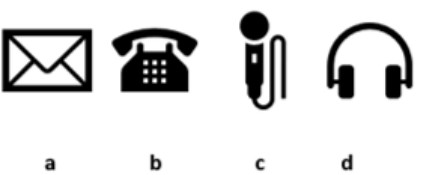
The task is to identify the figure that does not belong to the group based on a common characteristic shared by the other figures.
Correct Option: B) Telephone — It is related to audio communication, unlike the envelope which is related to written communication.