
Select the option that represents the number of squares in the given figure.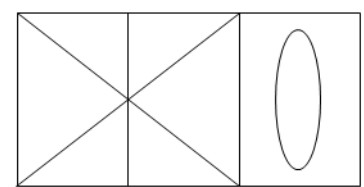
To determine the number of squares in the given figure, we need to carefully analyze each section of the diagram and count the squares formed by the lines.
Correct Option: D) 2
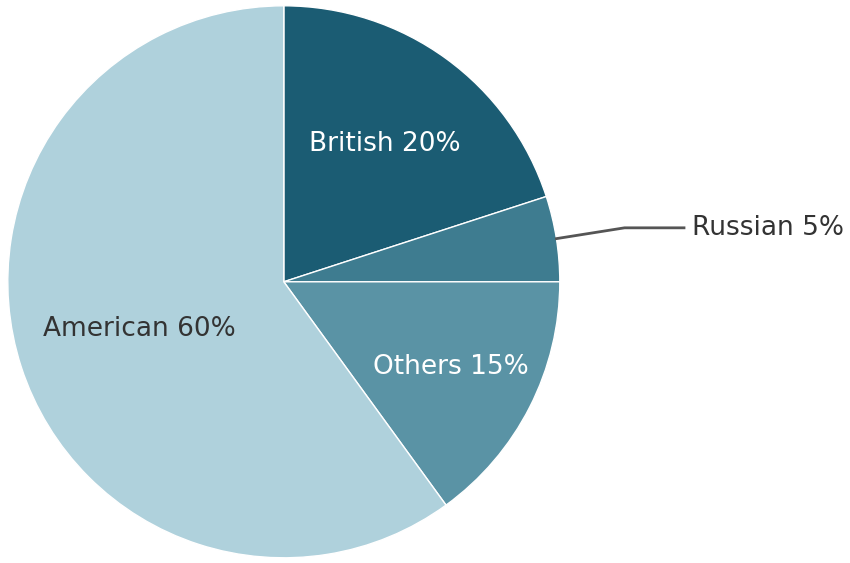
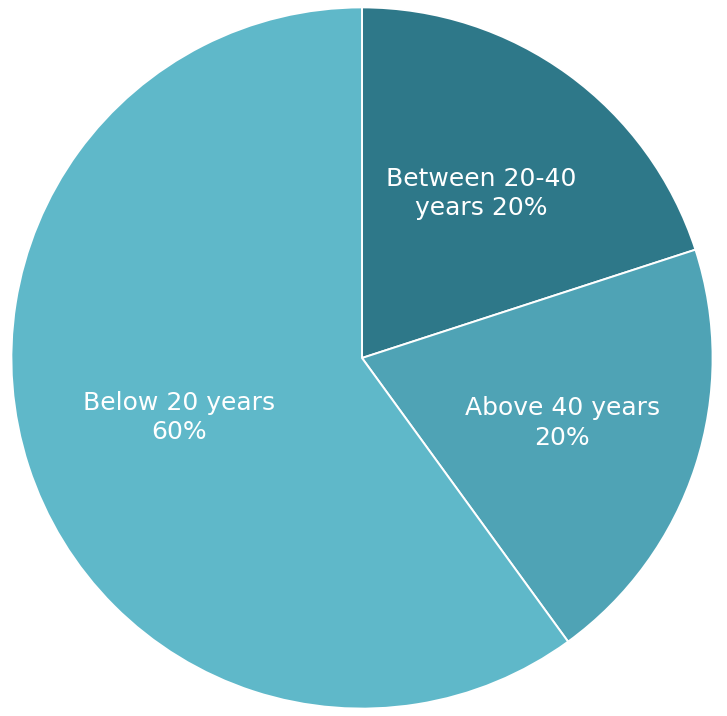
The given figures depict the country-wise and age-wise distribution of the people who visit China for business setup.
If in a given year, 500,000 people visited China, then the ratio of the number of Americans with the age group between 20 and 40 years to the Russians with the age group below 20 years who visited China is:
To find the ratio of Americans aged between 20 and 40 years to Russians below 20 years who visited China, we need to calculate the number of people in each category using the percentage distributions provided in the diagrams.
Correct Option: B) 4 : 1
In the following diagram, Set U is the universal set, and Set L, M and N represent students studying History, Geography and Language, respectively.
Based on the given data, what is the total number of students studying Language and Geography but not History?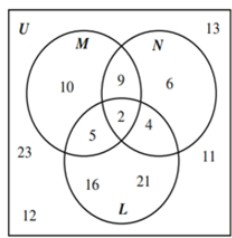
We need to find the number of students studying both Language and Geography but not History. This involves analyzing the Venn diagram provided.
Correct Option: C) 9
To calculate the simple interest, we use the standard formula: Simple Interest \[= \frac{\text{Principal} \times \text{Rate} \times \text{Time}}{100}\]. We will substitute the given values for principal, rate, and time into this formula.
\[ \text{Simple Interest (SI)} = \frac{P \times R \times T}{100} \]
\[ \text{SI} = \frac{2000 \times 8.5 \times 6}{100} \]
\[ 2000 \times 8.5 \times 6 = 17000 \times 6 = 102000 \]
\[ \text{SI} = \frac{102000}{100} = 1020 \]
Correct Option: B) ₹ 1,020
The problem presents a letter series and asks to identify the missing letter. To solve this, we need to find the pattern or rule governing the progression of letters in the given series. This typically involves looking at the alphabetical positions of the letters and the differences between them.
Therefore, the missing letter is Y.
C) Y — The pattern of differences between consecutive letters is an increasing sequence: +2, +3, +4. Following this pattern, the next difference should be +5. Adding 5 to the alphabetical position of T (20th letter) gives 25, which corresponds to the letter Y.
Which of the following statements is/are INCORRECT?
A. The value of G on the moon is equal to that on the earth.
B. 26.68 × 10⁻¹¹ N is the force of gravitation between two point masses of 2 kg and 2 kg kept 1 m apart.
C. Newton's law of gravitation is valid in the laboratory only.
D. Force is inversely proportional to the square of the distance between two bodies.
The question asks to identify the incorrect statement(s) regarding Newton's Law of Universal Gravitation. We need to evaluate each statement individually based on the principles of physics.
A) Only C is the incorrect statement. Statements A, B, and D are correct.
The question asks to identify the term for the distance between two consecutive compressions or two consecutive rarefactions in a longitudinal wave. This is a fundamental definition in wave physics.
A) Wavelength — The wavelength of a longitudinal wave is indeed the distance between two consecutive compressions or two consecutive rarefactions. This is a standard definition in wave mechanics.
Select the option that depicts the following transparent sheet (Problem Figure) when folded at the dotted line shown.
Problem Figure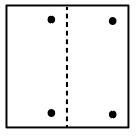
Answer Figures: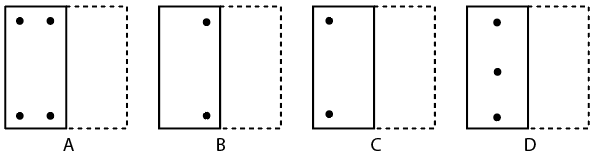
To solve this problem, we need to visualize how the transparent sheet will look when folded along the dotted line. The key is to understand the positions of the dots on the sheet before and after folding.
Correct Option: A) The dots align perfectly when the sheet is folded, matching the arrangement in the problem figure.
Ajay can do a painting in 12 days. Amit is 70% more efficient than Ajay. What is the number of days Amit would need to finish the same painting?
7\( \frac{1}{17} \)
3\( \frac{3}{5} \)
6\( \frac{4}{15} \)
5\( \frac{1}{13} \)
This problem involves concepts of work and time, specifically efficiency. We are given the time taken by one person (Ajay) to complete a task and the relative efficiency of another person (Amit) compared to Ajay. We need to find the time Amit would take to complete the same task.
Calculate Ajay's daily work:
If Ajay can do a painting in 12 days, his work rate per day is \(\frac{1}{12}\) of the painting.
\[ \text{Ajay's daily work} = \frac{1}{\text{Days taken by Ajay}} = \frac{1}{12} \text{ painting/day} \]Calculate Amit's efficiency relative to Ajay:
Amit is 70% more efficient than Ajay. This means Amit's efficiency is 100% + 70% = 170% of Ajay's efficiency.
\[ \text{Amit's efficiency} = 170\% \times \text{Ajay's efficiency} = 1.70 \times \text{Ajay's efficiency} \]Calculate Amit's daily work:
Since efficiency is directly proportional to the work done per day, Amit's daily work will be 170% of Ajay's daily work.
\[ \text{Amit's daily work} = 1.70 \times \frac{1}{12} = \frac{170}{100} \times \frac{1}{12} = \frac{17}{10} \times \frac{1}{12} = \frac{17}{120} \text{ painting/day} \]Calculate the number of days Amit would take:
The number of days Amit would take to finish the painting is the reciprocal of his daily work rate.
\[ \text{Days taken by Amit} = \frac{1}{\text{Amit's daily work}} = \frac{1}{\frac{17}{120}} = \frac{120}{17} \text{ days} \]Convert the fraction to a mixed number:
Divide 120 by 17:
\(120 \div 17 = 7\) with a remainder of \(120 - (17 \times 7) = 120 - 119 = 1\).
So, \(\frac{120}{17}\) days can be written as \(7 \frac{1}{17}\) days.
A) \(7 \frac{1}{17}\)
As calculated, Amit would take \(7 \frac{1}{17}\) days to finish the painting.
To find the angle between the hands of a clock, we need to calculate the angular position of both the hour hand and the minute hand relative to the 12 o'clock mark. We will then find the difference between these angles. A clock face is a circle, which measures 360 degrees. There are 12 hours marked on a clock, so each hour mark represents \(360^\circ / 12 = 30^\circ\). The minute hand completes a full circle (360°) in 60 minutes, so it moves \(360^\circ / 60 = 6^\circ\) per minute. The hour hand completes a full circle in 12 hours, so it moves \(360^\circ / (12 \times 60) = 0.5^\circ\) per minute.
At 2:30, the minute hand is exactly at the 30-minute mark (which corresponds to the number 6 on the clock face).
Angle of minute hand from 12:
\[ \text{Angle}_{\text{minute}} = 30 \text{ minutes} \times 6^\circ/\text{minute} = 180^\circ \]At 2:30, the hour hand is between 2 and 3. It has moved past 2 by 30 minutes.
The hour hand moves \(0.5^\circ\) per minute.
Total minutes from 12 o'clock for the hour hand: \(2 \text{ hours} \times 60 \text{ minutes/hour} + 30 \text{ minutes} = 120 + 30 = 150 \text{ minutes}\).
Angle of hour hand from 12:
\[ \text{Angle}_{\text{hour}} = 150 \text{ minutes} \times 0.5^\circ/\text{minute} = 75^\circ \]The difference between the angles of the minute hand and the hour hand is:
\[ \text{Angle} = |\text{Angle}_{\text{minute}} - \text{Angle}_{\text{hour}}| \] \[ \text{Angle} = |180^\circ - 75^\circ| = 105^\circ \]The angle calculated is \(105^\circ\). An obtuse angle is an angle greater than \(90^\circ\) but less than \(180^\circ\). Since \(105^\circ\) falls within this range, it is the obtuse angle formed by the hands.
If the calculated angle were acute (less than \(90^\circ\)), the obtuse angle would be \(360^\circ - \text{acute angle}\). In this case, \(105^\circ\) is already obtuse.
C) 105° is the obtuse angle formed by the hands of the clock at 2:30.