
The problem asks us to evaluate two courses of action based on a given statement. The statement highlights a problem: during natural calamities, departments blame each other due to overlapping functions. We need to determine which of the suggested actions logically follow to address this issue.
B) Neither 1 nor 2 follows.
In the figure, 'O' is the centre of a circle. The area of sector OAPB is \( \frac{5}{18} \) of the area of the circle. Find x.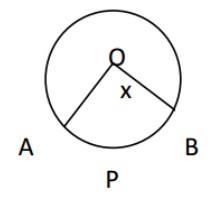
To find the angle \(x\) in the sector OAPB, we use the relationship between the area of the sector and the area of the circle.
Thus, the angle \(x\) is 100 degrees.
Correct Option: C) 100 degrees
To solve this problem, we need to first determine the cost of one guava. We are given the cost of 3 dozen guavas. Since 1 dozen equals 12 units, we can find the total number of guavas for the given cost. Then, we calculate the cost per guava. Finally, we use the cost per guava to find out how many guavas can be bought for ₹ 240.
We know that 1 dozen = 12 guavas.
So, 3 dozen guavas = \(3 \times 12 = 36\) guavas.
The cost of 36 guavas is ₹ 90.
Cost of 1 guava = \[\frac{\text{Total Cost}}{\text{Number of Guavas}}\]
Cost of 1 guava = \(\frac{90}{36}\)
Simplifying the fraction:
\[ \frac{90}{36} = \frac{18 \times 5}{18 \times 2} = \frac{5}{2} = 2.50 \]
So, the cost of one guava is ₹ 2.50.
Number of guavas = \[\frac{\text{Total Amount}}{\text{Cost per Guava}}\]
Number of guavas = \(\frac{240}{2.50}\)
To simplify the division, we can multiply the numerator and denominator by 10:
\[ \frac{240}{2.50} = \frac{240 \times 10}{2.50 \times 10} = \frac{2400}{25} \]
Now, perform the division:
\[ \frac{2400}{25} = 96 \]
Therefore, 96 guavas can be bought for ₹ 240.
Correct Option: C) 96
The question asks to identify the specific translation Sir Charles Wilkins is famous for. This requires knowledge of key figures in early Indology and their contributions to translating Sanskrit texts into English.
Correct Option: A) 'Bhagavad Gita' to English
Select the option that correctly matches the contents of the first column with the contents of the second column.
| A. Calcium, Oxygen | I. Formula of Calcium Phosphide |
| B. Ca₃P₂ | II. Elements present in Quicklime |
| C. 0.1 Moles | III. This number is known as the Avogadro constant |
| D. The fixed number of atoms or molecules present in gram atomic mass of an atom or molecules is 6.022 × 10²³ | IV. Are present in 2.3 g of Na |
A-II, B-I, C-IV, D-III
A-I, B-II, C-IV, D-III
A-II, B-IV, C-I, D-III
A-II, B-I, C-III, D-IV
The question asks us to match the items in the first column with their correct descriptions or related concepts in the second column. We need to evaluate each pair and find the combination that correctly matches all four items.
A) A-II, B-I, C-IV, D-III. This option correctly matches all the items as determined in the step-by-step analysis.
To solve this problem, we need to follow the order of operations, often remembered by the acronym BODMAS/PEMDAS. This means we perform operations in the following order: Brackets/Parentheses, Orders/Exponents, Division and Multiplication (from left to right), and Addition and Subtraction (from left to right).
Thus, the final answer is 26.
Correct Option: A) 26
The question asks to identify the country of origin of the well-known author and leadership speaker, Robin Sharma. This requires general knowledge about prominent personalities.
D) Canada: Robin Sharma is a Canadian writer, best known for his leadership and self-help books.
This is a blood relation problem. We need to deduce the relationship between Y's husband's father and X by breaking down the given statement step-by-step and establishing the connections.
Correct Option: D) Grandfather
The question asks to identify the true statement among the given options regarding chromosomes and sex determination. We need to evaluate each option based on established biological facts about human genetics and sex determination in different organisms.
D) In diploid organisms having separate sexes, a specific pair of chromosomes in each diploid cell determines the sex of the individual; they are called sex chromosomes. This statement is fundamentally correct. In many diploid species, including humans, a particular pair of chromosomes (e.g., XX in females and XY in males) is responsible for determining the sex of the individual. These are known as sex chromosomes or allosomes, distinct from autosomes.
This is a syllogism problem. We need to determine which conclusions logically follow from the given statements. We can use Venn diagrams to visualize the relationships between the categories (ponds, lakes, rivers, seas) and then evaluate each conclusion.
Let's represent each category as a circle. Since the statements use "Some", we know there's an overlap, but not necessarily that one category is entirely contained within another, or that there's no overlap beyond the stated one.
Consider two possible scenarios:
Based on our Venn diagrams, this conclusion is possible (Scenario 1). If some rivers are lakes and some rivers are seas, it is possible that the 'some rivers' that are seas are also the 'some rivers' that are lakes, leading to an overlap between lakes and seas. However, it is not definitively true in all possible diagrams.
Based on our Venn diagrams, this conclusion is also possible (Scenario 2). It's possible to draw a diagram where the 'some rivers' that are seas do not overlap with the 'some rivers' that are lakes, thus keeping seas and lakes entirely separate.
Since Conclusion 1 states "Some seas are lakes" and Conclusion 2 states "No sea is a lake", these two conclusions form a complementary pair (either one or the other must be true, and both cannot be true simultaneously). Since we found that both scenarios are possible (one where there is an overlap and one where there isn't), and they are contradictory, it means that either Conclusion 1 follows or Conclusion 2 follows. This is a case of 'Either/Or'.
A) Either 1 or 2 follows — This is correct because the two conclusions are contradictory (complementary pair) and both are individually possible based on the given statements. Therefore, one of them must be true.