
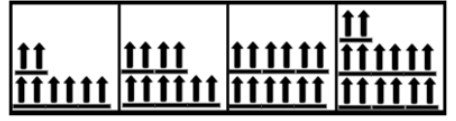
The above figures are arranged in some order. The next figure that follows the same order is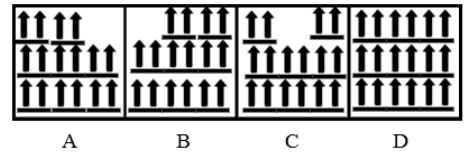
The question involves identifying the pattern in a sequence of figures and determining which option follows this pattern.
Correct Option: B) Option B has four rows of arrows, matching the expected pattern.
The question asks to identify which of the given metals is found in its free (uncombined) state in nature. This relates to the reactivity series of metals. Metals with low reactivity are generally found in their free state, while highly reactive metals are found in combined forms (ores).
Correct Option: D) Gold is a noble metal, meaning it is very unreactive. Due to its low reactivity, it does not readily form compounds with other elements and is therefore found in its elemental or free state in nature.
To find out when the bells will ring together again, we need to find the least common multiple (LCM) of their individual ringing intervals. The LCM will give us the time duration after which all bells will ring simultaneously.
Identify the given intervals: The bells ring at intervals of 15 minutes, 30 minutes, and 45 minutes.
Find the LCM of the intervals: We need to find the LCM of 15, 30, and 45.
To find the LCM, we take the highest power of all prime factors present:
\[ \text{LCM}(15, 30, 45) = 2^1 \times 3^2 \times 5^1 = 2 \times 9 \times 5 = 90 \]Interpret the LCM: The LCM is 90 minutes. This means the bells will ring together again after 90 minutes from the time they last rang simultaneously.
Calculate the next ringing time: The bells rang simultaneously at 8:00 AM. We need to add 90 minutes to 8:00 AM.
Correct Option: A) 9.30 AM is the time when the bells will ring together again.
We need to determine if the given statements are sufficient to answer whether \(X+6\) is odd, where \(X\) is a natural number. We will analyze each statement individually.
D) 2 alone is sufficient while 1 alone is not sufficient to answer the question.
To find the selling price per egg, we first need to calculate the cost price per egg. Then, we will calculate the profit amount and add it to the cost price per egg to find the selling price per egg.
Calculate the Cost Price (CP) per egg:
Given that the shopkeeper purchased eggs at ₹ 19.20 per dozen.
We know that 1 dozen = 12 eggs.
So, the cost of 12 eggs = ₹ 19.20.
Cost price per egg (CP per egg) is:
\[ \text{CP per egg} = \frac{\text{Cost of 1 dozen eggs}}{\text{Number of eggs in a dozen}} \] \[ \text{CP per egg} = \frac{19.20}{12} = \text{₹} 1.60 \]Calculate the Selling Price (SP) per egg:
The shopkeeper sold them at a profit of 25%.
Profit percentage is calculated on the Cost Price.
Profit amount per egg = 25% of CP per egg
\[ \text{Profit per egg} = 0.25 \times 1.60 = \text{₹} 0.40 \]Selling price per egg (SP per egg) = CP per egg + Profit per egg
\[ \text{SP per egg} = 1.60 + 0.40 = \text{₹} 2.00 \]Alternatively, we can directly calculate the selling price using the formula:
\[ \text{SP} = \text{CP} \times \left(1 + \frac{\text{Profit Percentage}}{100}\right) \] \[ \text{SP per egg} = 1.60 \times \left(1 + \frac{25}{100}\right) \] \[ \text{SP per egg} = 1.60 \times (1 + 0.25) \] \[ \text{SP per egg} = 1.60 \times 1.25 \] \[ \text{SP per egg} = \text{₹} 2.00 \]Correct Option: A) ₹ 2.00
The problem involves simple interest calculations for two different investments. We are given that the interest earned from both investments is equal. We will use the simple interest formula to set up an equation and then find the ratio of the principal amounts.
The formula for simple interest (SI) is:
\[ \text{SI} = \frac{P \times R \times T}{100} \]where \(P\) is the principal amount, \(R\) is the rate of interest per annum, and \(T\) is the time in years.
For the first investment:
The interest earned \((SI_1)\) is:
\[ \text{SI}_1 = \frac{x \times 9 \times 5}{100} = \frac{45x}{100} \]For the second investment:
The interest earned \((SI_2)\) is:
\[ \text{SI}_2 = \frac{y \times 6.25 \times 8}{100} \]To simplify \(6.25 \times 8\):
\[ 6.25 \times 8 = \frac{25}{4} \times 8 = 25 \times 2 = 50 \]So, the interest earned \((SI_2)\) is:
\[ \text{SI}_2 = \frac{50y}{100} \]The problem states that the interest yielded from both investments is the same:
\[ \text{SI}_1 = \text{SI}_2 \]\[ \frac{45x}{100} = \frac{50y}{100} \]Multiply both sides by 100:
\[ 45x = 50y \]To find the ratio \(x : y\), rearrange the equation:
\[ \frac{x}{y} = \frac{50}{45} \]Simplify the fraction by dividing both numerator and denominator by their greatest common divisor, which is 5:
\[ \frac{x}{y} = \frac{50 \div 5}{45 \div 5} = \frac{10}{9} \]Thus, \(x : y = 10 : 9\).
B) 10 : 9 is the correct ratio of \(x\) to \(y\).
This is a statement and assumption type of question. We need to analyze the given statement and determine which of the provided assumptions are implicitly made when the statement is uttered. An assumption is something taken for granted or supposed without proof.
D) Only assumption 1 is implicit.
Which of the following statements is/are true or false?
Statements:
A) H2SO4 is used in the refining of petroleum to remove sulphur and other compounds.
B) The basic nature of sodium hydroxide (NaOH) is due to the presence of hydrogen ions in the solution.
Only statement B is true
Both statements are false
Both statements are true
Only statement A is true
The question asks to evaluate the truthfulness of two statements related to chemical applications and properties. We need to analyze each statement individually based on chemical principles and industrial processes.
Correct Option: D) Only statement A is true
Two partners M and N buy a car. M pays his share of \( \frac{3}{7} \)th of the total cost of the car. M pays ₹ 31,540 less than N. What is the cost of the car?
The problem involves calculating the total cost of a car based on the fractional share paid by one partner and the difference in payment between the two partners. We will represent the total cost as a variable, express each partner's share as a fraction of the total cost, and then use the given difference in payment to find the total cost.
Correct Option: A) ₹ 2,20,780
Select the figure that does NOT belong in the following group.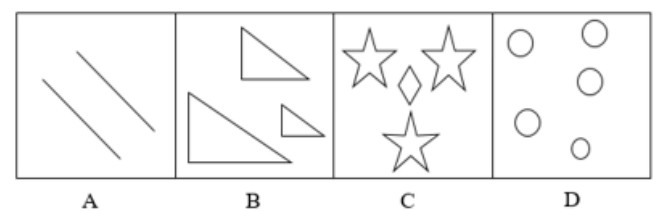
The task is to identify the figure that does not belong to the group based on a common characteristic shared by the others. This involves analyzing the shapes and their properties.
Correct Option: A) Figure A does not belong because it consists of open lines, unlike the closed shapes in the other figures.