
The question asks about the medium through which sound cannot travel. To answer this, we need to understand the fundamental nature of sound waves and how they propagate.
Correct Option: C) Vacuum — A vacuum is a space entirely devoid of matter. Since sound is a mechanical wave and requires a medium (particles) to propagate by vibrating and colliding, it cannot travel through a vacuum where there are no particles to transmit these vibrations.
This problem involves an arithmetic progression. We are given the number of sisters, the interval between their births, and the sum of their ages. We need to find the age of the eldest sister. We can set up an equation based on the properties of an arithmetic series.
Correct Option: A) 16 years
The question asks about the original language of 'Baburnama', the autobiography of Babur. To answer this, one needs to recall historical facts about Babur's background and linguistic proficiency.
C) Turkish — Babur was a native speaker of Chagatai Turkic, a Central Asian Turkic language. He composed his memoirs, 'Baburnama', in this language.
The question asks to identify the female reproductive part of a flower. We need to recall the basic structure of a flower and the functions of its different parts.
Correct Option: D) Carpel is the female reproductive part of a flower. It consists of the stigma, style, and ovary, which collectively facilitate fertilization and seed development.
This problem involves understanding the concept of shadows based on the time of day and relative directions. In the morning, the sun is in the East, so shadows fall towards the West. We need to determine X's facing direction based on Y's shadow falling to X's right.
C) South is the correct answer because if X's right side is West (where Y's shadow falls), then X must be facing South.
The question asks for the unit of power commonly used in industry. This requires knowledge of standard and historical units of power and their applications.
Correct Option: D) Horse power is a traditional unit of power widely used in industry, especially for rating engines and machinery. One horsepower is approximately equal to 745.7 watts.
Two or more elements combine to form a ___.
The question asks what is formed when two or more elements combine. This is a fundamental concept in chemistry related to how different substances interact to create new ones.
B) Compound — A compound is a substance formed when two or more different chemical elements are chemically bonded together in a fixed proportion. For example, water (\(\text{H}_2\text{O}\)) is a compound formed from hydrogen and oxygen elements.
Select the correct figure that replaces the question mark.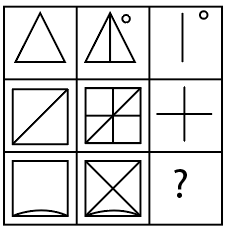
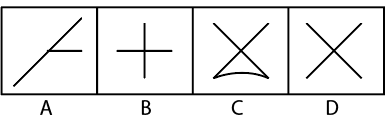
To solve this pattern-based question, we need to identify the rule governing the sequence of figures in each row and column. Observing the patterns in the grid will help us determine the correct figure to replace the question mark.
Correct Option: D) The figure is an 'X' without any additional elements, fitting the pattern of simplification seen in the previous rows.
Which of the following devices helps to maintain a potential difference across a conductor?
The question asks to identify the device that maintains a potential difference across a conductor. Understanding the function of each given device is key to answering this question.
Based on these functions, only a cell or battery is capable of establishing and maintaining a potential difference across a conductor.
Correct Option: C) A cell or battery helps to maintain a potential difference across a conductor by converting chemical energy into electrical energy, thereby providing the necessary electromotive force (EMF).
The problem presents an alphanumeric series where each term consists of a number followed by a letter. We need to identify the pattern in both the numerical and alphabetical parts of the series independently to find the missing term.
The numbers in the series are 5, 7, 11, 17.
The differences are 2, 4, 6. This indicates a pattern where the difference increases by 2 each time. So, the next difference should be \(6 + 2 = 8\).
Therefore, the next number in the sequence will be \(17 + 8 = 25\).
The letters in the series are E, F, H, K.
Let's find the position of each letter in the English alphabet (A=1, B=2, ...):
Now, let's look at the differences in their positions:
The differences are 1, 2, 3. This indicates a pattern where the difference increases by 1 each time. So, the next difference should be \(3 + 1 = 4\).
Therefore, the next letter will be the letter whose position is \(11 + 4 = 15\). The 15th letter of the English alphabet is O.
The next number is 25 and the next letter is O.
So, the missing term is 25O.
B) 25O is the correct option because the numerical part follows a pattern of increasing differences (2, 4, 6, 8...) and the alphabetical part follows a pattern of increasing positional differences (1, 2, 3, 4...).