
This problem involves concepts of speed, distance, and time, specifically in the context of boats and streams. We need to calculate the speed of the rower in still water using the given information about upstream and downstream travel times and distance.
Let \(S_R\) be the speed of the rower in still water (in km/h).
Let \(S_C\) be the speed of the current (in km/h).
When rowing upstream, the current opposes the rower, so the effective speed is:
\[ S_{Upstream} = S_R - S_C \]When rowing downstream, the current aids the rower, so the effective speed is:
\[ S_{Downstream} = S_R + S_C \]The distance is 40 km for both upstream and downstream travel.
Upstream: Time taken = 8 hours.
\[ S_{Upstream} = \frac{\text{Distance}}{\text{Time}} = \frac{40 \text{ km}}{8 \text{ h}} = 5 \text{ km/h} \]Downstream: Time taken = 5 hours.
\[ S_{Downstream} = \frac{\text{Distance}}{\text{Time}} = \frac{40 \text{ km}}{5 \text{ h}} = 8 \text{ km/h} \]From step 2 and step 3, we have:
Equation (1): \(S_R - S_C = 5\)
Equation (2): \(S_R + S_C = 8\)
Add Equation (1) and Equation (2):
\[ (S_R - S_C) + (S_R + S_C) = 5 + 8 \]\[ 2S_R = 13 \]\[ S_R = \frac{13}{2} \]\[ S_R = 6.5 \text{ km/h} \]C) 6.5 km/h is the rower's speed in still water, as calculated by solving the system of equations.
The question asks to identify the Indian weightlifter who secured a gold medal at the World Weightlifting Championship held in Anaheim, USA, in 2017. This is a factual recall question related to sports achievements.
A) Mirabai Chanu: Saikhom Mirabai Chanu indeed won the gold medal in the women's 48 kg category at the 2017 World Weightlifting Championships held in Anaheim, USA. This was a historic achievement for Indian weightlifting.
Use each of the following figures only once and form three groups. The three groups so formed are: 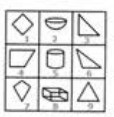
(1,4,7), (2,5,8), (3,6,9)
(1,5,7), (2,4,8), (3,6,9)
(1,4,7), (3,5,8), (2,6,9)
(1,4,7), (2,6,8), (3,5,9)
The task is to group the figures into three sets based on similar characteristics. Each group should have figures that share a common property.
Correct Option: A) (1,4,7), (2,5,8), (3,6,9)
The question asks about the primary component of a fungal cell wall. This is a direct factual recall question from biology, specifically mycology (the study of fungi). Knowing the characteristic cell wall composition of different organisms is key.
A) chitin
Fungal cell walls are primarily composed of chitin. Chitin is a long-chain polymer of N-acetylglucosamine, a derivative of glucose. It provides structural rigidity and protection to the fungal cell, similar to how cellulose functions in plants or peptidoglycan in bacteria. Chitin is also found in the exoskeletons of insects and crustaceans.
The question asks to complete the sentence "A king will always have a _____." We need to identify the essential element that defines a king's existence or role. This is a question testing basic vocabulary and understanding of social roles.
Correct Option: B) Kingdom
A king, by definition, rules over a kingdom. It is the fundamental entity that makes someone a king. Without a kingdom, there is no domain to rule, and thus no king.
Consider the argument and decide which of the given assumptions is/are implicit.
Argument:
A flyover has been constructed with a heavy cost of ₹200 crores, yet people are not utilising the flyover much.
Assumptions:
1. Construction of the flyover is useless.
2. The time, money and energy spent on the construction of the flyover was wasted.
Both 1 and 2 are implicit.
Only assumption 2 is implicit.
Only assumption 1 is implicit.
Neither 1 nor 2 is implicit.
This question tests the ability to identify implicit assumptions in an argument. An assumption is something taken for granted or supposed in advance. We need to determine if the given assumptions are necessarily true based solely on the argument presented, without adding external information or making further inferences.
D) Neither 1 nor 2 is implicit. The argument simply states a fact about the flyover's cost and current low utilization. It does not inherently assume that the flyover is useless or that the resources spent on it were wasted. These are interpretations or conclusions that one might draw, but they are not implicit assumptions within the argument itself.
This question tests the fundamental definition of mechanical energy in physics. Mechanical energy is a concept that describes the energy associated with the motion and position of an object.
Correct Option: B) kinetic energy + potential energy
The pH of a solution is a measure of its acidity or alkalinity. It is defined by the negative logarithm (base 10) of the hydrogen ion concentration. We will use the formula for pH to calculate its value given the hydrogen ion concentration.
where \([\text{H}^+]\) is the molar concentration of hydrogen ions.
Since \(\log_{10}1 = 0\):
\[ \text{pH} = -(0 + (-5)) \]\[ \text{pH} = -(-5) \]\[ \text{pH} = 5 \]B) 5 — The calculation shows that a hydrogen ion concentration of \(1 \times 10^{-5}\) M results in a pH of 5.
To find the duration Anit took to complete his journey, we first need to calculate the duration Praneet took. Then, we can determine Anit's start and end times relative to Praneet's, and finally calculate Anit's journey duration.
Calculate Praneet's journey duration:
Praneet started at 2:45:46 p.m. and reached at 4:55:57 p.m.
Duration = Reaching Time - Starting Time
\[ \begin{array}{l} \text{Hours} & \text{Minutes} & \text{Seconds} \ 4 & 55 & 57 \ -2 & 45 & 46 \ \hline 2 & 10 & 11 \ \end{array} \]So, Praneet took 2 hours 10 minutes 11 seconds.
Calculate Anit's start time:
Anit started 58 minutes 40 seconds after Praneet.
Praneet's start time: 2:45:46 p.m.
Adding 58 minutes 40 seconds:
\[ \begin{array}{l} \text{Hours} & \text{Minutes} & \text{Seconds} \ 2 & 45 & 46 \ +0 & 58 & 40 \ \hline \end{array} \]Seconds: \(46 + 40 = 86\) seconds \( = 1\) minute \(26\) seconds.
Minutes: \(45 + 58 + 1\) (from seconds) \( = 104\) minutes \( = 1\) hour \(44\) minutes.
Hours: \(2 + 1\) (from minutes) \( = 3\) hours.
So, Anit started at 3:44:26 p.m.
Calculate Anit's reaching time:
Anit reached 49 minutes 41 seconds after Praneet.
Praneet's reaching time: 4:55:57 p.m.
Adding 49 minutes 41 seconds:
\[ \begin{array}{l} \text{Hours} & \text{Minutes} & \text{Seconds} \ 4 & 55 & 57 \ +0 & 49 & 41 \ \hline \end{array} \]Seconds: \(57 + 41 = 98\) seconds \( = 1\) minute \(38\) seconds.
Minutes: \(55 + 49 + 1\) (from seconds) \( = 105\) minutes \( = 1\) hour \(45\) minutes.
Hours: \(4 + 1\) (from minutes) \( = 5\) hours.
So, Anit reached at 5:45:38 p.m.
Calculate Anit's journey duration:
Anit started at 3:44:26 p.m. and reached at 5:45:38 p.m.
Duration = Reaching Time - Starting Time
\[ \begin{array}{l} \text{Hours} & \text{Minutes} & \text{Seconds} \ 5 & 45 & 38 \ -3 & 44 & 26 \ \hline 2 & 1 & 12 \ \end{array} \]Anit took 2 hours 1 minute 12 seconds to complete his journey.
C) 2 hours 1 minute 12 seconds
Select the option that gives the number missing from the following figure. 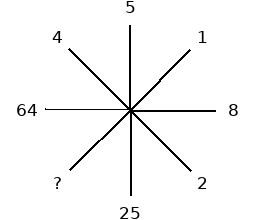
To solve this problem, we need to identify the pattern in the given figure. The numbers are arranged in a symmetrical manner around a central point, suggesting a mathematical relationship between them.
Correct Option: A) 1