
Choose the correct water image of the problem figure.
Problem Figure: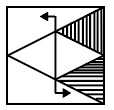
Answer Figures: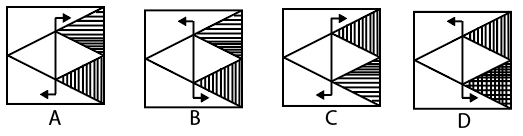
To find the correct water image of the given problem figure, we need to visualize how the figure would appear if it were reflected vertically. This involves flipping the figure along the horizontal axis.
Correct Option: A) Option A is the correct water image as it accurately mirrors the problem figure vertically.
To determine the day of the week for a future date, we need to calculate the total number of odd days between the given start date and the end date. Odd days are the remainder when the total number of days is divided by 7. Each odd day shifts the day of the week forward by one day.
Calculate days remaining in 2018 from February 5th:
Total days in 2018 from Feb 5th to Dec 31st:
\[ 23 + 31 + 30 + 31 + 30 + 31 + 31 + 30 + 31 + 30 + 31 = 339 \text{ days} \]Calculate odd days for 2018:
Number of odd days in 2018 (from Feb 5th):
\[ 339 \div 7 = 48 \text{ weeks and } 3 \text{ days remainder} \]So, there are 3 odd days in 2018.
Calculate days in 2019 until April 8th:
Total days in 2019 until April 8th:
\[ 31 + 28 + 31 + 8 = 98 \text{ days} \]Calculate odd days for 2019:
Number of odd days in 2019 (until April 8th):
\[ 98 \div 7 = 14 \text{ weeks and } 0 \text{ days remainder} \]So, there are 0 odd days in 2019.
Calculate total odd days:
Total odd days from February 5th, 2018 to April 8th, 2019:
\[ 3 \text{ (from 2018)} + 0 \text{ (from 2019)} = 3 \text{ odd days} \]Determine the final day of the week:
Given day: Monday (February 5th, 2018)
Add 3 odd days to Monday:
Wait, let's recheck the calculation. The question asks for 8th April 2019. Let's calculate the total number of days more simply.
Alternative approach: Calculate odd days for each full year and remaining months.
From Feb 5, 2018 to Feb 5, 2019:
This period covers exactly one year. Since 2018 is not a leap year, it has 365 days.
Number of odd days in 365 days:
\[ 365 \div 7 = 52 \text{ weeks and } 1 \text{ day remainder} \]So, Feb 5, 2019 will be Monday + 1 day = Tuesday.
From Feb 5, 2019 to April 8, 2019:
Total days from Feb 5, 2019 to April 8, 2019:
\[ 23 + 31 + 8 = 62 \text{ days} \]Calculate odd days for this period:
\[ 62 \div 7 = 8 \text{ weeks and } 6 \text{ days remainder} \]So, there are 6 odd days for this period.
Determine the final day of the week:
Feb 5, 2019 was Tuesday.
Add 6 odd days to Tuesday:
Therefore, April 8, 2019 will be a Monday.
C) Monday
Select the figure which does NOT belong to the group.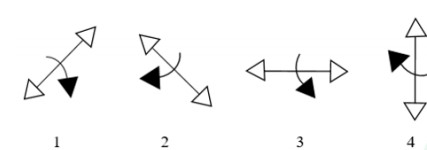
To identify the figure that does not belong to the group, we need to analyze the orientation and arrangement of the arrows in each figure. The key is to look for a pattern or common characteristic shared by three of the figures and identify the one that deviates from this pattern.
Correct Option: A) Figure 1 does not belong to the group as it lacks the symmetrical arrangement present in the other figures.
The problem asks us to calculate the value of an electric bulb after one year, given its initial cost and an annual depreciation rate. Depreciation means the value decreases over time. We need to calculate the amount of depreciation for one year and subtract it from the initial cost.
Thus, the value of the electric bulb after one year will be ₹ 3,864.
Correct Option: C) ₹ 3,864
The question asks to identify the Indian model who won the Miss World 2017 contest. This is a factual recall question related to current affairs and general knowledge, specifically in the field of international beauty pageants.
Correct Option: C) Manushi Chhillar was crowned Miss World 2017 on November 18, 2017, in Sanya, China. She became the sixth Indian woman to win the title.
The question asks to identify the cricketer who had scored three double centuries in One-Day International (ODI) cricket as of 2018. This requires knowledge of significant records in cricket history, specifically related to double centuries in ODIs.
D) Rohit Sharma is the only cricketer to have scored three double centuries in One-Day International cricket as of 2018. His scores were 209, 264, and 208*.
To identify a chemical change, we need to understand the fundamental difference between physical and chemical changes. A chemical change results in the formation of new substances with different chemical properties, often irreversible. A physical change alters the form or appearance of a substance but not its chemical composition, and is often reversible.
Correct Option: A) Butter turning rancid. This is a chemical change because the fats in butter react with oxygen (oxidation) or water (hydrolysis) to form new compounds, altering its chemical composition and properties (smell, taste).
Select the option that represents the number of triangles in the given figure.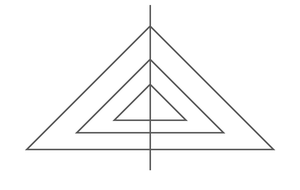
To determine the number of triangles in the given figure, we need to identify and count all the distinct triangles formed by the intersecting lines.
However, upon closer inspection, we realize that some triangles were counted twice due to overlapping lines. Re-evaluating, we find:
Thus, the correct count is actually 9 distinct triangles.
Correct Option: D) 9
The question asks for the highest Goods and Services Tax (GST) slab percentage in India as of 2018. To answer this, one needs to recall the GST rate structure implemented in India.
Correct Option: D) 28% is the highest percentage slab for GST in India as of 2018. This slab primarily applies to luxury items, demerit goods, and certain services.
Let the positive integer be \(x\). We are given a condition involving \(x\), 1000, 100, and 10.06. We need to translate this condition into an inequality and then test the given options to find the integer that satisfies it.
Multiply both sides by 100:
\[ 1000 + x > 10.06 \times 100 \]\[ 1000 + x > 1006 \]\[ x > 1006 - 1000 \]\[ x > 6 \]Only option B (7) satisfies the condition \(x > 6\).
B) 7 — When \(x = 7\), the expression becomes \[\frac{1000 + 7}{100} = \frac{1007}{100} = 10.07\]. Since \(10.07 > 10.06\), this option is correct.