
This question tests knowledge about the electronic configuration of non-metals and their tendency to achieve a stable octet configuration. Non-metals typically gain or share electrons to complete their outermost shell.
Correct Option: B) 5, 6, 7 or 8. Non-metals typically have 5, 6, 7 (and thus tend to gain electrons) or 8 (like noble gases, which are stable non-metals) electrons in their outermost shell.
From the given four answer figures choose the correct water image of the problem figure.
Problem Figure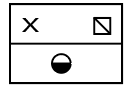
Answer Figures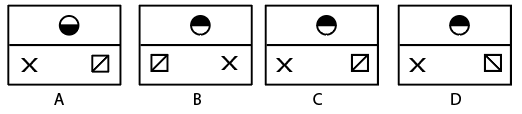
To find the correct water image of the given problem figure, we need to reflect the figure vertically. This means flipping the figure upside down as if it is reflected on a horizontal surface, like water.
Correct Option: D) The semicircle is correctly placed at the top with the flat side down, and the 'X' and square with a diagonal are correctly placed at the bottom.
The question asks what property of an atom is measured by its radius. We need to understand the definition of atomic radius and how it relates to other atomic properties.
C) Atomic size. The atomic radius is a direct measure of an atom's size, representing the distance from the nucleus to the outermost electron shell.
This problem can be solved using Newton's Second Law of Motion, which states that the force acting on an object is equal to the product of its mass and acceleration. We are given the force and the mass, and we need to find the acceleration.
The formula for Newton's Second Law is:
\[ F = m \times a \]To find acceleration, we can rearrange the formula as:
\[ a = \frac{F}{m} \]Substitute \(F = 20 \text{ N}\) and \(m = 10 \text{ kg}\) into the rearranged formula:
\[ a = \frac{20 \text{ N}}{10 \text{ kg}} \]The unit of acceleration is meters per second squared (\(\text{m/sec}^2\)).
Correct Option: D) 2 m/sec² is the correct answer. When a force of 20 N is applied to a 10 kg body, it produces an acceleration of 2 m/sec² according to Newton's Second Law of Motion.
The question asks for the formula of Power. Power is a fundamental concept in physics that describes the rate at which work is done or energy is transferred. We need to recall its definition and mathematical representation.
Correct Option: B) work/time
To find the position of the image formed by a convex lens, we use the lens formula. We are given the object distance and the focal length of the convex lens. We need to apply the sign conventions for lenses carefully.
The lens formula is given by:
\[ \frac{1}{f} = \frac{1}{v} - \frac{1}{u} \]Substitute \(f = +10 \text{ cm}\) and \(u = -20 \text{ cm}\):
\[ \frac{1}{10} = \frac{1}{v} - \frac{1}{(-20)} \]\[ \frac{1}{10} = \frac{1}{v} + \frac{1}{20} \]Rearrange the equation to solve for \(v\):
\[ \frac{1}{v} = \frac{1}{10} - \frac{1}{20} \]\[ \frac{1}{v} = \frac{2}{20} - \frac{1}{20} \]\[ \frac{1}{v} = \frac{2 - 1}{20} \]\[ \frac{1}{v} = \frac{1}{20} \]\[ v = +20 \text{ cm} \]The positive sign for \(v\) indicates that the image is formed on the right side of the lens, which means it is a real and inverted image.
C) The image is formed at a distance of 20 cm. This matches our calculated value of \(v = +20 \text{ cm}\).
The question asks to identify a word pair that shares the same relationship as "Sankranti : Andhra Pradesh". The relationship in the given pair is that Sankranti is a major festival celebrated in the state of Andhra Pradesh. We need to find an option where the first word is a significant festival or cultural event and the second word is the specific Indian state where it is primarily celebrated.
Based on this analysis, Option A establishes the same analogous relationship as the given pair.
Correct Option: A) Onam : Kerala — Onam is a significant harvest festival primarily celebrated in the state of Kerala, establishing the same "Festival : State" relationship as Sankranti : Andhra Pradesh.
To find the Least Common Multiple (LCM) of a set of numbers, we can use the prime factorization method. This involves finding the prime factors of each number and then multiplying the highest powers of all the prime factors involved.
The unique prime factors are 2, 5, and 7.
Correct Option: A) 280
The question asks to identify the Mughal emperor under whose reign the Jama Masjid in Delhi was constructed. This requires knowledge of prominent Mughal architectural projects and their patrons.
Correct Option: D) Shah Jahan was the Mughal emperor who commissioned the construction of the Jama Masjid in Delhi. It was built between 1650 and 1656.
If the valency of Aluminum is 3 and that of Oxygen is 2, then the chemical formula of Aluminum oxide is:
To determine the chemical formula of a compound formed between two elements, we use the criss-cross method, which involves exchanging their valencies and writing them as subscripts.
Correct Option: D) Al 2 O 3