
The question asks for the common name of solid carbon dioxide. This is a direct knowledge-based question related to common chemical substances and their colloquial names.
D) dry ice — Solid carbon dioxide is famously known as dry ice due to its property of subliming directly into a gas without passing through a liquid phase at atmospheric pressure, thus remaining "dry."
This question tests our ability to identify implicit assumptions based on a given statement. An implicit assumption is something that is not directly stated but must be true for the argument to hold. We need to evaluate each assumption to see if it is a necessary condition for Akbar's statement to be meaningful.
B) Only assumption 1 is implicit. For Birbal to be the wisest man in the kingdom, it logically follows that no one, including Akbar, can be wiser than him.
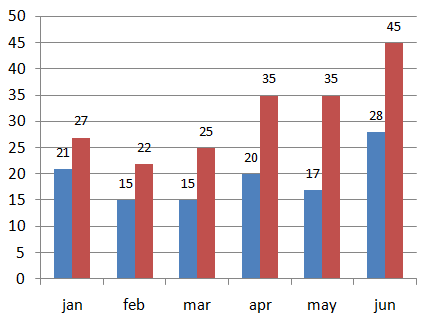
The given graph shows the registration of bikes and total vehicles (in thousands) for 6 months in 2017 in City X.
Note: In the chart, the first number represents bikes (grey) and the second number represents total vehicles (black).
Based on the given data, in March 2017, the number of vehicles other than bikes registered is:
To find the number of vehicles other than bikes registered in March 2017, we need to subtract the number of bikes from the total number of vehicles registered in that month.
\[ \text{Vehicles other than bikes} = \text{Total vehicles} - \text{Bikes} = 25,000 - 15,000 = 10,000 \]
Therefore, the number of vehicles other than bikes registered in March 2017 is 10,000.
Correct Option: D) 10,000
The question asks about the color of a flame when there is sufficient oxygen supply. This relates to the concept of complete combustion in chemistry.
Therefore, a sufficient oxygen supply leads to complete combustion and a blue flame.
D) blue — A blue flame indicates complete combustion, which occurs when there is an adequate supply of oxygen. This type of flame is hotter and more efficient.
The question gives the ratio of sand to gravel as 7 : 8 and the ratio of gravel to cement as 6 : 7. We need to find the ratio of sand to cement. Since gravel is common to both ratios, we can make the gravel quantities equal using the Least Common Multiple (LCM) and then combine the ratios.
Identify the given ratios:
We need to determine Sand : Cement.
Find the LCM of the gravel quantities:
The gravel quantities in the two ratios are 8 and 6.
\[ \text{LCM}(8,6)=24 \]We need to make the gravel quantity equal to 24 in both ratios.
Convert the first ratio:
Sand : Gravel = 7 : 8
Multiply both terms by 3:
\[ 7\times3:8\times3 \] \[ =21:24 \]Therefore, Sand : Gravel = 21 : 24.
Convert the second ratio:
Gravel : Cement = 6 : 7
Multiply both terms by 4:
\[ 6\times4:7\times4 \] \[ =24:28 \]Therefore, Gravel : Cement = 24 : 28.
Combine the ratios:
Since the gravel quantity is now equal in both ratios:
\[ \text{Sand : Gravel : Cement}=21:24:28 \]Therefore:
\[ \text{Sand : Cement}=21:28 \]Simplify by dividing both terms by 7:
\[ 21:28=3:4 \]Therefore, the ratio of sand to cement is 3 : 4.
Correct Option: B) 3 : 4 — The given ratios are Sand : Gravel = 7 : 8 and Gravel : Cement = 6 : 7. Making the gravel quantities equal gives 21 : 24 and 24 : 28. Combining them, Sand : Gravel : Cement = 21 : 24 : 28. Therefore, Sand : Cement = 21 : 28 = 3 : 4. Hence, Option B is the correct answer.
A) 8 : 6: This is incorrect because 8 and 6 represent the gravel quantities in the two given ratios, not the required ratio of sand to cement.
C) 49 : 48: This is incorrect because directly multiplying the given ratios without correctly matching the common gravel quantity produces an incorrect result. The correct ratio is 3 : 4.
D) 7 : 7: This is incorrect because the sand and cement quantities are not equal. After matching the gravel quantities, the ratio of sand to cement is 21 : 28, which simplifies to 3 : 4.
The question asks to identify the device that converts chemical energy into electrical energy. This involves understanding the basic function of common electrical devices and energy transformations.
Correct Option: A) An electric cell (or battery) uses chemical reactions to produce an electric current, thereby converting chemical energy into electrical energy.
The question asks about the pH of a solution that turns blue litmus red. This involves understanding the properties of acids, bases, and neutral substances, specifically how they interact with litmus paper and their corresponding pH values.
C) 6 is the correct answer because a solution with a pH of 6 is acidic, and acidic solutions turn blue litmus paper red.
The question asks for the definition of implantation in the context of human reproduction. We need to identify the correct biological process among the given options.
Correct Option: A) attachment of zygote to the lining of a uterus
Implantation is precisely defined as the attachment of the blastocyst (which develops from the zygote) to the uterine wall. This process typically occurs about 6-12 days after fertilization.
The problem asks us to find the related letters for "CITY" based on the pattern established between "PUNE" and "SXQF". This is a letter-coding problem where we need to identify the transformation rule applied to each letter of the first word to get the corresponding letter in the second word.
C) FLWZ — This matches our derived word by applying the \(+3, +3, +3, +1\) pattern to each letter of CITY.
This question asks for the square of the number 11111. We can solve this by direct multiplication or by recognizing a pattern in squaring numbers consisting only of ones.
D) 123454321 — This matches the pattern observed for squaring numbers consisting only of ones. Since 11111 has five '1's, its square will count up to 5 and then back down to 1.