
The length of an animal's intestine is primarily determined by its diet. Herbivores, which consume plant matter, generally have longer intestines compared to carnivores, which eat meat. This is because plant material, especially cellulose, is harder to digest and requires a longer digestive tract for nutrient absorption.
D) Rabbit — Rabbits are herbivores, meaning their diet consists solely of plant material. Plant matter, particularly cellulose, is complex and difficult to digest. To efficiently extract nutrients from this fibrous diet, herbivores like rabbits have evolved to have a significantly longer intestine compared to carnivores or omnivores. This extended length provides more surface area and time for digestion and absorption.
An object weighing 20 kg is raised through a height of 2 m. What will be the work done against the force of gravity in this process? (Take g = 10 m/s2)
To calculate the work done against the force of gravity, we need to use the formula for work done, which is the product of the force applied and the distance moved in the direction of the force. In this case, the force applied is equal to the weight of the object, and the distance is the height through which it is raised.
The force of gravity (weight) is given by the formula:
\[ F = m \times g \]Work done (\(W\)) against gravity is given by the formula:
\[ W = F \times h \]Thus, the work done against the force of gravity is 400 Joules.
D) 400 J — This is the correct calculation for the work done, as \(W = mgh = 20 \text{ kg} \times 10 \text{ m/s}^2 \times 2 \text{ m} = 400 \text{ J}\).
This is a syllogism problem. We need to evaluate the given statements and determine which conclusions logically follow. We can use Venn diagrams or logical deduction to solve this.
This means that the category of "sharks" is entirely contained within the category of "fish". If we were to draw a Venn diagram, the circle for "sharks" would be inside the circle for "fish".
This means that the category of "fish" and the category of "snakes" have no overlap. They are mutually exclusive. In a Venn diagram, the circle for "fish" and the circle for "snakes" would be separate and not touching.
From statement 2, we know that no fish is a snake. Since all sharks are fish (statement 1), it logically follows that if snakes have no relation to fish, they also have no relation to anything that is a fish, including sharks. Therefore, no snake can be a shark. This conclusion definitely follows.
This is essentially the converse of Conclusion 1. If no fish is a snake, and all sharks are fish, then it directly implies that no shark can be a snake. If a shark were a snake, it would also have to be a fish (because all sharks are fish), which contradicts the statement that no fish is a snake. Therefore, no shark is a snake. This conclusion definitely follows.
Both Conclusion 1 and Conclusion 2 logically follow from the given statements.
D) Both 1 and 2 follow.
As explained in the step-by-step analysis, both conclusions are direct and valid deductions from the given statements. If all sharks are fish, and no fish are snakes, then it is impossible for a shark to be a snake, and vice versa.
Select the figure which does NOT belong to the group.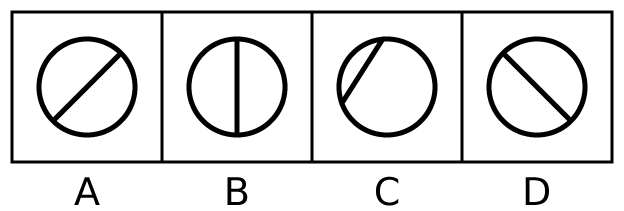
To solve this problem, we need to identify the pattern or characteristic that is common among most of the figures and find the one that does not fit this pattern.
Correct Option: A) Option A does not belong to the group because its diagonal line orientation is different from the symmetry or pattern seen in the other options.
How many triangles are present in the following figure?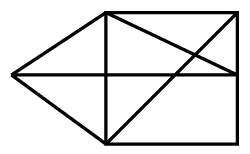
To find the number of triangles in the given figure, we need to identify all possible combinations of lines that form triangles. This involves analyzing the intersections and connections between lines.
Correct Option: C) 15
The question asks about the founders of the first city of Delhi, named Indraprastha. This requires knowledge of ancient Indian history, specifically the epic Mahabharata, which describes the establishment of this city.
Therefore, the Pandavas are credited with founding Indraprastha, the first city of Delhi.
Correct Option: A) Pandavas
The angle of depression of the foot of a building from the top of a tower 30 m away is 30°. How high is the tower?
This problem involves trigonometry, specifically the concept of angles of depression. We are given the angle of depression from the top of a tower to the foot of a building and the horizontal distance between the tower and the building. We need to find the height of the tower. We can form a right-angled triangle and use the tangent function.
Correct Option: C) \(10\sqrt{3}\) m
This is an analogy question based on letter series. We need to find the relationship between the first pair of letters (DWT : GZW) and apply the same logic to the second pair (QPM : ______). The relationship usually involves a consistent pattern of letter shifts (addition or subtraction of positions in the alphabet).
A) TSP is the correct answer because applying a \(+3\) shift to each letter of QPM results in TSP.
To find X's rank from the bottom, we can use a standard formula that relates the total number of students, the rank from the top, and the rank from the bottom. This formula helps to account for the person (X) being counted once in both rankings.
The formula to find the rank from the bottom when the total number of students and rank from the top are known is:
\[ \text{Rank from bottom} = (\text{Total number of students} - \text{Rank from top}) + 1 \]So, X's rank from the bottom is 5.
B) 5 — This is the correct calculation using the formula. The logic is that if X is 12th from the top in a class of 16, there are \(16 - 12 = 4\) students below X. Therefore, X's rank from the bottom is \(4 + 1 = 5\).
Tapan, Ravi and Trisha shared a cake. Tapan had \(\frac{1}{4}\) of it, Trisha had \(\frac{2}{3}\) of it and Ravi had the rest. What was Ravi's share of the cake?
\(\frac{1}{12}\)
\(\frac{4}{7}\)
\(\frac{2}{6}\)
\(\frac{1}{6}\)
To find Ravi's share of the cake, we first need to determine the total share of the cake eaten by Tapan and Trisha. Since the total cake is represented by 1, we can subtract the combined share of Tapan and Trisha from 1 to find Ravi's share.
To add fractions, we need a common denominator. The least common multiple (LCM) of 4 and 3 is 12.
\[ \text{Tapan's share} + \text{Trisha's share} = \frac{1}{4} + \frac{2}{3} \]Convert the fractions to have a denominator of 12:
\[ \frac{1 \times 3}{4 \times 3} + \frac{2 \times 4}{3 \times 4} = \frac{3}{12} + \frac{8}{12} \]Add the fractions:
\[ \frac{3 + 8}{12} = \frac{11}{12} \]So, Tapan and Trisha together had \(\frac{11}{12}\) of the cake.
The total cake is represented by 1 (or \(\frac{12}{12}\)). Ravi had the rest of the cake. So, we subtract the combined share of Tapan and Trisha from the total cake:
\[ \text{Ravi's share} = 1 - \left( \text{Tapan's share} + \text{Trisha's share} \right) \] \[ \text{Ravi's share} = 1 - \frac{11}{12} \]Convert 1 to a fraction with a denominator of 12:
\[ \text{Ravi's share} = \frac{12}{12} - \frac{11}{12} \]Subtract the fractions:
\[ \text{Ravi's share} = \frac{12 - 11}{12} = \frac{1}{12} \]Correct Option: A) Ravi's share of the cake was \(\frac{1}{12}\).