
To solve this problem, we need to first calculate Raghav's total score. Then, we need to determine Zubeida's current total score. To match Raghav's performance, Zubeida's final average across all 12 tests must be at least 24. We will calculate the total score Zubeida needs and then distribute the remaining required score among the three tests to find the minimum score needed in any one test, assuming she scores the maximum possible in the other two.
Calculate Raghav's total score:
Raghav's average score in 12 tests is 24.
\[ \text{Raghav's Total Score} = \text{Average Score} \times \text{Number of Tests} \] \[ \text{Raghav's Total Score} = 24 \times 12 = 288 \]Calculate Zubeida's current total score:
Zubeida's average score in 9 tests is 23.
\[ \text{Zubeida's Current Total Score} = \text{Average Score} \times \text{Number of Tests} \] \[ \text{Zubeida's Current Total Score} = 23 \times 9 = 207 \]Calculate the total score Zubeida needs to match Raghav's average:
To match Raghav's performance, Zubeida must also achieve an average of 24 across all 12 tests. So, her total score in 12 tests must be:
\[ \text{Zubeida's Target Total Score} = 24 \times 12 = 288 \]Calculate the remaining score Zubeida needs in the last 3 tests:
\[ \text{Score Needed} = \text{Target Total Score} - \text{Current Total Score} \] \[ \text{Score Needed} = 288 - 207 = 81 \]Zubeida needs to score a total of 81 marks in the remaining 3 tests.
Determine the minimum score in one test:
Each test is out of 30 marks. To find the minimum score Zubeida must get in any one of the remaining three tests, she should maximize her scores in the other two tests. The maximum score she can get in one test is 30.
So, in the other two tests, she can score a maximum of:
\[ \text{Maximum Score in 2 Tests} = 30 \times 2 = 60 \]The minimum score she must get in the third test (the one in question) is:
\[ \text{Minimum Score in One Test} = \text{Score Needed} - \text{Maximum Score in 2 Tests} \] \[ \text{Minimum Score in One Test} = 81 - 60 = 21 \]Therefore, Zubeida must score at least 21 in one of the remaining tests to have a chance to match Raghav's performance.
Correct Option: B) 21
To solve this direction-based problem, we need to track the net angular displacement from the initial direction. We will sum up all clockwise turns and all anticlockwise turns separately, then find the difference to determine the final net turn and its direction.
C) East is the correct direction Aishwarya is facing now.
This problem involves calculating simple interest. Simple interest is calculated on the principal amount only. The formula for simple interest is given by \(I = \frac{P \times R \times T}{100}\), where \(P\) is the principal amount, \(R\) is the annual interest rate, and \(T\) is the time in years.
The formula for simple interest is:
\[ I = \frac{P \times R \times T}{100} \]The interest earned will be Rs. 240.
Correct Option: D) Rs. 240 is the correct amount of interest Rahi will earn.
Choose the correct figure from the answer figures that replaces the question mark.
Problem Figure: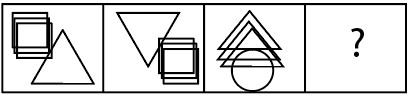
Answer Figures: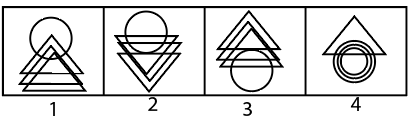
The problem involves identifying a pattern among a series of figures and selecting the correct figure that logically follows the sequence. Each figure contains geometric shapes arranged in a specific manner.
Correct Option: A) Figure 1 matches the pattern by combining circles and triangles, following the sequence's logic.
At 8% simple interest per annum a sum of money becomes Rs. 300 in 2 \( \frac{1}{2} \) years. What was the sum invested?
This problem involves simple interest. We are given the amount (principal + interest), the rate of interest, and the time period. We need to find the principal sum invested. We will use the formula for simple interest and the formula for the amount.
Identify the given values:
Recall the formula for Simple Interest (SI):
\[ SI = \frac{P \times R \times T}{100} \]Where \(P\) is the Principal sum.
Recall the formula for Amount (A):
\[ A = P + SI \]Substitute the SI formula into the Amount formula:
\[ A = P + \frac{P \times R \times T}{100} \]Factor out \(P\):
\[ A = P \left(1 + \frac{R \times T}{100}\right) \]Substitute the given values into the formula:
\[ 300 = P \left(1 + \frac{8 \times 2.5}{100}\right) \]Calculate the term inside the parenthesis:
\[ 8 \times 2.5 = 20 \] \[ \frac{20}{100} = 0.20 \] \[ 1 + 0.20 = 1.20 \]Solve for P:
\[ 300 = P \times 1.20 \] \[ P = \frac{300}{1.20} \] \[ P = \frac{300}{\frac{120}{100}} \] \[ P = \frac{300 \times 100}{120} \] \[ P = \frac{30000}{120} \] \[ P = \frac{3000}{12} \] \[ P = 250 \]So, the sum invested was Rs. 250.
Correct Option: D) Rs. 250
From the top of a platform, the angle of elevation of a tower was 30°. The tower was 45 m high and the horizontal distance between the platform and the tower was 40\(\sqrt{3}\) m. What was the height of the platform?
This problem involves trigonometry, specifically the tangent function, to relate angles of elevation, heights, and horizontal distances. We will use the given angle of elevation, the horizontal distance, and the total height of the tower to find the height of the platform.
Correct Option: B) 5 m
The question asks to identify the element that replaced eka-Aluminium in Mendeleev's Periodic Table. This requires knowledge of Mendeleev's predictions and the elements later discovered that matched those predictions.
C) Gallium is the element that replaced eka-Aluminium in Mendeleev's Periodic Table, as its properties closely matched Mendeleev's predictions.
This is a work and time problem. We need to find the individual work rate of B. We can solve this by setting up equations based on the given information about combined work rates and then solving for B's individual rate.
Let the work rates of A, B, and C be \(R_A\), \(R_B\), and \(R_C\) respectively. The work rate is the fraction of the task completed per day.
From the first statement, A, B, and C together complete the task in 10 days. So, their combined work rate is:
\[ R_A + R_B + R_C = \frac{1}{10} \quad \text{(Equation 1)} \]From the second statement, A and B together complete the task in 12 days. So, their combined work rate is:
\[ R_A + R_B = \frac{1}{12} \quad \text{(Equation 2)} \]From the third statement, B and C together complete the task in 20 days. So, their combined work rate is:
\[ R_B + R_C = \frac{1}{20} \quad \text{(Equation 3)} \]Substitute Equation 2 into Equation 1 to find \(R_C\):
\[ \frac{1}{12} + R_C = \frac{1}{10} \]\[ R_C = \frac{1}{10} - \frac{1}{12} \]\[ R_C = \frac{6 - 5}{60} \]\[ R_C = \frac{1}{60} \]Now substitute the value of \(R_C\) into Equation 3 to find \(R_B\):
\[ R_B + \frac{1}{60} = \frac{1}{20} \]\[ R_B = \frac{1}{20} - \frac{1}{60} \]\[ R_B = \frac{3 - 1}{60} \]\[ R_B = \frac{2}{60} \]\[ R_B = \frac{1}{30} \]The work rate of B is \( \frac{1}{30} \) of the task per day. This means B alone would take 30 days to complete the task.
A) 30
The calculation shows that B's individual work rate is 1/30 of the task per day, meaning B would take 30 days to complete the task alone.
Choose the correct water image of the given figure.
Problem Figure:
Answer Figures: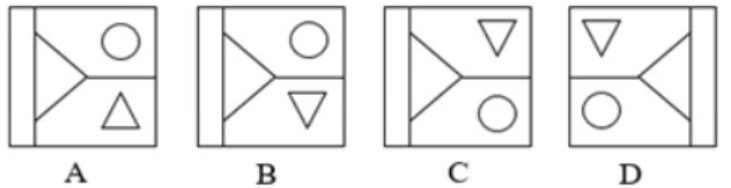
To find the correct water image of a given figure, we need to visualize how the figure would appear if reflected over a horizontal axis, as if mirrored by water.
Option C matches these criteria: the triangle is at the bottom with the apex pointing downwards, and the circle is at the top.
Correct Option: C) The triangle and circle swap positions, and the triangle's orientation inverts correctly.
The question asks to identify the stage of mitosis where chromosomes align at the equatorial plate. This requires knowledge of the distinct events occurring in each phase of mitosis.
Based on these events, the alignment of chromosomes at the equatorial plate is characteristic of metaphase.
A) Metaphase — In metaphase, the chromosomes line up precisely at the center of the cell, forming the metaphase plate or equatorial plate. This is a defining event of this stage.