The area of the base of a cone is 64π cm2 while its slant height is 17 cm. This cone is remoulded to obtain a solid sphere. The radius of this sphere will be:
2 \(\sqrt[3]{30}\) cm
8 \(\sqrt[3]{30}\) cm
6.5 cm
2 \(\sqrt[3]{40}\) cm
When a solid object is remoulded into another shape, its volume remains constant. Therefore, we need to calculate the volume of the cone first. From the given area of the base and slant height, we can find the radius and height of the cone. Once the volume of the cone is known, we equate it to the volume of a sphere to find the radius of the sphere.
Find the radius of the cone:
The area of the base of a cone is given by the formula \(A = \pi r^2\), where \(r\) is the radius of the base.
Given area of the base \( = 64\pi \text{ cm}^2\).
So, \( \pi r^2 = 64\pi \text{ cm}^2 \).
Dividing by \( \pi \) on both sides, we get:
\( r^2 = 64 \text{ cm}^2 \)
\( r = \sqrt{64} \text{ cm} \)
\( r = 8 \text{ cm} \)
Find the height of the cone:
The relationship between the radius (\(r\)), height (\(h\)), and slant height (\(l\)) of a cone is given by the Pythagorean theorem: \(l^2 = r^2 + h^2\).
Given slant height \(l = 17 \text{ cm}\) and we found \(r = 8 \text{ cm}\).
So, \( 17^2 = 8^2 + h^2 \)
\( 289 = 64 + h^2 \)
\( h^2 = 289 - 64 \)
\( h^2 = 225 \)
\( h = \sqrt{225} \text{ cm} \)
\( h = 15 \text{ cm} \)
Calculate the volume of the cone:
The volume of a cone is given by the formula \(V_{\text{cone}} = \frac{1}{3} \pi r^2 h\).
Substituting the values \(r = 8 \text{ cm}\) and \(h = 15 \text{ cm}\):
\[ V_{\text{cone}} = \frac{1}{3} \pi (8 \text{ cm})^2 (15 \text{ cm}) \]
\[ V_{\text{cone}} = \frac{1}{3} \pi (64 \text{ cm}^2) (15 \text{ cm}) \]
\[ V_{\text{cone}} = \pi (64 \text{ cm}^2) \left(\frac{15}{3}\right) \text{ cm} \]
\[ V_{\text{cone}} = \pi (64 \text{ cm}^2) (5 \text{ cm}) \]
\[ V_{\text{cone}} = 320\pi \text{ cm}^3 \]
Equate the volume of the cone to the volume of the sphere:
When the cone is remoulded into a solid sphere, their volumes are equal.
Let \(R\) be the radius of the sphere.
The volume of a sphere is given by the formula \(V_{\text{sphere}} = \frac{4}{3} \pi R^3\).
So, \(V_{\text{sphere}} = V_{\text{cone}}\)
\[ \frac{4}{3} \pi R^3 = 320\pi \text{ cm}^3 \]
Divide both sides by \( \pi \):
\[ \frac{4}{3} R^3 = 320 \text{ cm}^3 \]
Multiply both sides by \( \frac{3}{4} \):
\[ R^3 = 320 \times \frac{3}{4} \text{ cm}^3 \]
\[ R^3 = 80 \times 3 \text{ cm}^3 \]
\[ R^3 = 240 \text{ cm}^3 \]
To find \(R\), take the cube root of 240:
\[ R = \sqrt[3]{240} \text{ cm} \]
We need to simplify \( \sqrt[3]{240} \). Find the prime factors of 240:
\( 240 = 24 \times 10 = (8 \times 3) \times (2 \times 5) = (2^3 \times 3) \times (2 \times 5) = 2^4 \times 3 \times 5 \)
\[ R = \sqrt[3]{2^3 \times 2 \times 3 \times 5} \text{ cm} \]
\[ R = 2 \sqrt[3]{2 \times 3 \times 5} \text{ cm} \]
\[ R = 2 \sqrt[3]{30} \text{ cm} \]
Correct Option: A) \(2 \sqrt[3]{30}\) cm
The question asks to identify the first Indian cricketer to score a century in his debut One Day International (ODI) match, specifically mentioning that this feat occurred in 2016. We need to recall significant cricketing milestones and debut performances from that period.
Correct Option: C) K.L. Rahul scored an unbeaten 100 runs against Zimbabwe in his debut ODI match on June 11, 2016, in Harare. This historic knock made him the first Indian player to score a century on ODI debut.
The question asks about the general nature of non-metal oxides. We need to recall the chemical properties of oxides formed by non-metals.
Correct Option: A) acidic. Non-metal oxides are typically acidic in nature. They react with water to form acids and with bases to form salt and water.
Assuming that the numbers in each of the following figures follow a similar pattern, select the option that can replace the question mark (?) in figure C.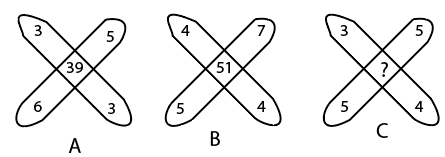
The problem involves identifying a pattern in the given figures to determine the missing number in Figure C. Each figure contains numbers arranged in a similar pattern, and the goal is to find the rule that applies to all of them.
Correct Option: B) 37
The question asks about the percentage contribution of the Services Sector to India's GDP as per the Economic Survey 2017-18. This requires knowledge of the sectoral composition of India's GDP during that period, which is a common topic in economic surveys and competitive exams.
Correct Option: C) Greater than 50%
As per the Economic Survey 2017-18, the Services Sector's contribution to India's GDP was consistently above 50%, estimated to be around 53-54% for that financial year. This makes "Greater than 50%" the correct range.
The question asks to identify the Indian state known as the "Spice Garden of India". This is a common geographical and agricultural fact often tested in competitive exams. The approach is to recall the primary agricultural products and historical significance of each state listed in the options.
Kerala, a state in the southern part of India, has a long history of spice cultivation and trade. Its favorable climate and fertile soil are ideal for growing a wide variety of spices like black pepper, cardamom, cinnamon, cloves, nutmeg, and ginger. Historically, it was a major center for spice trade, attracting traders from across the globe, which earned it the title "Spice Garden of India".
Correct Option: D) Kerala — Kerala is famously known as the "Spice Garden of India" due to its extensive cultivation of various spices and its historical significance in the global spice trade.
The percentage of carbon in CO2 is:
To find the percentage of carbon in CO₂, we need to calculate the molar mass of carbon and the molar mass of carbon dioxide. Then, we divide the mass of carbon by the total molar mass of CO₂ and multiply by 100.
Correct Option: B) 27.3
This question asks us to identify implicit assumptions based on a given argument. An implicit assumption is something that is not stated directly but must be true for the argument to make sense or be logically valid. We need to evaluate each assumption to see if it is a necessary underlying belief for the highway authority's announcement.
D) Only assumption 1 is implicit. The announcement of road repair work inherently implies that travelers will need to adjust their plans. Assumption 2 introduces an opinion about the necessity of the work and the authority's intent, which cannot be inferred from the simple statement of repair work.
This question tests the understanding of uniform circular motion. In uniform circular motion, an object moves in a circular path at a constant speed. We need to identify which physical quantity associated with the object changes during this motion.
Correct Option: C) Direction. In uniform circular motion, the speed of the body is constant, but its direction of motion continuously changes as it moves along the circular path. This continuous change in direction implies a change in velocity, even if the speed is constant. The force causing this change in direction is the centripetal force, which acts towards the center of the circle.
Select the correct mirror image of the given figure if the mirror is placed horizontally as shown.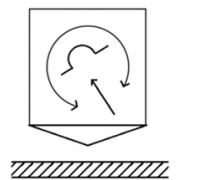
To find the correct mirror image of a figure when the mirror is placed horizontally, we need to reflect the elements vertically across the horizontal axis.
Correct Option: D) The mirror image correctly reflects the original figure horizontally. The arrow pointing towards the center now points upwards, and the curved arrows have flipped correctly.