
The volume of a right circular cone, whose radius of the base is half of its altitude, and the volume of a hemisphere are equal. The ratio of the radius of the cone to the radius of the hemisphere is:
To solve this problem, we need to use the formulas for the volume of a right circular cone and a hemisphere. We will set up equations based on the given conditions: the radius of the cone's base is half its altitude, and the volumes of the cone and hemisphere are equal. Then, we will find the ratio of their radii.
Define variables for the cone:
Let \(r_c\) be the radius of the base of the cone.
Let \(h_c\) be the altitude (height) of the cone.
Define variables for the hemisphere:
Let \(r_h\) be the radius of the hemisphere.
Write down the given condition for the cone:
The radius of the base of the cone is half of its altitude. So,
Write down the formula for the volume of a cone (\(V_c\)):
\[ V_c = \frac{1}{3} \pi r_c^2 h_c \]Substitute \(h_c = 2r_c\) into the volume of the cone formula:
\[ V_c = \frac{1}{3} \pi r_c^2 (2r_c) = \frac{2}{3} \pi r_c^3 \]Write down the formula for the volume of a hemisphere (\(V_h\)):
\[ V_h = \frac{2}{3} \pi r_h^3 \]Use the condition that the volumes are equal (\(V_c = V_h\)):
\[ \frac{2}{3} \pi r_c^3 = \frac{2}{3} \pi r_h^3 \]Simplify the equation:
Divide both sides by \(\frac{2}{3} \pi\):
Solve for the ratio of the radii:
Taking the cube root of both sides:
Therefore, the ratio of the radius of the cone to the radius of the hemisphere is:
\[ \frac{r_c}{r_h} = \frac{1}{1} \]So, the ratio is \(1 : 1\).
Correct Option: B) 1 : 1
Select the figure which does NOT belong to the group.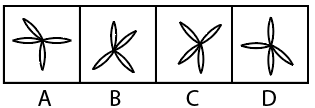
To solve this problem, we need to identify the pattern or characteristic that is common among three of the figures and find the one that does not fit.
Figures A, C, and D have a similar orientation pattern, where two figures (A and C) have horizontal and vertical alignment, and figure D has diagonal alignment like figure B.
Figure C stands out because it repeats the horizontal and vertical alignment, making it the odd one out in terms of the overall pattern.
Correct Option: C) Figure C does not belong to the group because it repeats the orientation pattern of figure A, making it inconsistent with the alternating pattern.
To determine the components of common salt (NaCl), we need to identify the acid and base from which it is formed. Salts are typically formed from the neutralization reaction between an acid and a base. We will identify the parent acid and base for NaCl and classify them as strong or weak.
Correct Option: D) Common salt (NaCl) is made up of a strong acid (Hydrochloric Acid, HCl) and a strong base (Sodium Hydroxide, NaOH).
The question asks about the normal pH range within which the human body functions. This is a fundamental concept in biology and chemistry, particularly important for understanding physiological processes.
Correct Option: C) 7.0 to 7.8
This range accurately reflects the slightly alkaline nature of the human body's internal environment. While the ideal blood pH is even narrower (7.35-7.45), a functional range of 7.0 to 7.8 covers the general physiological tolerance for various body fluids and tissues, with blood being the most critical at 7.35-7.45. A pH of 7.0 is neutral, and the body can tolerate slight fluctuations around the neutral point, leaning towards slightly basic.
To find the displacement after 7 seconds, we first need to determine the initial velocity of the ball and the time it takes to reach its maximum height and return to the starting point. Then, we can calculate its position at 7 seconds.
Calculate the initial velocity (\(u\)):
The ball rises to a maximum height \(h = 80 \text{ m}\). At the maximum height, its final velocity \(v = 0 \text{ m/s}\). We can use the kinematic equation:
Here, \(a = -g = -10 \text{ m/s}^2\) (since gravity acts downwards). So,
\[ 0^2 = u^2 + 2(-10)(80) \]\[ 0 = u^2 - 1600 \]\[ u^2 = 1600 \]\[ u = \sqrt{1600} = 40 \text{ m/s} \]Calculate the time to reach maximum height (\(t_h\)):
Using the kinematic equation:
Here, \(v = 0\), \(u = 40 \text{ m/s}\), \(a = -10 \text{ m/s}^2\). So,
\[ 0 = 40 + (-10)t_h \]\[ 10t_h = 40 \]\[ t_h = 4 \text{ s} \]Determine the position at 7 seconds:
The ball takes 4 seconds to go up and 4 seconds to come down to its original position. So, after \(4 + 4 = 8 \text{ s}\), the ball returns to its starting point, and its displacement would be 0.
We need to find the displacement at \(t = 7 \text{ s}\). Since \(7 \text{ s} < 8 \text{ s}\), the ball is on its way down but has not yet reached the starting point. The time elapsed after reaching the maximum height is \(7 \text{ s} - 4 \text{ s} = 3 \text{ s}\).
Now, we calculate the distance fallen from the maximum height in these 3 seconds. For this downward motion, the initial velocity is \(u' = 0 \text{ m/s}\) (at maximum height), acceleration is \(a' = g = 10 \text{ m/s}^2\), and time is \(t' = 3 \text{ s}\). We use the equation:
\[ s' = u't' + \frac{1}{2}a'(t')^2 \]\[ s' = (0)(3) + \frac{1}{2}(10)(3)^2 \]\[ s' = 0 + \frac{1}{2}(10)(9) \]\[ s' = 5 \times 9 \]\[ s' = 45 \text{ m} \]This \(s'\) is the distance the ball has fallen from its maximum height of 80 m. Therefore, its position from the ground (original position) is:
\[ \text{Displacement} = \text{Maximum height} - s' \]\[ \text{Displacement} = 80 \text{ m} - 45 \text{ m} \]\[ \text{Displacement} = 35 \text{ m} \]Since the ball is above the original position, the displacement is positive.
A) 35 m is the correct displacement after 7 seconds.
The question asks for an essential component that a school must always possess. We need to identify the core element without which a place cannot function or be recognized as a school.
Correct Option: B) Teacher
A school's fundamental purpose is education, which is facilitated by teaching. Without a teacher, the core function of a school (imparting knowledge and guiding students) cannot be fulfilled. Even in informal or unconventional settings, the presence of an instructor or guide is what makes it a learning environment, hence a 'school' in its most basic sense.
The problem presents a pair of letter clusters (BFK : IMR) and asks us to find a similar relationship for another cluster (DGP). This is a letter analogy problem where we need to identify the pattern or rule applied to transform the first cluster into the second, and then apply the same rule to the third cluster to find the missing term.
B) KNW is the correct answer because applying the +7 shift rule to each letter of DGP results in KNW.
This problem can be solved using the Remainder Theorem. The Remainder Theorem states that if a polynomial \(P(x)\) is divided by \((x - c)\), the remainder is \(P(c)\). We will apply this theorem to both given polynomial division scenarios to form a system of two linear equations in terms of \(a\) and \(b\), and then solve for \(a+b\).
Apply Remainder Theorem to the first polynomial:
The first polynomial is \(P_1(x) = x^2 + ax + b\). When divided by \((x - 3)\), the remainder is 22.
According to the Remainder Theorem, \(P_1(3) = 22\).
\[ 3^2 + a(3) + b = 22 \]\[ 9 + 3a + b = 22 \]\[ 3a + b = 22 - 9 \]\[ 3a + b = 13 \quad \text{(Equation 1)} \]Apply Remainder Theorem to the second polynomial:
The second polynomial is \(P_2(x) = x^2 + bx + a\). When divided by \((x - 3)\), the remainder is 24.
According to the Remainder Theorem, \(P_2(3) = 24\).
\[ 3^2 + b(3) + a = 24 \]\[ 9 + 3b + a = 24 \]\[ a + 3b = 24 - 9 \]\[ a + 3b = 15 \quad \text{(Equation 2)} \]Solve the system of equations for \(a+b\):
We have two linear equations:
Equation 1: \(3a + b = 13\)
Equation 2: \(a + 3b = 15\)
To find \(a+b\), we can add Equation 1 and Equation 2:
\[ (3a + b) + (a + 3b) = 13 + 15 \]\[ 4a + 4b = 28 \]Find the value of \(a+b\):
Divide both sides of the equation \(4a + 4b = 28\) by 4:
A) 7 is the correct answer, as derived from solving the system of equations.
This question asks us to identify implicit assumptions behind a given argument. An assumption is something taken for granted or supposed to be true without proof. For an assumption to be implicit, it must be a necessary condition for the argument to make sense or be stated. We need to analyze each assumption in relation to the argument.
B) Both 1 and 2 are implicit. Assumption 1 is implicit because instructions are usually given to address a problem or ensure compliance where it might be lacking. Assumption 2 is implicit because the very act of giving an instruction implies an expectation that it will be followed by the recipients.
This problem involves setting up and solving a system of linear equations based on the given age relationships. We will use variables to represent the current ages of the father and son, form equations from the given conditions, solve for their present ages, and then calculate the son's age after 6 years.
Define variables for present ages:
Let the present age of the father be \(F\) years.
Let the present age of the son be \(S\) years.
Formulate the first equation:
The sum of their present ages is 60 years.
\[ F + S = 60 \quad \text{(Equation 1)} \]
Formulate the second equation based on past ages:
Six years ago:
According to the problem, six years ago, father's age was five times the age of the son.
\[ F - 6 = 5(S - 6) \]
Expand and simplify this equation:
\[ F - 6 = 5S - 30 \]
\[ F = 5S - 30 + 6 \]
\[ F = 5S - 24 \quad \text{(Equation 2)} \]
Solve the system of equations:
Substitute Equation 2 into Equation 1:
\[ (5S - 24) + S = 60 \]
\[ 6S - 24 = 60 \]
\[ 6S = 60 + 24 \]
\[ 6S = 84 \]
\[ S = \frac{84}{6} \]
\[ S = 14 \text{ years} \]
So, the present age of the son is 14 years.
Calculate the son's age after 6 years:
The question asks for the son's age after 6 years from the present.
Son's age after 6 years \( = S + 6 \)
\[ = 14 + 6 \]
\[ = 20 \text{ years} \]
B) 20 years. Based on our calculations, the son's present age is 14 years, and therefore, his age after 6 years will be 20 years.