
The question asks to identify one of the saltiest lakes in the world from the given options. This requires knowledge of the salinity levels of major water bodies.
B) Dead Sea. The Dead Sea is renowned for its exceptionally high salinity, making it one of the saltiest lakes globally. Its high salt content is due to its endorheic nature (no outlet) and high evaporation rates.
If two coulombs of charge flow through any cross-section of a conductor in one second, what will be the current flowing through it?
\( \frac{1}{2} \) Ampere
2 Amperes
\( \frac{1}{4} \) Ampere
1 Ampere
The problem asks us to calculate the electric current flowing through a conductor given the amount of charge that passes through its cross-section and the time taken. We will use the fundamental definition of electric current to solve this problem.
Thus, the current flowing through the conductor is 2 Amperes.
B) 2 Amperes — This is the correct calculation based on the definition of electric current.
The question asks to identify the carriers of hereditary material. This requires understanding the basic units and mechanisms of heredity in biology.
Therefore, genes are the direct carriers of hereditary material.
D) Genes — Genes are specific sequences of DNA that carry the genetic information from one generation to the next. They are the functional units of heredity.
This is a syllogism problem. We need to evaluate the given conclusions based on the provided statements. We can use Venn diagrams or logical deduction to determine if the conclusions logically follow.
C) Both conclusions 1 and 2 follow.
To determine for how many positive integers 'n' the given expression \(n^3 - 8n^2 + 20n - 13\) is a prime number, we first try to factorize the polynomial. We can test integer roots using the Rational Root Theorem, looking for divisors of the constant term \(-13\).
Let the given polynomial be \(P(n) = n^3 - 8n^2 + 20n - 13\). We look for integer roots that are divisors of \(-13\), which are \(\pm 1, \pm 13\).
Test \(n = 1\):
\[ P(1) = (1)^3 - 8(1)^2 + 20(1) - 13 = 1 - 8 + 20 - 13 = 21 - 21 = 0 \]Since \(P(1) = 0\), \((n-1)\) is a factor of \(P(n)\).
Perform polynomial division or synthetic division to divide \(P(n)\) by \((n-1)\):
Using synthetic division with root 1:
1 | 1  -8   20  -13
  |    1   -7   13
  -----------------
    1  -7   13    0
So, \(P(n) = (n-1)(n^2 - 7n + 13)\).
For \(P(n)\) to be a prime number, one of the following conditions must be met:
Case 1: \(n-1 = 1\)
If \(n-1 = 1\), then \(n = 2\).
Substitute \(n=2\) into the second factor:
\[ n^2 - 7n + 13 = (2)^2 - 7(2) + 13 = 4 - 14 + 13 = 3 \]In this case, \(P(2) = (1)(3) = 3\), which is a prime number. So, \(n=2\) is a solution.
Case 2: \(n^2 - 7n + 13 = 1\)
If \(n^2 - 7n + 13 = 1\), then \(n^2 - 7n + 12 = 0\).
Factor this quadratic equation: \((n-3)(n-4) = 0\).
This gives \(n=3\) or \(n=4\).
Case 3: \(n-1 = -1\)
If \(n-1 = -1\), then \(n = 0\).
However, the question asks for positive integers 'n', so \(n=0\) is not a valid solution.
Case 4: \(n^2 - 7n + 13 = -1\)
If \(n^2 - 7n + 13 = -1\), then \(n^2 - 7n + 14 = 0\).
Calculate the discriminant \(\Delta = b^2 - 4ac\):
\[ \Delta = (-7)^2 - 4(1)(14) = 49 - 56 = -7 \]Since the discriminant is negative, there are no real solutions for \(n\), and thus no integer solutions.
We need to check if any other values of \(n\) result in \(P(n)\) being prime. If both factors \( (n-1) \) and \( (n^2 - 7n + 13) \) are positive and greater than 1, then \( P(n) \) would be a composite number (product of two integers greater than 1).
For \(n=1\), \(P(1)=0\), which is not prime.
For \(n=2\), \(P(2)=3\) (prime).
For \(n=3\), \(P(3)=2\) (prime).
For \(n=4\), \(P(4)=3\) (prime).
For \(n=5\):
\[ n-1 = 5-1 = 4 \]\[ n^2 - 7n + 13 = 5^2 - 7(5) + 13 = 25 - 35 + 13 = 3 \]\[ P(5) = (4)(3) = 12 \]which is not prime.
For \(n=6\):
\[ n-1 = 6-1 = 5 \]\[ n^2 - 7n + 13 = 6^2 - 7(6) + 13 = 36 - 42 + 13 = 7 \]\[ P(6) = (5)(7) = 35 \]which is not prime.
For \(n=7\):
\[ n-1 = 7-1 = 6 \]\[ n^2 - 7n + 13 = 7^2 - 7(7) + 13 = 49 - 49 + 13 = 13 \]\[ P(7) = (6)(13) = 78 \]which is not prime.
For \(n > 4\), both factors \( (n-1) \) and \( (n^2 - 7n + 13) \) will be greater than 1. Specifically, for \(n \ge 5\), \(n-1 \ge 4\). For \(n^2 - 7n + 13\), its minimum value occurs at \(n = -(-7)/(2*1) = 3.5\). At \(n=3.5\), \( (3.5)^2 - 7(3.5) + 13 = 12.25 - 24.5 + 13 = 0.75 \). For integer values, the minimum is at \(n=3\) or \(n=4\), where it is 1. For \(n \ge 5\), \(n^2 - 7n + 13\) will be greater than 1. (e.g., at \(n=5\), it's 3; at \(n=6\), it's 7; at \(n=7\), it's 13). Since both factors are greater than 1 for \(n \ge 5\), \(P(n)\) will be a composite number.
Therefore, the positive integers 'n' for which \(P(n)\) is a prime number are \(n=2, 3, 4\).
There are 3 such positive integers.
Correct Option: D) 3
Select the figure that does NOT belong in the following group. 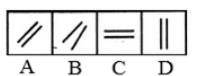
The task is to identify the figure that does not belong with the others based on a pattern or characteristic shared by the majority.
Correct Option: C) Figure C does not belong because its lines are horizontal, unlike the slanted or vertical lines in the other figures.
To find the missing number in the series, we need to identify the pattern or rule governing the sequence of numbers. We will look for arithmetic progressions, alternating patterns, or other mathematical relationships between consecutive or alternate terms.
Correct Option: A) 21
10 people can build a wall in 12 days. Six people, each only half as efficient as those in the first group, will be able to complete \( \frac{3}{5} \) of such a wall in:
This problem involves the concept of work, efficiency, and time. We need to determine the total work units, then calculate the efficiency of the second group of people, and finally find the time required to complete a fraction of the wall.
Calculate the total work units for the first group:
Let the efficiency of one person in the first group be \(E_1\). The total work done is the product of the number of people, their efficiency, and the number of days.
\[ \text{Total Work} = \text{Number of People} \times \text{Efficiency per Person} \times \text{Number of Days} \]Given: 10 people, 12 days. Let's assume the efficiency of one person in the first group is 1 unit of work per day.
\[ \text{Total Work} = 10 \times 1 \times 12 = 120 \text{ units} \]This 120 units represents the work required to build one full wall.
Determine the efficiency of the second group:
The people in the second group are half as efficient as those in the first group. So, the efficiency of one person in the second group, \(E_2\), is:
\[ E_2 = \frac{1}{2} \times E_1 = \frac{1}{2} \times 1 = 0.5 \text{ units per day} \]Calculate the total work rate of the second group:
There are 6 people in the second group. Their combined work rate is:
\[ \text{Work Rate of Second Group} = 6 \times E_2 = 6 \times 0.5 = 3 \text{ units per day} \]Calculate the work to be completed by the second group:
The second group needs to complete \( \frac{3}{5} \) of such a wall. The total work for one wall is 120 units.
\[ \text{Work to be Completed} = \frac{3}{5} \times 120 = 3 \times 24 = 72 \text{ units} \]Calculate the time taken by the second group:
Time taken is the work to be completed divided by the work rate.
\[ \text{Time} = \frac{\text{Work to be Completed}}{\text{Work Rate of Second Group}} = \frac{72}{3} = 24 \text{ days} \]A) 24 days is the correct answer, as calculated in the step-by-step solution.
Select the image that will correctly fit in the blank space of the following figure.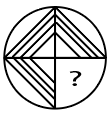
The problem is to identify the correct piece that fits into the blank space in the given circular diagram. The solution involves analyzing the pattern and orientation of lines in the existing parts of the circle and matching them with the options provided.
Correct Option: A) The pattern of diagonal lines in Option A matches the existing pattern in the circle, completing the symmetry.
To determine which element forms a basic oxide, we need to recall the general trend of oxide acidity/basicity across the periodic table. Metals typically form basic oxides, while non-metals form acidic oxides. Metalloids can form amphoteric oxides. The atomic number helps identify the element and its metallic or non-metallic character.
Correct Option: B) 20


