
To determine the conditions for a quadratic equation to have two distinct real solutions, we need to analyze its discriminant. For a quadratic equation of the form \(ax^2 + bx + c = 0\), the discriminant is given by \(\Delta = b^2 - 4ac\). For two distinct real solutions, the discriminant must be strictly greater than zero (\(\Delta > 0\)).
Identify the coefficients:
The given quadratic equation is \(x^2 + kx + k = 0\).
Comparing this with the standard form \(ax^2 + bx + c = 0\), we can identify the coefficients:
Calculate the discriminant:
The discriminant \(\Delta\) is given by the formula \(b^2 - 4ac\).
Substitute the values of \(a\), \(b\), and \(c\) into the discriminant formula:
\[ \Delta = (k)^2 - 4(1)(k) \]\[ \Delta = k^2 - 4k \]Apply the condition for distinct real solutions:
For a quadratic equation to have two distinct real solutions, the discriminant must be strictly greater than zero (\(\Delta > 0\)).
So, we set up the inequality:
\[ k^2 - 4k > 0 \]Solve the inequality:
Factor out \(k\) from the expression:
\[ k(k - 4) > 0 \]Determine the values of \(k\):
For the product of two terms to be positive, both terms must be positive, or both terms must be negative.
Case 1: Both terms are positive
\(k > 0\) AND \(k - 4 > 0\)
\(k > 0\) AND \(k > 4\)
The intersection of these two conditions is \(k > 4\).
Case 2: Both terms are negative
\(k < 0\) AND \(k - 4 < 0\)
\(k < 0\) AND \(k < 4\)
The intersection of these two conditions is \(k < 0\).
Combining both cases, the value of \(k\) must satisfy \(k < 0\) or \(k > 4\).
A) k < 0 or k > 4
This option correctly represents the solution to the inequality \(k(k-4) > 0\), which ensures that the quadratic equation has two distinct real solutions.
B) 0 < k < 4
This range of \(k\) values would make \(k(k-4) < 0\), meaning the discriminant is negative. A negative discriminant implies that the quadratic equation has two distinct complex (non-real) solutions, not distinct real solutions.
C) k < 0 only
While \(k < 0\) is part of the correct solution, it is not the complete solution. \(k > 4\) also leads to distinct real solutions. Therefore, this option is incomplete.
D) k > 4 only
Similar to option C, while \(k > 4\) is part of the correct solution, it is not the complete solution. \(k < 0\) also leads to distinct real solutions. Therefore, this option is incomplete.
The question asks about a specific record achieved by Ravichandran Ashwin in Test cricket. To answer this, one needs to recall the details of this particular cricketing milestone.
C) 54 — Ravichandran Ashwin reached 300 Test wickets in his 54th Test match, making him the fastest player to achieve this milestone globally.
The question asks to identify the host country of the FIFA U-17 World Cup in 2017. This is a factual question related to sports events and requires knowledge of past major international tournaments.
Correct Option: D) India hosted the FIFA Under 17 (U-17) World Cup in 2017. This was a significant event for Indian football, marking the first time the country hosted a FIFA tournament.
To find the rate of profit, we first need to calculate the profit amount. Profit is the difference between the selling price and the cost price. Once the profit is known, the profit percentage is calculated by dividing the profit by the cost price and multiplying by 100.
The calculated profit percentage is 12.5%, which matches option C.
Select the option that correctly fits in the blank space in the given figure.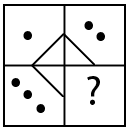
The problem involves identifying the pattern in the given figure and selecting the option that correctly completes the pattern. Each quadrant of the main figure contains a diagonal line and a specific arrangement of dots.
Correct Option: B) The option matches the required pattern with the correct diagonal and dot arrangement.
The question asks to identify an element that has 3 electron shells and 8 electrons in its outermost (last) shell. To solve this, we need to recall the electronic configuration of the given elements and relate it to their position in the periodic table.
C) Ar has an atomic number of 18. Its electronic configuration is \(2, 8, 8\). This means it has 3 electron shells (K, L, M) and the outermost (M) shell contains 8 electrons, fulfilling both conditions of the question.
From the given four figures choose the correct mirror image for the problem figure when the mirror is on AB line.
Problem Figure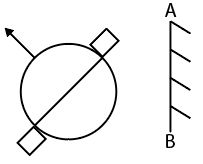
Answer Figures: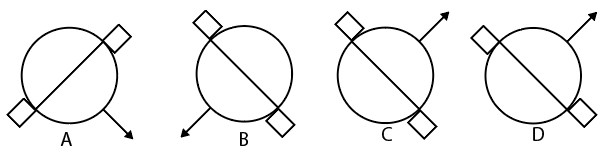
To find the correct mirror image of the problem figure, we need to reflect the figure across the given line AB. This involves reversing the orientation of elements in the figure as if viewed in a mirror placed along the AB line.
Correct Option: D) The mirror image correctly reflects the orientation and placement of the elements.
The problem presents a numerical series and asks us to find the missing number. We need to identify the pattern or rule governing the sequence of numbers.
B) 23 is the correct answer because adding 5 to the last known term (18) gives 23, which follows the established pattern of the series.
The problem asks us to identify letters in a given arrangement that satisfy two conditions: they must be immediately preceded by a number AND NOT immediately followed by a letter. We will scan the arrangement from left to right, checking each letter against these conditions.
B) Two. Based on our step-by-step analysis, there are two letters ('T' and 'O') in the arrangement that meet both specified conditions.
The question refers to Newlands' Law of Octaves, a historical attempt at classifying elements. This law states that when elements are arranged in increasing order of their atomic masses, the properties of every eighth element are similar to those of the first. We need to identify which element the tenth element would resemble based on this pattern.
D) Third — According to Newlands' Law of Octaves, the properties of every eighth element are similar to those of the first. If we consider the sequence of elements, the 1st element's properties are repeated by the 8th element. Similarly, the 2nd element's properties are repeated by the 9th element, and the 3rd element's properties are repeated by the 10th element. Thus, the tenth element resembles the third element.


