
The question asks why a compressed spring has more energy than a spring at its normal length. This involves understanding different forms of energy, particularly how energy is stored in mechanical systems like springs.
A) potential energy — A compressed spring stores energy due to its deformed state, which is a form of potential energy, specifically elastic potential energy. When released, this potential energy can be converted into kinetic energy or do work.
To identify the reproductive parts of a flower, we need to understand the function of each floral whorl. Flowers typically consist of four main whorls: sepals (calyx), petals (corolla), stamens (androecium), and carpels (gynoecium). The reproductive parts are directly involved in the formation of seeds and fruits.
Therefore, the stamens and carpels are the reproductive parts of a flower.
Correct Option: C) Stamens and carpels
The question asks to identify the Indian city that was given to Charles II of England as dowry when he married Catherine of Braganza, the Portuguese princess, in 1662. This is a historical fact related to European colonial powers in India.
Correct Option: D) Mumbai
The city of Mumbai (then known as Bombay) was indeed gifted by the Portuguese to Charles II of England in 1662 as part of the dowry for his marriage to Catherine of Braganza, a Portuguese princess.
This is a syllogism problem. We need to determine which conclusions logically follow from the given statements. We can use Venn diagrams or logical deduction to solve this.
This means that the set of 'Carpenters' is entirely contained within the set of 'Workers'. If we represent this with Venn diagrams, the circle for 'Carpenters' would be inside the circle for 'Workers'.
This means that the set of 'Workers' is entirely contained within the set of 'Hardworking' people. In Venn diagrams, the circle for 'Workers' would be inside the circle for 'Hardworking' people.
From (1) and (2), we can deduce a chain: All Carpenters are Workers, and All Workers are Hardworking. Therefore, All Carpenters are Hardworking. The Venn diagram would show 'Carpenters' inside 'Workers', which is inside 'Hardworking'.
Since all workers are hardworking, it logically follows that some hardworking people must be workers. If the entire set of 'Workers' is part of the 'Hardworking' set, then there must be at least some hardworking people who are workers. This conclusion is definitely true.
As established in step 3, because all carpenters are workers and all workers are hardworking, it directly follows that all carpenters are hardworking. This conclusion is also definitely true.
D) Both conclusions 1 and 2 follow.
Both conclusions are logically derived from the given statements. Conclusion 1 is a direct implication of the second statement (if all A are B, then some B are A). Conclusion 2 is a transitive property derived from combining both statements (if all A are B and all B are C, then all A are C).
To solve this problem, we need to follow the order of operations, often remembered by the acronym BODMAS/PEMDAS. This means we perform operations in the following order: Brackets (Parentheses), Orders (Exponents), Division and Multiplication (from left to right), and Addition and Subtraction (from left to right). We will start from the innermost bracket and work our way outwards.
First, evaluate the innermost parenthesis: \((90 - 80 + 70)\).
\[ 90 - 80 + 70 = 10 + 70 = 80 \]Substitute this value back into the expression:
\[ 2550 - [510 - \{270 - 80\}] \]Next, evaluate the curly braces: \(\{270 - 80\}\).
\[ 270 - 80 = 190 \]Substitute this value back into the expression:
\[ 2550 - [510 - 190] \]Now, evaluate the square brackets: \([510 - 190]\).
\[ 510 - 190 = 320 \]Finally, perform the last subtraction:
\[ 2550 - 320 = 2230 \]Correct Option: B) 2230
To determine in which activity work is NOT done, we need to understand the definition of work in physics. Work is done when a force causes a displacement in the direction of the force. Mathematically, work (W) is defined as the dot product of force (F) and displacement (d):
\[ W = \vec{F} \cdot \vec{d} = Fd \cos\theta \]
where \(F\) is the magnitude of the force, \(d\) is the magnitude of the displacement, and \(\theta\) is the angle between the force and displacement vectors. For work to be done, there must be both a force applied and a displacement, and at least a component of the force must be in the direction of the displacement.
D) Ashwin is standing on the platform
The question asks to identify which of the given applications does NOT use a concave mirror. We need to understand the properties of concave mirrors and their common uses.
D) As rear view mirrors — Rear view mirrors in vehicles are designed to provide a wider field of view and always form a diminished, erect, and virtual image of objects behind the vehicle. This property is characteristic of convex mirrors, not concave mirrors. Concave mirrors would either produce a magnified image (if the object is close) or an inverted image (if the object is far), neither of which is suitable for a rear view mirror.
The question asks for the specific term used to describe the diameter of the reflecting surface of a spherical mirror. We need to recall the standard terminology associated with spherical mirrors.
B) aperture — The aperture of a spherical mirror is defined as the effective diameter of its reflecting surface. It determines the amount of light that falls on the mirror and thus the brightness of the image formed.
To determine which of the given numbers is a prime number, we need to test each number for divisibility by prime numbers up to its square root. A prime number is a natural number greater than 1 that has no positive divisors other than 1 and itself.
C) 997 is a prime number because it is not divisible by any prime number less than or equal to its square root.
Select the figure that does NOT belong in the following group. 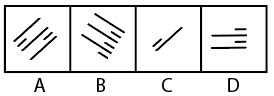
The task is to identify which figure does not belong in the group based on a common pattern or characteristic shared by the other figures.
Correct Option: A) C