
The question asks for the velocity of light in a vacuum. This is a fundamental physical constant that candidates appearing for competitive exams are expected to know. We need to recall the standard value of the speed of light in a vacuum and compare it with the given options.
Correct Option: C) The velocity of light in a vacuum is approximately \(3 \times 10^8 \text{ ms}^{-1}\). This is a well-established fundamental constant in physics.
The question asks to find the relationship between 'Cube' and one of the given options, based on the established relationship between 'Square' and 'Line'. We need to identify the fundamental component or building block of a 'Square' and then apply the same logic to a 'Cube'.
D) Square — A square is a 2D shape whose boundaries are lines. Similarly, a cube is a 3D shape whose faces are squares. Thus, 'Square' is the fundamental component that forms the faces of a 'Cube', just as 'Line' forms the sides of a 'Square'.
To find the combined ratio of copper to zinc to nickel, we need to make the common element, zinc, have the same ratio value in both given ratios. We will find the least common multiple (LCM) of the zinc parts in the individual ratios and adjust the ratios accordingly.
Given the ratio of copper to zinc (Cu : Zn):
\[ \text{Cu} : \text{Zn} = 17 : 7 \]Given the ratio of nickel to zinc (Ni : Zn):
\[ \text{Ni} : \text{Zn} = 4 : 3 \]This can also be written as Zinc to Nickel (Zn : Ni):
\[ \text{Zn} : \text{Ni} = 3 : 4 \]We need to make the zinc part common in both ratios. The zinc parts are 7 and 3. The LCM of 7 and 3 is \(7 \times 3 = 21\).
Adjust the first ratio (Cu : Zn) so that the zinc part becomes 21. To do this, multiply both parts of the ratio by 3:
\[ \text{Cu} : \text{Zn} = (17 \times 3) : (7 \times 3) = 51 : 21 \]Adjust the second ratio (Zn : Ni) so that the zinc part becomes 21. To do this, multiply both parts of the ratio by 7:
\[ \text{Zn} : \text{Ni} = (3 \times 7) : (4 \times 7) = 21 : 28 \]Now that the zinc part is common (21) in both adjusted ratios, we can combine them to find the ratio of copper to zinc to nickel (Cu : Zn : Ni):
\[ \text{Cu} : \text{Zn} : \text{Ni} = 51 : 21 : 28 \]Correct Option: A) 51 : 21 : 28
The question asks to identify the primary sex organ in man. Primary sex organs are responsible for producing gametes (sperm in males) and sex hormones. We need to evaluate each given option based on this definition.
B) Testis — The testes are the primary male sex organs because they produce both sperm (male gametes) and male sex hormones (androgens, mainly testosterone).
Parties and the seats won by them are listed in the following table.
| S. No | Party | South | East | West | North |
| 1 | A | 40 | 37 | 35 | 27 |
| 2 | B | 6 | 26 | 76 | 86 |
| 3 | C | 83 | 71 | 4 | 21 |
| 4 | D | 1 | 7 | 3 | 11 |
Based on the given data, the total number of candidates elected is ______.
To find the total number of candidates elected, we need to sum up the seats won by all parties across all regions (South, East, West, North).
A) 534 is the correct total number of candidates elected, as calculated by summing all the seats won by all parties across all regions.
The question asks to identify the Indian state where the Rann of Kutch, one of the world's largest salt deserts, is primarily located. This requires knowledge of Indian geography.
Correct Option: B) Gujarat
The Rann of Kutch is a well-known geographical feature primarily located in the state of Gujarat, India. It is famous for its vast salt marshes and unique landscape.
Select the option that will correctly fit in the blank space in the following figure.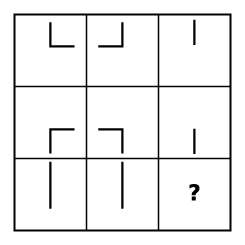
options: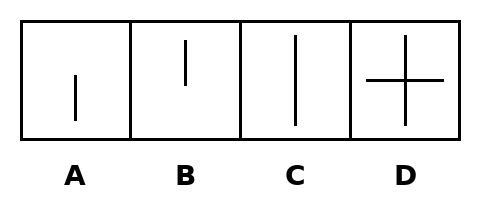
The problem involves identifying a pattern in a sequence of figures and selecting the correct option to complete the sequence. The sequence is arranged in a 3x3 grid, with the last position being empty.
Correct Option: A) The vertical line on the right completes the pattern observed in the sequence.
The given Problem Figure is embedded in one of the given Answer Figures. Which is that Answer Figure?
Problem Figures: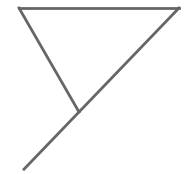
Answer Figures: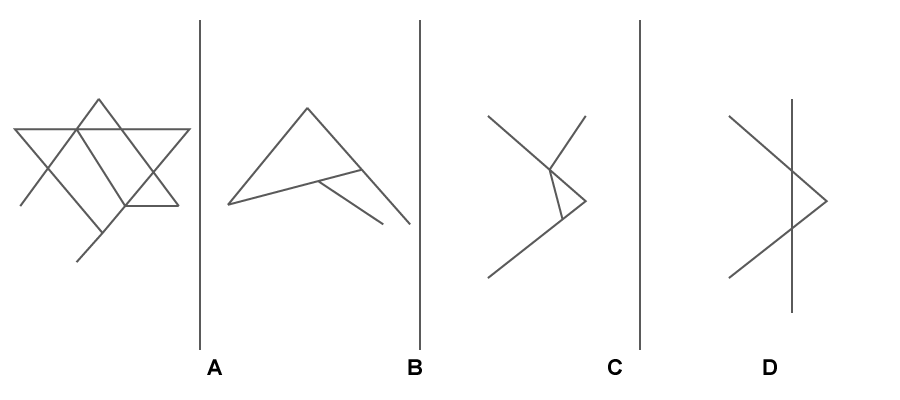
To solve this problem, we need to identify which of the given answer figures contains the problem figure as a part of its structure. This requires careful observation of the shapes and orientations in both the problem and answer figures.
Correct Option: B) The problem figure is embedded in this answer figure.
To solve this problem, we need to first identify the twelfth term from the left end of the given sequence. Then, from that identified term, we count three positions to its right to find the final answer.
Therefore, the term that is third to the right of the twelfth term from the left end is 'B'.
Correct Option: D) B
The problem asks whether the statement "If the side of a square is 1 unit, its area (in square units) is numerically equal to its side" is always true, never true, sometimes true, or often true. We need to analyze the formula for the area of a square and compare it to its side when the side length is 1 unit.
Correct Option: A) Always
The calculation shows that when the side of a square is 1 unit, its area is \(1^2 = 1\) square unit. Numerically, the side (1) is equal to the area (1). This is a direct consequence of the definition of area for a square and will always be true under the given condition, without exception.