
The question asks to identify an organism that reproduces by both regeneration and budding. We need to recall the reproductive methods of each option provided.
Correct Option: D) Hydra
The question asks to identify which of the given elements is NOT a borderline element. Borderline elements, also known as metalloids, are elements that have properties intermediate between metals and nonmetals.
C) Bismuth is a post-transition metal, not a borderline element (metalloid). It displays metallic properties despite its position near the metalloid line.
The question asks about a potential endless source of energy that can be derived from the vast amount of seaweeds in oceans. We need to identify which energy source is directly linked to the biological processes or composition of seaweeds.
Correct Option: B) Methane. Seaweeds are a rich source of biomass that can be anaerobically digested to produce methane, a valuable biofuel. This makes methane a potential endless energy source from seaweeds.
Choose the correct figure that replaces the question mark.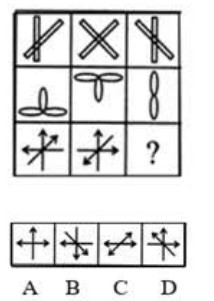
To solve this pattern completion problem, observe the sequence of transformations in the given grid and determine the rule applied to each row to find the missing figure.
Correct Option: C) The figure with combined diagonal and horizontal arrows.
The question asks to identify the author of the Indian English novel 'When Dimple Met Rishi', published in 2017. This requires knowledge of contemporary Indian English literature and popular authors.
Correct Option: B) Sandhya Menon is the author of the Indian English novel 'When Dimple Met Rishi', which was published in 2017. The book is a popular young adult romance and was later adapted into the Netflix series 'Mismatched'.
The problem asks us to identify the set of numbers that does not follow the same pattern as the other sets. We need to find a common mathematical relationship between the three numbers in each set and then identify the set that deviates from this relationship.
Let the numbers be \(a, b, c\). Here, \(a=2, b=14, c=16\).
Observe the relationship: \(b = a \times 7\) (\(14 = 2 \times 7\)).
Also, \(c = a \times 8\) (\(16 = 2 \times 8\)) or \(c = b + a\) (\(16 = 14 + 2\)). Let's check which pattern holds for other sets.
Here, \(a=3, b=21, c=24\).
Check the first pattern: \(b = a \times 7\) (\(21 = 3 \times 7\)). This holds.
Check the second pattern: \(c = a \times 8\) (\(24 = 3 \times 8\)). This also holds.
Alternatively, \(c = b + a\) (\(24 = 21 + 3\)). This also holds.
So, the pattern seems to be: the second number is 7 times the first, and the third number is 8 times the first (or the sum of the first two numbers).
Here, \(a=8, b=56, c=64\).
Check the pattern: \(b = a \times 7\) (\(56 = 8 \times 7\)). This holds.
Check the pattern: \(c = a \times 8\) (\(64 = 8 \times 8\)). This also holds.
Alternatively, \(c = b + a\) (\(64 = 56 + 8\)). This also holds.
Here, \(a=5, b=35, c=41\).
Check the pattern: \(b = a \times 7\) (\(35 = 5 \times 7\)). This holds.
Now, let's check the second part of the pattern:
Is \(c = a \times 8\)? \(5 \times 8 = 40\). But \(c=41\). So, \(41 \neq 40\).
Is \(c = b + a\)? \(35 + 5 = 40\). But \(c=41\). So, \(41 \neq 40\).
Since the third number in this set does not follow the established pattern (\(a \times 8\) or \(b + a\)), this set does not belong to the group.
Correct Option: B) (5, 35, 41) is the set that does not follow the pattern. In this set, the first number is 5, the second is \(5 \times 7 = 35\), but the third number is 41, which is not \(5 \times 8 = 40\) and also not \(35 + 5 = 40\). The pattern for the other sets is \((x, 7x, 8x)\) or \((x, 7x, 7x+x)\).
The question asks to identify a cation from the given options. A cation is an ion with a net positive charge. This means it has lost one or more electrons. Conversely, an anion is an ion with a net negative charge, meaning it has gained one or more electrons.
C) Ammonium: The ammonium ion has the chemical formula \(\text{NH}_4^+\), which indicates a net positive charge. Therefore, it is a cation.
The volume of a right circular cone, with a base radius the same as its altitude, and the volume of a hemisphere are equal. The ratio of the radii of the cone to the hemisphere is:
\(\sqrt{2}\) : 1
\(\sqrt[3]{3}:\sqrt[3]{2}\)
\(\sqrt[3]{2}:1\)
2 : 1
We need to find the ratio of the radius of a cone to the radius of a hemisphere, given that their volumes are equal. We will use the formulas for the volume of a right circular cone and a hemisphere, set them equal, and then solve for the ratio of their radii.
Define variables:
State the given condition for the cone:
The base radius of the cone is the same as its altitude.
Write the formula for the volume of a right circular cone:
\[ V_c = \frac{1}{3} \pi r_c^2 h_c \]Substitute the condition from step 2 into the cone's volume formula:
\[ V_c = \frac{1}{3} \pi r_c^2 (r_c) \]\[ V_c = \frac{1}{3} \pi r_c^3 \]Write the formula for the volume of a hemisphere:
\[ V_h = \frac{2}{3} \pi r_h^3 \]Set the volumes equal, as given in the problem:
\[ V_c = V_h \]\[ \frac{1}{3} \pi r_c^3 = \frac{2}{3} \pi r_h^3 \]Solve for the ratio of the radii:
Cancel out common terms \(\frac{1}{3}\pi\) from both sides:
Take the cube root of both sides to find the ratio:
\[ \frac{r_c}{r_h} = \sqrt[3]{2} \]\[ \frac{r_c}{r_h} = \frac{\sqrt[3]{2}}{1} \]Express the ratio:
\[ r_c : r_h = \sqrt[3]{2} : 1 \]Correct Option: C) \(\sqrt[3]{2}:1\)
This matches our derived ratio of the radii of the cone to the hemisphere.
Study the following graph and answer the question that follows.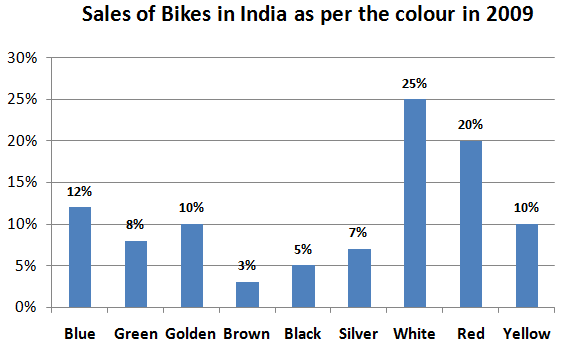
If the total number of bikes sold in 2009 was 10000, how many more yellow bikes were sold than green ones?
To determine how many more yellow bikes were sold than green ones, we need to compare the percentages of yellow and green bikes sold and calculate the difference using the total number of bikes sold.
Thus, 200 more yellow bikes were sold than green bikes.
Correct Option: A) 200
This problem involves concepts of work and time. We are given the ratio of working speeds of two individuals and the difference in time they take to complete a task. We need to find the time taken when they work together. The key idea is that if a person works 'n' times faster, they take '1/n' times the time to complete the same work. We will use this relationship to find individual times and then calculate their combined work rate.
Let the time taken by Ramya to complete the work be \(R\) days.
Since Surya works 3 times as fast as Ramya, Surya will take \(1/3\) of the time Ramya takes.
So, the time taken by Surya to complete the work is \(S = \frac{R}{3}\) days.
We are given that Surya completes the work in 40 days less than Ramya.
\[ R - S = 40 \]Substitute \(S = \frac{R}{3}\) into the equation:
\[ R - \frac{R}{3} = 40 \]\[ \frac{3R - R}{3} = 40 \]\[ \frac{2R}{3} = 40 \]\[ 2R = 40 \times 3 \]\[ 2R = 120 \]\[ R = \frac{120}{2} \]\[ R = 60 \text{ days} \]Now find Surya's time:
\[ S = \frac{R}{3} = \frac{60}{3} = 20 \text{ days} \]If Ramya takes 60 days, her one day's work is \(\frac{1}{60}\) of the total work.
If Surya takes 20 days, his one day's work is \(\frac{1}{20}\) of the total work.
When they work together, their combined one day's work is:
\[ \text{Combined work per day} = \frac{1}{60} + \frac{1}{20} \]\[ \text{Combined work per day} = \frac{1}{60} + \frac{3}{60} \]\[ \text{Combined work per day} = \frac{1+3}{60} \]\[ \text{Combined work per day} = \frac{4}{60} \]\[ \text{Combined work per day} = \frac{1}{15} \]If their combined one day's work is \(\frac{1}{15}\) of the total work, then they will complete the work together in 15 days.
D) 15 days — As calculated, when Surya and Ramya work together, they can complete the work in 15 days.