
To solve this problem, we need to follow the order of operations, often remembered by the acronym BODMAS/PEMDAS: Brackets/Parentheses, Orders/Exponents, Division/Multiplication (from left to right), and Addition/Subtraction (from left to right). We will simplify the expression step-by-step, working from the innermost brackets outwards.
First, simplify the innermost parenthesis: \((–18 \div –2)\).
\[ -18 \div -2 = 9 \]Next, substitute this value back into the expression: \(\{27 \div 9\}\).
\[ 27 \div 9 = 3 \]Now, the expression inside the square brackets becomes: \([3 \text{ of } -4 + (-1)]\). Remember that "of" means multiplication.
\[ 3 \times -4 + (-1) \]Perform the multiplication first:
\[ 3 \times -4 = -12 \]Then perform the addition:
\[ -12 + (-1) = -12 - 1 = -13 \]Finally, substitute this result back into the original expression: \(78 \div [-13]\).
\[ 78 \div -13 = -6 \]The final answer is \(-6\).
A) -6 is the correct answer, as derived from following the order of operations.
This problem involves analyzing logical statements and conclusions, a common type of question in competitive exams. We will use Venn diagrams or logical reasoning to determine if the conclusions necessarily follow from the given statements.
Neither Conclusion 1 nor Conclusion 2 logically follows from the given statements. The statements establish relationships between 'angels' and 'gods', and 'living beings' and 'gods', but they do not provide enough information to establish a definite relationship between 'angels' and 'living beings'.
To find the compound interest, we first need to determine the principal amount. We can calculate the principal using the given simple interest, time, and rate. Once the principal is known, we can then calculate the compound interest for the same principal, rate, and time.
The formula for Simple Interest (SI) is:
\[ \text{SI} = \frac{P \times R \times T}{100} \]Given:
Substitute the values into the formula:
\[ 5250 = \frac{P \times 5 \times 3}{100} \]\[ 5250 = \frac{15P}{100} \]\[ P = \frac{5250 \times 100}{15} \]\[ P = \frac{525000}{15} \]\[ P = \text{₹ } 35000 \]The formula for the Amount (A) under compound interest is:
\[ A = P \left(1 + \frac{R}{100}\right)^T \]Given:
Substitute the values into the formula:
\[ A = 35000 \left(1 + \frac{5}{100}\right)^3 \]\[ A = 35000 \left(1 + 0.05\right)^3 \]\[ A = 35000 \left(1.05\right)^3 \]\[ A = 35000 \times 1.157625 \]\[ A = \text{₹ } 40516.875 \]Now, calculate the Compound Interest (CI):
\[ \text{CI} = A - P \]\[ \text{CI} = 40516.875 - 35000 \]\[ \text{CI} = \text{₹ } 5516.875 \]Rounding to two decimal places, \(\text{CI} = \text{₹ } 5516.88\).
D) ₹ 5,516.88 is the correct compound interest calculated using the principal derived from the simple interest information.
In the reaction H2O2 + Cl2 → 2HCl + O2, H2O2 acts as:
To determine whether H₂O₂ acts as an oxidising or reducing agent, we need to examine the change in oxidation states of the elements involved in the reaction. An oxidising agent itself gets reduced (gains electrons), while a reducing agent itself gets oxidised (loses electrons).
The reaction can be written with oxidation states as:
\[ \text{H}_2\text{O}_2^{-1} + \text{Cl}_2^0 \rightarrow 2\text{H}\text{Cl}^{-1} + \text{O}_2^0 \]
Here, oxygen changes from \(-1\) to \(0\) (oxidation), and chlorine changes from \(0\) to \(-1\) (reduction).
D) a reducing agent. H₂O₂ is oxidised (oxygen changes from -1 to 0), meaning it acts as a reducing agent.
This is a syllogism-based question where we need to determine which conclusions logically follow from the given statements. We must assume the statements are true and evaluate each conclusion independently based on the information provided.
D) Only conclusion 2 follows
This problem involves calculating the displacement from the initial position after a series of movements in different directions. We can solve this by visualizing the path taken and then using the Pythagorean theorem to find the shortest distance (displacement) from the starting point to the end point.
Now, let's analyze the net displacement:
Since the net East-West displacement is 0 km, X is directly south of the initial position. The total distance from the initial position is the sum of the southward movements.
\[ \text{Total distance from initial position} = \text{OA} + \text{BC} = 30 \text{ km} + 20 \text{ km} = 50 \text{ km} \]A) 50 km is the correct answer because the East-West movements cancel out, and the total southward displacement is 50 km.
The question asks about the Chief Minister of Goa after the 2017 elections. To answer this, one needs to recall the political developments and appointments following the Goa Legislative Assembly elections in 2017.
A) Manohar Parrikar – He was sworn in as the Chief Minister of Goa on March 14, 2017, after the BJP formed a coalition government following the 2017 assembly elections.
Select the missing term based on the given related pair.
Grape : Bunch :: Sheep : ?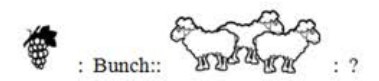
The question involves identifying the correct collective noun for a group of sheep, similar to how "bunch" is used for grapes.
Correct Option: B) Flock
The question asks to identify the missing letter in the given word fragment 'MA_T'. This is a common type of verbal reasoning question that tests vocabulary and pattern recognition. The goal is to find a letter that, when inserted, forms a meaningful English word.
Correct Option: A) R — When 'R' is inserted into 'MA_T', it forms the word 'MART', which is a valid English word meaning a market or a store.
To determine the number of solutions for a pair of linear equations, we compare the ratios of their coefficients. For two linear equations in the form \(a_1x + b_1y + c_1 = 0\) and \(a_2x + b_2y + c_2 = 0\), the number of solutions depends on the relationship between the ratios \(\frac{a_1}{a_2}\), \(\frac{b_1}{b_2}\), and \(\frac{c_1}{c_2}\).
Write down the given linear equations in the standard form \(ax + by + c = 0\):
\[ \text{Equation 1: } x + 2y - 8 = 0 \]\[ \text{Equation 2: } 2x + 4y - 18 = 0 \]Identify the coefficients for each equation:
For Equation 1:
\[ a_1 = 1, \quad b_1 = 2, \quad c_1 = -8 \]For Equation 2:
\[ a_2 = 2, \quad b_2 = 4, \quad c_2 = -18 \]Calculate the ratios of the coefficients:
\[ \frac{a_1}{a_2} = \frac{1}{2} \]\[ \frac{b_1}{b_2} = \frac{2}{4} = \frac{1}{2} \]\[ \frac{c_1}{c_2} = \frac{-8}{-18} = \frac{8}{18} = \frac{4}{9} \]Compare the ratios:
We observe that:
\[ \frac{a_1}{a_2} = \frac{b_1}{b_2} \neq \frac{c_1}{c_2} \]\[ \frac{1}{2} = \frac{1}{2} \neq \frac{4}{9} \]Interpret the result:
When \[\frac{a_1}{a_2} = \frac{b_1}{b_2} \neq \frac{c_1}{c_2}\], the lines represented by the equations are parallel and distinct. Parallel lines never intersect, which means there are no common solutions.
A) 0 — As the ratios of the coefficients satisfy \[\frac{a_1}{a_2} = \frac{b_1}{b_2} \neq \frac{c_1}{c_2}\], the lines are parallel and distinct, meaning there are no solutions.