Tapas, Avi and Rishi shared a cake. Tapas had \( \frac{1}{2} \) of it, Rishi had \( \frac{1}{3} \) of it and Avi had the rest. What was Avi's share of the cake?
\( \frac{2}{6} \)
\( \frac{1}{6} \)
\( \frac{3}{5} \)
\( \frac{3}{6} \)
To find Avi's share of the cake, we first need to determine the total share taken by Tapas and Rishi. Since the total cake represents a whole (1), we can subtract the combined shares of Tapas and Rishi from 1 to find Avi's share.
To add fractions, we need a common denominator. The least common multiple (LCM) of 2 and 3 is 6.
\[ \text{Tapas's share} + \text{Rishi's share} = \frac{1}{2} + \frac{1}{3} \]\[ = \frac{1 \times 3}{2 \times 3} + \frac{1 \times 2}{3 \times 2} \]\[ = \frac{3}{6} + \frac{2}{6} \]\[ = \frac{3+2}{6} \]\[ = \frac{5}{6} \]The total cake is represented by 1. Avi had the rest, so we subtract the combined share of Tapas and Rishi from 1.
\[ \text{Avi's share} = 1 - \left( \text{Tapas's share} + \text{Rishi's share} \right) \]\[ = 1 - \frac{5}{6} \]\[ = \frac{6}{6} - \frac{5}{6} \]\[ = \frac{6-5}{6} \]\[ = \frac{1}{6} \]B) \( \frac{1}{6} \) is the correct share for Avi.
To determine which number has an irrational square root, we need to check if the number is a perfect square. If a number is a perfect square, its square root will be a rational number (an integer, in this case). If a number is not a perfect square, its square root will be an irrational number.
B) The square root of 2048 is \(32\sqrt{2}\), which is an irrational number because it contains the irrational factor \(\sqrt{2}\).
The question asks to identify the key difference between asexual and sexual reproduction. We need to recall the fundamental characteristics of each reproductive mode to determine which statement accurately describes asexual reproduction's distinction.
Based on these evaluations, the statement that accurately describes asexual reproduction's difference from sexual reproduction is that the new organisms are genetically identical to the parent.
Correct Option: C) the new organisms are genetically identical to the parent
Select the most appropriate term for the following set of items. (Medal, Trophy, Podium with people)
The question asks us to identify the most appropriate term that relates to a set of items depicted in the diagram: a medal, a trophy, and a podium with people. These items are commonly associated with events where achievements are recognized and celebrated.
Correct Option: C) Celebration
This problem involves simple interest. We are given the amount (principal + interest), the rate of interest, and the time period. We need to find the initial sum (principal). We can use the formula for simple interest and the formula for the amount to solve this.
Simple Interest (\(SI\)) is given by:
\[ SI = \frac{P \times R \times T}{100} \]where \(P\) is the Principal.
The Amount (\(A\)) is the sum of the Principal and Simple Interest:
\[ A = P + SI \]We can express \(A\) in terms of \(P\), \(R\), and \(T\):
\[ A = P + \frac{P \times R \times T}{100} \]Factor out \(P\):
\[ A = P \left(1 + \frac{R \times T}{100}\right) \]Given \(A = 942\), \(R = 9.5\), \(T = 6\):
\[ 942 = P \left(1 + \frac{9.5 \times 6}{100}\right) \] \[ 942 = P \left(1 + \frac{57}{100}\right) \] \[ 942 = P \left(1 + 0.57\right) \] \[ 942 = P (1.57) \]Now, solve for \(P\):
\[ P = \frac{942}{1.57} \]To simplify the division, multiply the numerator and denominator by 100:
\[ P = \frac{94200}{157} \]Perform the division:
\[ P = 600 \]So, the initial sum invested was Rs. 600.
C) Rs. 600 is the correct answer. The calculation shows that an initial principal of Rs. 600, when invested at 9.5% simple interest for 6 years, grows to Rs. 942.
The question asks about the type of mirror used as a reflector in a searchlight. Searchlights are designed to produce a strong, parallel beam of light over long distances. We need to consider the properties of different types of mirrors (plane, convex, concave, cylindrical) and how they reflect light from a source placed at their focus.
C) concave mirror — A concave mirror, particularly a parabolic one, is used in searchlights. When a light source (bulb) is placed at its principal focus, the rays of light, after reflection from the concave mirror, travel parallel to the principal axis, forming a strong, parallel beam. This is ideal for searchlights, car headlights, and torchlights.
The question asks to identify the location of Nodes of Ranvier. This requires knowledge of the basic structure of neurons and their associated cells in the nervous system.
D) myelinated axons — Nodes of Ranvier are indeed microscopic gaps found at regular intervals along the length of myelinated axons. These gaps are essential for the rapid propagation of action potentials.
To determine the profit-sharing ratio in a partnership, we need to calculate the effective investment of each partner. The effective investment is the product of the amount invested and the duration for which it was invested. Since the total profit period is 12 months, we will calculate the investment for each partner for this duration.
The profit-sharing ratio is directly proportional to the ratio of their effective investments.
\[ \text{Ratio} = \text{Umar's effective investment} : \text{Avinash's effective investment} \] \[ \text{Ratio} = 120,000 : 120,000 \] \[ \text{Ratio} = 1 : 1 \]Thus, the profit should be shared in the ratio of 1:1.
B) 1 : 1 is the correct ratio because both Umar and Avinash had an effective investment of Rs. 120,000 over the 12-month period.
This question asks about the extraction method for highly reactive metals from their purified molten ores. We need to recall the principles of metallurgy, specifically how different types of metals (based on reactivity) are extracted.
Correct Option: C) Electrolysis is the process used to extract highly reactive metals from their purified molten ore because these metals have a very strong affinity for oxygen and other non-metals, making conventional reduction methods ineffective. Electrolysis provides the necessary energy to force the reduction of the metal ions.
Select the option that is related to the third figure in the same way as the second figure is related to the first figure.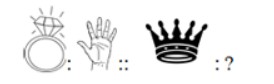
To solve this analogy question, we need to identify the relationship between the first pair of images and apply the same relationship to the second pair.
Correct Option: D) Head with hair