
This problem involves two right-angled triangles formed by the ladder, the wall, and the ground. The length of the ladder is the hypotenuse in both cases. We can use the Pythagorean theorem to find the base of each triangle, which represents the distance from the foot of the ladder to the base of the wall on each side of the street. The total width of the street will be the sum of these two distances.
Let \(D_1\) be this distance. Using the Pythagorean theorem (\(L^2 = H_1^2 + D_1^2\)):
\[ 13^2 = 12^2 + D_1^2 \]\[ 169 = 144 + D_1^2 \]\[ D_1^2 = 169 - 144 \]\[ D_1^2 = 25 \]\[ D_1 = \sqrt{25} \]\[ D_1 = 5 \text{ m} \]Let \(D_2\) be this distance. Using the Pythagorean theorem (\(L^2 = H_2^2 + D_2^2\)):
\[ 13^2 = 5^2 + D_2^2 \]\[ 169 = 25 + D_2^2 \]\[ D_2^2 = 169 - 25 \]\[ D_2^2 = 144 \]\[ D_2 = \sqrt{144} \]\[ D_2 = 12 \text{ m} \]The total width of the street (\(W\)) is the sum of the distances \(D_1\) and \(D_2\).
\[ W = D_1 + D_2 \]\[ W = 5 \text{ m} + 12 \text{ m} \]\[ W = 17 \text{ m} \]D) 17 m is the correct answer, as calculated by summing the distances from the foot of the ladder to each side of the street.
The question asks to identify a product whose price increase would have a widespread ripple effect, leading to inflation. This implies looking for a product that is a fundamental input or cost factor for a large number of other goods and services in the economy.
C) Petroleum. Petroleum is a critical input for transportation, manufacturing, and various industries. An increase in its price directly raises the cost of producing and distributing almost all goods and services in an economy, leading to a significant ripple effect and contributing to inflation.
To find the length of the train, we need to use the relationship between speed, distance, and time. When a train crosses a bridge, the total distance covered is the sum of the length of the train and the length of the bridge. We will first convert the speed from kmph to m/s, then calculate the total distance covered, and finally subtract the bridge's length to find the train's length.
The speed of the train is given as \(90 \text{ kmph}\). To convert kilometers per hour to meters per second, we multiply by \(\frac{5}{18}\).
\[ \text{Speed} = 90 \times \frac{5}{18} \text{ m/s} \]\[ \text{Speed} = 5 \times 5 \text{ m/s} \]\[ \text{Speed} = 25 \text{ m/s} \]The train takes \(10\) seconds to cross the bridge. The formula for distance is \(\text{Distance} = \text{Speed} \times \text{Time}\).
\[ \text{Total Distance} = 25 \text{ m/s} \times 10 \text{ s} \]\[ \text{Total Distance} = 250 \text{ m} \]When a train crosses a bridge, the total distance covered is the sum of the length of the train and the length of the bridge.
\[ \text{Total Distance} = \text{Length of Train} + \text{Length of Bridge} \]\[ 250 \text{ m} = \text{Length of Train} + 100 \text{ m} \]\[ \text{Length of Train} = 250 \text{ m} - 100 \text{ m} \]\[ \text{Length of Train} = 150 \text{ m} \]B) 150 — The length of the train is calculated to be \(150\) meters after converting speed to m/s and applying the distance formula.
The problem asks for the net work required to increase the speed of an object. According to the Work-Energy Theorem, the net work done on an object is equal to the change in its kinetic energy. We need to calculate the initial and final kinetic energies and then find their difference.
The formula for kinetic energy is \(KE = \frac{1}{2}mv^2\).
\[ KE_i = \frac{1}{2} m v_i^2 \]\[ KE_i = \frac{1}{2} (4.0 \, \text{kg}) (5.0 \, \text{m/s})^2 \]\[ KE_i = \frac{1}{2} (4.0) (25.0) \]\[ KE_i = 2.0 \times 25.0 \]\[ KE_i = 50 \, \text{J} \]According to the Work-Energy Theorem, \(W_{net} = \Delta KE = KE_f - KE_i\).
\[ W_{net} = 200 \, \text{J} - 50 \, \text{J} \]\[ W_{net} = 150 \, \text{J} \]Correct Option: B) 150 J
Seven years from now Virat will be twice as old as Mohinder. Five years ago Mohinder's age was one year less than \( \frac{2}{5} \) of Virat's age. What is Virat's present age?
This problem involves setting up a system of two linear equations based on the given age relationships between Virat and Mohinder at different points in time. We will define variables for their current ages, translate the word problem into algebraic equations, and then solve the system to find Virat's present age.
Let Virat's present age be \(V\) years and Mohinder's present age be \(M\) years.
First condition: "Seven years from now Virat will be twice as old as Mohinder."
According to the condition:
\[ V + 7 = 2(M + 7) \] \[ V + 7 = 2M + 14 \] \[ V - 2M = 14 - 7 \] \[ V - 2M = 7 \quad \text{(Equation 1)} \]Second condition: "Five years ago Mohinder's age was one year less than \( \frac{2}{5} \) of Virat's age."
According to the condition:
\[ M - 5 = \frac{2}{5}(V - 5) - 1 \]To eliminate the fraction, multiply the entire equation by 5:
\[ 5(M - 5) = 5 \left( \frac{2}{5}(V - 5) - 1 \right) \] \[ 5M - 25 = 2(V - 5) - 5 \] \[ 5M - 25 = 2V - 10 - 5 \] \[ 5M - 25 = 2V - 15 \]Rearrange the terms to form a standard linear equation:
\[ 5M - 2V = 25 - 15 \] \[ -2V + 5M = 10 \quad \text{(Equation 2)} \]Now we have a system of two linear equations:
Equation 1: \(V - 2M = 7\)
Equation 2: \(-2V + 5M = 10\)
We want to find \(V\). We can use the substitution or elimination method. Let's use elimination. Multiply Equation 1 by 2:
\[ 2(V - 2M) = 2(7) \] \[ 2V - 4M = 14 \quad \text{(Equation 3)} \]Add Equation 3 and Equation 2:
\[ (2V - 4M) + (-2V + 5M) = 14 + 10 \] \[ (2V - 2V) + (-4M + 5M) = 24 \] \[ M = 24 \]So, Mohinder's present age is 24 years.
Substitute the value of \(M\) into Equation 1 to find \(V\):
\[ V - 2(24) = 7 \] \[ V - 48 = 7 \] \[ V = 7 + 48 \] \[ V = 55 \]Therefore, Virat's present age is 55 years.
Correct Option: B) 55 years
Virat's present age is 55 years.
The question asks to identify the Chairman of the Economic Advisory Council to the Prime Minister (PMEAC) as of February 2018. This requires knowledge of key appointments in the Indian government during that specific period.
Correct Option: C) Bibek Debroy
The question asks to identify the acid present in red ants. This is a factual recall question related to common organic acids and their natural sources.
Red ants, also known as fire ants or wood ants, produce and inject an acid as a defense mechanism and for hunting. This acid is called formic acid.
A) Formic acid — Formic acid (\(HCOOH\)) is the simplest carboxylic acid. It is naturally found in the venom of ants (from the Latin word "formica" meaning ant) and in the sting of bees. When red ants bite, they inject formic acid, which causes the characteristic burning sensation and irritation.
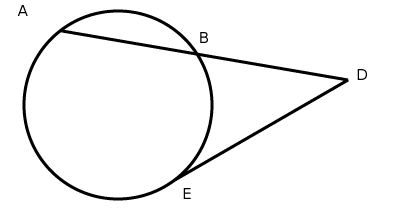
In the circle, chord \(\overline{AB}\) is extended to meet the tangent \(\overline{DE}\) at D. If \(\overline{AB}\) = 12 cm and \(\overline{DE}\) = 8 cm, find the length of \(\overline{BD}\).
To solve this problem, we use the property of tangents and chords intersecting outside a circle. According to the tangent-secant theorem, if a tangent and a secant (or chord) intersect outside a circle, then the square of the length of the tangent segment is equal to the product of the lengths of the entire secant segment and its external part.
Correct Option: C) 4 cm
The question asks to identify a metal that is soft enough to be cut with a knife. This property relates to the metal's hardness. We need to recall the general properties of the given metals.
A) Sodium is an alkali metal, which is known for its extreme softness. It can be easily cut with a knife, unlike most other metals. This is due to its metallic bonding structure and large atomic radius, which results in weaker metallic bonds.
This is a blood relation problem. We need to trace the relationships described in the statement made by Sheesha to determine her connection to the girl in the portrait. We will break down the statement piece by piece, starting from the end to identify the key individuals.
Correct Option: A) Sheesha is the girl in the portrait