The question asks to identify the company that was granted Maharatna status by the Government of India in September 2017. This requires knowledge of the Maharatna scheme and the specific companies that received this status around that time.
Correct Option: B) Bharat Petroleum Corporation Limited (BPCL)
The question asks to identify the canal that connects the Pacific Ocean to the Atlantic Ocean and was commissioned in 1914. This requires knowledge of major world canals and their geographical locations and historical details.
Correct Option: C) Panama Canal
The question asks to identify the INCORRECT match between an element and its chemical symbol. We need to recall the standard chemical symbols for the given elements.
Based on this analysis, the only incorrect match is C.
Correct Option: D) Only C
To determine which ball is moving faster, we need to use the formula for kinetic energy, which relates mass and speed. Since both balls have equal kinetic energy, we can set up an equation and compare their speeds based on their masses.
Kinetic energy (\(KE\)) is given by the formula:
\[ KE = \frac{1}{2}mv^2 \]where \(m\) is the mass of the object and \(v\) is its speed.Let \(m_1\) and \(v_1\) be the mass and speed of the first ball (5 kg), and \(m_2\) and \(v_2\) be the mass and speed of the second ball (10 kg).
Given:
Since \(KE_1 = KE_2\), we can write:
\[ \frac{1}{2}m_1v_1^2 = \frac{1}{2}m_2v_2^2 \]Cancel out the \(\frac{1}{2}\) from both sides:
\[ m_1v_1^2 = m_2v_2^2 \]Substitute \(m_1 = 5 \text{ kg}\) and \(m_2 = 10 \text{ kg}\):
\[ 5v_1^2 = 10v_2^2 \]Divide both sides by 5:
\[ v_1^2 = 2v_2^2 \]To find the relationship between \(v_1\) and \(v_2\):
\[ v_1 = \sqrt{2}v_2 \]Since \(\sqrt{2} \approx 1.414\), we have \(v_1 \approx 1.414v_2\). This means that \(v_1\) is greater than \(v_2\).
Therefore, the 5 kg ball is moving faster than the 10 kg ball.
C) The 5 kg ball is moving faster.
The _____ was originally built by the Kakatiya kings and was later rebuilt and expanded by the Qutb Shahi dynasty in the 16th century.
The question asks to identify a historical fort that was initially constructed by the Kakatiya kings and subsequently rebuilt and expanded by the Qutb Shahi dynasty in the 16th century. This requires knowledge of the architectural history and dynastic associations of prominent Indian forts.
C) Golconda Fort — The Golconda Fort was indeed first built as a mud fort by the Kakatiya kings (specifically, by Raja Krishna Dev of the Kakatiya dynasty in the 13th century). It was later rebuilt and extensively expanded by the Qutb Shahi dynasty, particularly during the 16th century, transforming it into the formidable structure seen today. It served as the capital of the Qutb Shahi kingdom until 1590 when the capital was moved to Hyderabad.
This problem involves the properties of an isosceles triangle and the sum of angles in a triangle. We will set up an equation based on the given conditions and solve for the unknown angle.
Define the angles: Let the third angle of the isosceles triangle be \(x\).
Relate the equal angles to the third angle: According to the problem statement, each of the two equal angles is twice the third angle. So, each of the equal angles will be \(2x\).
Apply the angle sum property of a triangle: We know that the sum of all angles in any triangle is \(180^\circ\). Therefore, for this isosceles triangle, we have:
\[ x + 2x + 2x = 180^\circ \]
Solve the equation for \(x\): Combine the terms on the left side:
\[ 5x = 180^\circ \] Divide by 5 to find the value of \(x\):
\[ x = \frac{180^\circ}{5} \]
\[ x = 36^\circ \]
Identify the measure of the third angle: The third angle is \(x\), which we found to be \(36^\circ\).
Correct Option: C) 36°
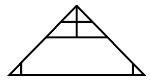
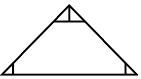
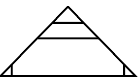
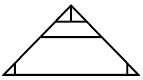
The given Problem Figure is embedded in one of the given Answer Figures. Which is that Answer Figure?
Problem Figure: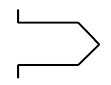
Answer Figures: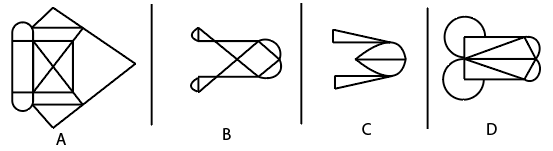
The task is to identify which of the given Answer Figures contains the embedded Problem Figure. This involves visually comparing the shapes and lines of the Problem Figure with those in each Answer Figure.
Correct Option: A) The Problem Figure is embedded in Answer Figure A.
Select the figure that does NOT belong in the following group.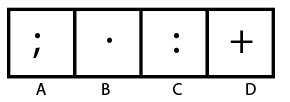
The task is to identify the figure that does not belong in the given group. To solve this, we need to analyze the characteristics of each figure and find the one that differs from the others.
Correct Option: B) The single dot does not fit the pattern of punctuation or mathematical symbols.
The question asks to identify the cell organelle known as the "Master of the Cell." This term refers to the organelle that controls and regulates most cellular activities. We need to recall the primary functions of each given organelle to determine which one fits this description.
Correct Option: A) The Nucleus is often called the "Master of the Cell" or the "Control Center of the Cell" because it contains the genetic material (DNA) and regulates all cellular activities, including growth, metabolism, and reproduction, by controlling gene expression.
Select the option that will fit in the blank space in the given figure.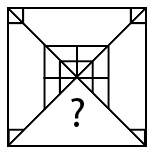
The question involves identifying the correct shape to fit into a blank space in a geometric figure. The task requires analyzing the symmetry and pattern of the given figure and matching it with one of the provided options.
Correct Option: A) Option A completes the triangular section and maintains the symmetry of the figure.