
The problem asks us to identify implicit assumptions based on a given statement. An assumption is something taken for granted or accepted as true without proof. When analyzing statements, we need to consider what must be true for the statement to make sense or for the action described to be plausible.
A) Both assumptions 1 and 2 are implicit.
Assumption 1 is implicit because the company, by setting a minimum criterion, expects applications from individuals who meet at least that criterion. If no one with a bachelor's degree applied, the announcement would be pointless. Assumption 2 is implicit because "minimum eligibility criteria" means that anyone with a qualification equal to or higher than a bachelor's degree is eligible. A Master's degree is a higher qualification, so Master's degree holders can also apply.
The question asks to identify the Chairperson of the Central Board of Film Certification (CBFC) as of March 2018. This is a factual question related to current affairs and appointments at a specific time.
B) Prasoon Joshi was appointed as the Chairperson of the CBFC in August 2017 and was still serving in that capacity in March 2018.
This is a syllogism problem that can be solved using Venn diagrams or by analyzing the logical relationships between the statements. We need to determine which conclusions logically follow from the given statements.
B) Only conclusion 1 follows.
Select the option that does NOT belong in the following figure series.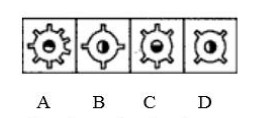
To identify the option that does not belong in the series, we need to analyze the patterns or features in each diagram and determine which one breaks the sequence.
Correct Option: D) Option D does not belong as it breaks the pattern of the number of spokes.
To find the height of the parallelogram, we will use the given relationship between its base and height, and the formula for the area of a parallelogram. We will set up an equation and solve for the height.
Correct Option: C) 14 m
To find the Highest Common Factor (HCF) of a set of numbers, we can use the prime factorization method. This involves finding the prime factors of each number and then multiplying the common prime factors raised to their lowest powers.
B) 27 is the HCF of 162, 54, and 135.
The given Problem Figure is embedded in one of the given Answer Figures. Which is that Answer Figure?
Problem Figure:
Answer Figures: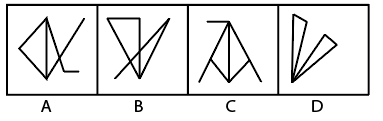
The task is to identify which of the given answer figures contains the problem figure as part of its structure. This involves visually comparing the shapes and orientations of the lines in the problem figure with those in each answer option.
Correct Option: C) The problem figure is embedded in Answer Figure C.
This question asks about the location where pollen grains are produced and stored within a flower. Understanding the basic anatomy of a flower's reproductive parts is key to answering this.
Correct Option: D) anthers
Solve the following: 252 ÷ [51 - {27 - (9 - (\(\overline{8+7}\)))}] = ?
To solve this problem, we need to follow the order of operations, often remembered by the acronym BODMAS/PEMDAS. This means we perform operations in the following order: Brackets (or Parentheses), Orders (exponents/roots), Division and Multiplication (from left to right), and Addition and Subtraction (from left to right). Within brackets, we also prioritize the Vinculum (bar over numbers) first.
Therefore, the final answer is 14.
Correct Option: A) 14
A and B can complete a task together in 35 days. If A works alone and completes \( \frac{5}{7} \) of the task and then leaves the rest for B to complete by herself, it will take a total of 90 days to complete the task. How many days would it take A, the more efficient among the duo, to complete the entire work by herself?
This problem involves work and time. We need to find the individual time taken by A to complete the work, given their combined work rate and a scenario where they work separately for parts of the task. We will use variables to represent their individual work rates and form equations based on the given information.
Let A's one day work be \( \frac{1}{a} \) and B's one day work be \( \frac{1}{b} \), where \(a\) and \(b\) are the number of days A and B take individually to complete the work.
From the first statement, A and B can complete a task together in 35 days. This means their combined one day work is \( \frac{1}{35} \).
\[ \frac{1}{a} + \frac{1}{b} = \frac{1}{35} \quad \text{(Equation 1)} \]From the second statement, if A works alone and completes \( \frac{5}{7} \) of the task, and then B completes the rest, it takes a total of 90 days. The rest of the task is \[1 - \frac{5}{7} = \frac{2}{7}\].
Let \(t_A\) be the time A works and \(t_B\) be the time B works. The total time is \(t_A + t_B = 90\) days.
The amount of work done by A is \[t_A \times \frac{1}{a} = \frac{5}{7}\]. So, \( t_A = \frac{5a}{7} \).
The amount of work done by B is \[t_B \times \frac{1}{b} = \frac{2}{7}\]. So, \( t_B = \frac{2b}{7} \).
Substituting these into the total time equation:
\[ \frac{5a}{7} + \frac{2b}{7} = 90 \]\[ 5a + 2b = 630 \quad \text{(Equation 2)} \]Now we have a system of two equations with two variables \(a\) and \(b\):
From Equation 1, \[\frac{1}{b} = \frac{1}{35} - \frac{1}{a} = \frac{a - 35}{35a}\]. Therefore, \( b = \frac{35a}{a - 35} \).
Substitute the expression for \(b\) into Equation 2:
\[ 5a + 2 \left( \frac{35a}{a - 35} \right) = 630 \]\[ 5a + \frac{70a}{a - 35} = 630 \]Divide the entire equation by 5 to simplify:
\[ a + \frac{14a}{a - 35} = 126 \]Multiply by \( (a - 35) \) to clear the denominator:
\[ a(a - 35) + 14a = 126(a - 35) \]\[ a^2 - 35a + 14a = 126a - 126 \times 35 \]\[ a^2 - 21a = 126a - 4410 \]\[ a^2 - 21a - 126a + 4410 = 0 \]\[ a^2 - 147a + 4410 = 0 \]This is a quadratic equation. We can solve for \(a\) using the quadratic formula or by factoring. Let's try factoring. We need two numbers that multiply to 4410 and add up to 147. Let's test the options provided. If A is more efficient, A should take less time than B.
Let's check the options for \(a\):
We need to determine which value of \(a\) corresponds to A being the more efficient worker. If \(a = 42\), then \[b = \frac{35 \times 42}{42 - 35} = \frac{35 \times 42}{7} = 5 \times 42 = 210\]. In this case, A takes 42 days and B takes 210 days. A is more efficient.
If \(a = 105\), then \[b = \frac{35 \times 105}{105 - 35} = \frac{35 \times 105}{70} = \frac{1}{2} \times 105 = 52.5\]. In this case, A takes 105 days and B takes 52.5 days. B is more efficient.
The problem states that A is the more efficient among the duo. Therefore, A must take less time than B. This means \(a < b\). The solution \(a = 42\) days satisfies this condition.
B) 42