
The question asks to identify the Indian female mountaineer who set a record for scaling Mount Everest twice within 5 days, specifically as of 2018. This requires knowledge of prominent Indian mountaineers and their achievements.
Correct Option: A) Anshu Jamsenpa
Anshu Jamsenpa is an Indian mountaineer from Arunachal Pradesh. She holds the world record for being the only woman to scale Mount Everest twice in a single season and the fastest double ascent by a woman. She achieved this feat in May 2017, summiting on May 16th and again on May 21st, completing the double ascent in just 5 days.
The question asks about the location of Dakshin Gangotri, an Indian research base. This requires knowledge of India's scientific missions and their geographical locations.
Correct Option: B) Antarctica
Dakshin Gangotri was India's first permanent scientific research base station in Antarctica, established during the third Indian Antarctic Expedition in 1983-84. Although it was decommissioned as an active research base in 1990 due to being buried under ice, it served as a logistics and transit camp for subsequent expeditions. India has since established other research stations in Antarctica, namely Maitri and Bharati.
This question asks us to identify which of the given assumptions are implicit in the provided argument. An implicit assumption is something that is taken for granted or presupposed by the statement, without being explicitly stated. We need to evaluate each assumption independently to see if the argument necessarily relies on it.
Correct Option: A) Neither assumption 1 nor 2 is implicit.
The problem can be solved by setting up a linear equation based on the given information. We will represent Poojitha's current age with a variable, then express her age three years ago and two years from now in terms of that variable. Finally, we will form an equation and solve for the variable.
Let Poojitha's current age be \(x\) years.
Her age three years ago would be \(x - 3\) years.
Her age two years from now would be \(x + 2\) years.
According to the problem statement, "one-third of Poojitha's age three years ago plus one-half of her age two years from now is twenty years". We can write this as an equation:
\[ \frac{1}{3}(x - 3) + \frac{1}{2}(x + 2) = 20 \]Now, we solve this equation for \(x\). First, distribute the fractions:
\[ \frac{x}{3} - \frac{3}{3} + \frac{x}{2} + \frac{2}{2} = 20 \]\[ \frac{x}{3} - 1 + \frac{x}{2} + 1 = 20 \]Simplify the equation by combining like terms:
\[ \frac{x}{3} + \frac{x}{2} = 20 \]To combine the terms with \(x\), find a common denominator, which is 6:
\[ \frac{2x}{6} + \frac{3x}{6} = 20 \]\[ \frac{2x + 3x}{6} = 20 \]\[ \frac{5x}{6} = 20 \]Multiply both sides by 6:
\[ 5x = 20 \times 6 \]\[ 5x = 120 \]Divide by 5 to find \(x\):
\[ x = \frac{120}{5} \]\[ x = 24 \]Therefore, Poojitha's current age is 24 years.
Correct Option: C) 24 years
The question asks to find a missing word based on a given relationship between two words. This is an analogy question where we need to identify the logical connection between the first pair of words and apply the same logic to the second pair.
Correct Option: A) Ship. A ship travels on the sea, just as a car travels on a road.
The problem provides a multiplication result and asks for the result of a similar multiplication involving decimals. The key is to understand how multiplying or dividing by powers of 10 affects the decimal point in the product.
\[ 170 \times 0.029 = (17 \times 10) \times (29 \times 0.001) \]
Rearrange the terms using the associative and commutative properties of multiplication:
\[ 170 \times 0.029 = (17 \times 29) \times (10 \times 0.001) \]
\[ 170 \times 0.029 = 493 \times (10 \times 0.001) \]
\[ 10 \times 0.001 = 0.01 \]
\[ 493 \times 0.01 \]
Multiplying by \(0.01\) (or \(\frac{1}{100}\)) means moving the decimal point two places to the left.
\[ 493.0 \times 0.01 = 4.93 \]
A) 4.93 is the correct answer, as derived from the step-by-step calculation.
The problem asks us to find the missing number in a given sequence: 1, 2, 6, _____, 120, 720. We need to identify the pattern or rule governing the sequence to determine the missing term.
Let's examine the relationship between consecutive terms in the sequence:
Let's look at the ratios or differences between consecutive terms:
The differences (1, 4) do not show an immediate clear pattern. Let's focus on the ratios (2, 3).
It appears the sequence is formed by multiplying the previous term by an increasing integer. Let's test this hypothesis:
Following this pattern, the next multiplier should be 4.
So, the missing number is 24.
Let's verify this pattern with the subsequent terms:
The pattern holds true. The sequence is generated by multiplying the \(n\)-th term by \((n+1)\) to get the \((n+1)\)-th term, or more simply, the \(n\)-th term is \(n!\) (factorial of n) if we consider the sequence starting from \(1!\).
The missing term is \(4!\), which is \(4 \times 3 \times 2 \times 1 = 24\).
C) 24 — The sequence follows the pattern where each term is the previous term multiplied by an increasing integer (2, 3, 4, 5, 6...). Alternatively, it represents the factorial series \(n!\) starting from \(1!\).
To find the number of complete revolutions a wheel makes, we need to calculate the distance covered in one revolution (which is its circumference) and then divide the total distance to be covered by the circumference. Ensure all units are consistent before performing calculations.
Given information:
Convert units to be consistent:
It's usually easier to work with meters. Convert the diameter from cm to m.
\[ D = 84 \text{ cm} = \frac{84}{100} \text{ m} = 0.84 \text{ m} \]Calculate the radius of the wheel:
The radius \(r\) is half of the diameter.
\[ r = \frac{D}{2} = \frac{0.84 \text{ m}}{2} = 0.42 \text{ m} \]Calculate the circumference of the wheel:
The distance covered in one revolution is the circumference \(C\) of the wheel. The formula for circumference is \(C = 2\pi r\) or \(C = \pi D\).
Using \(C = \pi D\):
\[ C = \pi \times 0.84 \text{ m} \]Using the approximation \(\pi = \frac{22}{7}\):
\[ C = \frac{22}{7} \times 0.84 \text{ m} \] \[ C = 22 \times 0.12 \text{ m} \] \[ C = 2.64 \text{ m} \]Calculate the number of revolutions:
The number of revolutions \(N\) is the total distance covered divided by the circumference of the wheel.
\[ N = \frac{\text{Total distance}}{\text{Circumference}} \] \[ N = \frac{792 \text{ m}}{2.64 \text{ m}} \]To simplify the division, multiply the numerator and denominator by 100:
\[ N = \frac{792 \times 100}{2.64 \times 100} = \frac{79200}{264} \]Now, perform the division:
\[ \frac{79200}{264} = 300 \]So, the wheel will make 300 complete revolutions.
Correct Option: C) 300
To find the square root of 27225, we can use a combination of estimation and observation of the last digit. Since the number ends in 5, its square root must also end in 5. We can then narrow down the possibilities by considering the range of squares of numbers ending in 5.
B) 165. As calculated, \(165^2 = 27225\).
Use each of the following figures only once and form three groups. The three groups thus formed are: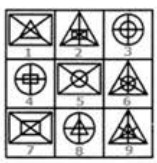
(1,5,7), (2,3,9), (4,6,8)
(1,5,7), (2,6,9), (4,3,8)
(1,5,9), (2,6,7), (4,3,8)
(1,5,7), (2,6,8), (4,3,9)
The goal is to form three groups from the nine figures provided. Each group should have a consistent characteristic or pattern that differentiates it from the others.
Correct Option: B) (1,5,7), (2,6,9), (4,3,8)