
To determine how many kilometres are in one metre, we need to understand the relationship between the units of length: metre and kilometre. The prefix "kilo-" means 1000.
One kilometre (\(\text{km}\)) is defined as 1000 metres (\(\text{m}\)).
\[ 1 \text{ km} = 1000 \text{ m} \]To find out how many kilometres are in one metre, we can rearrange the above equation:
Divide both sides by 1000:
\[ \frac{1 \text{ km}}{1000} = \frac{1000 \text{ m}}{1000} \] \[ 0.001 \text{ km} = 1 \text{ m} \]So, one metre is equal to 0.001 kilometres.
Correct Option: B) 0.001
This is a coding-decoding problem where words are assigned specific codes. The task is to find the code for a particular word by identifying common words and their corresponding common codes across different statements.
Analyze the first two statements:
The common word in both statements is "HARD".
The common code in both statements is "Z".
Therefore, the code for "HARD" is "Z".
Verify with the third statement (optional but good practice):
The word "HARD" does not appear in the third statement, and its code "Z" does not appear in the third statement's code. This is consistent with our finding.
Conclusion: The code for "HARD" is "Z".
C) Z is the correct code for the word "HARD" as it is the common element between the first two given coded phrases.
As per the given Venn diagram, the total number of students who play cricket as well as football but not Kabaddi is _____.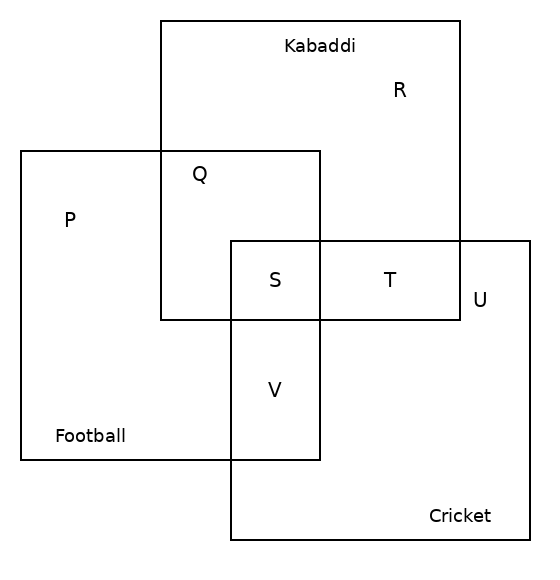
To find the number of students who play cricket and football but not Kabaddi, we need to identify the region in the Venn diagram that represents the intersection of cricket and football, excluding Kabaddi.
Therefore, the total number of students who play cricket and football but not Kabaddi is represented by "V."
Correct Option: C) V
The question asks to identify the organism that can thrive in extremely harsh environments such as hot springs, deep-sea thermal vents, and Antarctic ice. This points towards organisms known as extremophiles, which are predominantly found within the domain of Bacteria and Archaea.
A) Bacteria — Many species of bacteria, and especially archaea (which are often discussed alongside bacteria due to their prokaryotic nature), are extremophiles. They have evolved unique biochemical and structural adaptations that allow them to survive and reproduce in conditions of extreme temperature, pH, salinity, and pressure, such as those found in hot springs, deep-sea thermal vents, and polar ice.
To solve this blood relation problem, we need to break down the given statement step-by-step, starting from the end of the sentence and working backward to establish the relationship between Ryaan and Vehaan.
Thus, Ryaan is Vehaan's cousin.
Correct Option: C) Cousin
To determine the face value of 'x' in the number x4441, we need to apply the divisibility rule for 11. The divisibility rule for 11 states that a number is divisible by 11 if the difference between the sum of its digits at odd places and the sum of its digits at even places is either 0 or a multiple of 11.
The given number is x4441.
According to the rule, the difference between these two sums must be 0 or a multiple of 11.
\[ (x + 5) - 8 = 0 \quad \text{or} \quad \text{a multiple of 11} \] \[ x - 3 = 0 \quad \text{or} \quad \text{a multiple of 11} \]Since 'x' is a single digit (0-9), the only possible value for \((x-3)\) to be 0 or a multiple of 11 is 0.
\[ x - 3 = 0 \] \[ x = 3 \]If we consider the next multiple of 11, which is 11, then \(x - 3 = 11 \Rightarrow x = 14\), which is not a single digit. Therefore, \(x=3\) is the only valid solution.
Correct Option: D) 3
The problem requires us to find the correct sequence of mathematical operators to be placed between the numbers 5, 0, 3, and 5 to make the equation equal to 20. We will test each option by substituting the given operators into the expression and performing the calculations following the order of operations (BODMAS/PEMDAS).
Substitute the operators:
\[ 5 - 0 + 3 \times 5 \]Following BODMAS (multiplication first):
\[ 5 - 0 + 15 \]Then perform subtraction and addition from left to right:
\[ 5 + 15 = 20 \]This matches the RHS.
Substitute the operators:
\[ 5 + 0 \times 3 - 5 \]Following BODMAS (multiplication first):
\[ 5 + 0 - 5 \]Then perform addition and subtraction from left to right:
\[ 5 - 5 = 0 \]This does not match the RHS (20).
Substitute the operators:
\[ 5 + 0 - 3 \times 5 \]Following BODMAS (multiplication first):
\[ 5 + 0 - 15 \]Then perform addition and subtraction from left to right:
\[ 5 - 15 = -10 \]This does not match the RHS (20).
Substitute the operators:
\[ 5 \times 0 + 3 - 5 \]Following BODMAS (multiplication first):
\[ 0 + 3 - 5 \]Then perform addition and subtraction from left to right:
\[ 3 - 5 = -2 \]This does not match the RHS (20).
A) - + ×
When these operators are applied sequentially, the expression becomes \(5 - 0 + 3 \times 5\). Following the order of operations (BODMAS/PEMDAS), multiplication is performed first: \(3 \times 5 = 15\). The expression then becomes \(5 - 0 + 15\). Performing subtraction and addition from left to right: \(5 - 0 = 5\), and then \(5 + 15 = 20\). This matches the RHS of the equation.
Find the first negative term of the below A.P.
129, 120, 111, 102, ......
To find the first negative term of an Arithmetic Progression (A.P.), we first need to determine the general formula for the \(n\)-th term. Then, we set this \(n\)-th term to be less than zero and solve for \(n\). Since \(n\) must be an integer, the smallest integer value of \(n\) that satisfies the inequality will give us the position of the first negative term.
Identify the first term and common difference:
The given A.P. is 129, 120, 111, 102, ......
The first term, \(a = 129\).
The common difference, \(d = \text{second term} - \text{first term} = 120 - 129 = -9\).
Write the formula for the \(n\)-th term:
The formula for the \(n\)-th term of an A.P. is \(a_n = a + (n-1)d\).
Substitute the values of \(a\) and \(d\):
\[ a_n = 129 + (n-1)(-9) \]\[ a_n = 129 - 9n + 9 \]\[ a_n = 138 - 9n \]Find when the term becomes negative:
We want to find the first term that is less than zero, i.e., \(a_n < 0\).
So, set the expression for \(a_n\) to be less than zero:
\[ 138 - 9n < 0 \]Solve the inequality for \(n\):
Add \(9n\) to both sides:
\[ 138 < 9n \]\[ \frac{138}{9} < n \]\[ 15.33... < n \]Determine the smallest integer value for \(n\):
Since \(n\) must be an integer representing the term number, the smallest integer greater than 15.33... is 16.
Therefore, the 16th term will be the first negative term.
Verify (optional):
For \(n=15\): \(a_{15} = 138 - 9(15) = 138 - 135 = 3\) (positive)
For \(n=16\): \(a_{16} = 138 - 9(16) = 138 - 144 = -6\) (negative)
This confirms that the 16th term is indeed the first negative term.
A) 16 th term — As calculated, the smallest integer \(n\) for which \(a_n < 0\) is \(n=16\).
Which of the following gases turns lime water milky?
The question asks to identify which gas turns lime water milky. This is a common chemical test used to detect the presence of a specific gas. We need to recall the reaction of various gases with lime water (calcium hydroxide solution).
Correct Option: A) \(\text{CO}_2\) is the gas that turns lime water milky due to the formation of insoluble calcium carbonate.
The problem involves dividing a total amount among three individuals (A, B, and C) based on given percentage relationships between their shares. We need to establish the ratio of their shares and then use this ratio to find the individual share of B.
Define variables: Let the amounts received by A, B, and C be \(A\), \(B\), and \(C\) respectively.
Formulate equations from the given conditions:
Express all shares in terms of a single variable (e.g., C):
Find the ratio A : B : C:
Calculate the total parts in the ratio:
\[ \text{Total parts} = 1 + 2 + 10 = 13 \]Calculate B's share:
The total amount is ₹1560. B's share is 2 parts out of 13 total parts.
\[ B = \frac{\text{B's parts}}{\text{Total parts}} \times \text{Total amount} \] \[ B = \frac{2}{13} \times 1560 \] \[ B = 2 \times \frac{1560}{13} \] \[ B = 2 \times 120 \] \[ B = \text{₹}240 \]Correct Option: D) ₹240