This is a question based on logical deduction, often solved using Venn diagrams or by analyzing the relationship between categories. We need to determine if the conclusions logically follow from the given statements, treating the statements as absolutely true.
C) Neither 1 nor 2 follows. This is correct because the statements only establish that both 'rivers' and 'gods' belong to the larger category of 'holy things'. They do not provide any information about the direct relationship or overlap between 'rivers' and 'gods'. Therefore, we cannot logically deduce that all rivers are gods or that all gods are rivers.
The question asks to identify which statement is NOT a property of an ionic compound. We need to recall the general characteristics of ionic compounds and then compare them with the given options.
A) Low melting and boiling points — Ionic compounds have strong electrostatic forces between their ions, which require a large amount of energy to overcome. This results in very high melting and boiling points, not low ones. Therefore, this statement is not a property of an ionic compound.
The question asks about the primary field for which the Dr. B. C. Roy awards are given. To answer this, one needs to know about the Dr. B. C. Roy awards and the person they are named after.
Correct Option: D) Medicine. The Dr. B. C. Roy awards are primarily given to eminent achievers in the field of medicine, honoring Dr. Bidhan Chandra Roy, who was a renowned physician.
The question asks to identify a non-luminous body from the given options. A luminous body is an object that produces its own light, while a non-luminous body does not produce its own light but reflects light from another source.
Correct Option: B) The Moon is a non-luminous body because it does not produce its own light but reflects light from the Sun.
This is a blood relation problem. We need to deduce the relationship between W and Z by breaking down the given statements and establishing the family tree step-by-step.
Correct Option: B) Cousin
This problem involves ratios. We are given the ratio of the heights of two individuals, Nani and Leelu, and the actual height of one of them. We need to find the height of the other individual using the given ratio.
Correct Option: C) 1.6 m
This problem involves work and time. We will calculate the individual work rates of A, B, and C, then use these rates to find the work rate of D, and finally determine the time D takes to complete the task alone.
If A completes a task in 8 days, A's one-day work is:
\[ \text{A's 1-day work} = \frac{1}{8} \]If B completes a task in 12 days, B's one-day work is:
\[ \text{B's 1-day work} = \frac{1}{12} \]A, B, and C together complete the work in 4 days. So, their combined one-day work is:
\[ (\text{A} + \text{B} + \text{C})\text{'s 1-day work} = \frac{1}{4} \]We know the combined work rate of A, B, and C, and the individual rates of A and B. We can find C's rate:
\[ \text{C's 1-day work} = (\text{A} + \text{B} + \text{C})\text{'s 1-day work} - \text{A's 1-day work} - \text{B's 1-day work} \]\[ \text{C's 1-day work} = \frac{1}{4} - \frac{1}{8} - \frac{1}{12} \]To subtract these fractions, find a common denominator, which is 24:
\[ \text{C's 1-day work} = \frac{6}{24} - \frac{3}{24} - \frac{2}{24} \]\[ \text{C's 1-day work} = \frac{6 - 3 - 2}{24} = \frac{1}{24} \]C and D together complete the task in 15 days. So, their combined one-day work is:
\[ (\text{C} + \text{D})\text{'s 1-day work} = \frac{1}{15} \]We know the combined work rate of C and D, and C's individual rate. We can find D's rate:
\[ \text{D's 1-day work} = (\text{C} + \text{D})\text{'s 1-day work} - \text{C's 1-day work} \]\[ \text{D's 1-day work} = \frac{1}{15} - \frac{1}{24} \]To subtract these fractions, find a common denominator, which is 120:
\[ \text{D's 1-day work} = \frac{8}{120} - \frac{5}{120} \]\[ \text{D's 1-day work} = \frac{8 - 5}{120} = \frac{3}{120} = \frac{1}{40} \]If D's one-day work is \( \frac{1}{40} \), then D will take 40 days to complete the task alone.
A) 40
Select the missing figure based on the given related pair of figures.
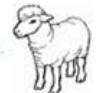
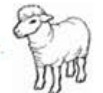
This question involves identifying the relationship between pairs of figures and applying the same logic to find the missing figure. The first pair consists of an apple and a glass of juice, suggesting a transformation or product relationship. We need to apply similar reasoning to the second pair, which includes a ball of yarn and knitting needles.
Correct Option: A) The sheep is the source of wool, which can be spun into yarn.
Choose the correct figure that replaces the question mark.
Problem Figure: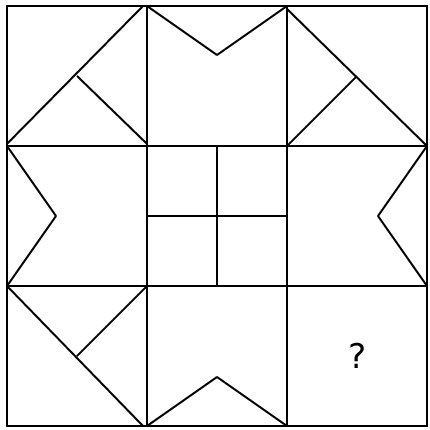
Answer Figures: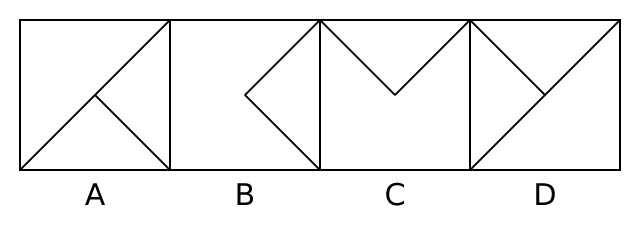
The problem involves identifying the correct figure that completes the pattern shown in the problem figure. The pattern involves geometric shapes and their orientations.
Correct Option: B) The triangle in option B points inward, maintaining the symmetry and pattern of the grid.
3rd January 2018 was a Wednesday. Which of the following years will also have 3rd January on a Wednesday?
To find the year when 3rd January falls on a Wednesday again, we need to calculate the number of odd days between the given year (2018) and the subsequent years. A year will have the same day for a given date if the total number of odd days accumulated between the two years is a multiple of 7.
| Year | Type of Year | Odd Days | Cumulative Odd Days |
|---|---|---|---|
| 2018 | Normal year | 1 | 1 |
| 2019 | Normal year | 1 | \(1 + 1 = 2\) |
| 2020 | Leap year | 2 | \(2 + 2 = 4\) |
| 2021 | Normal year | 1 | \(4 + 1 = 5\) |
| 2022 | Normal year | 1 | \(5 + 1 = 6\) |
| 2023 | Normal year | 1 | \(6 + 1 = 7\) |
B) 2024 — As calculated, the cumulative odd days from 2018 to the end of 2023 is 7. Therefore, 3rd January 2024 will be a Wednesday, the same day as 3rd January 2018.