
To find out how much needs to be added to a given fraction to obtain another fraction, we need to subtract the initial fraction from the target fraction. This is a basic arithmetic problem involving fractions.
Correct Option: D) \( \frac{9}{20} \)
To find a percentage of a number, we convert the percentage into a decimal or a fraction and then multiply it by the given number.
C) 140 is the correct answer because 56% of 250 is 140.
This problem involves trigonometry, specifically the concept of the angle of elevation. We need to visualize the situation as a right-angled triangle where the height difference between the tower and the platform, and the horizontal distance between them, form the sides. We will use the tangent function to find the unknown horizontal distance.
C) 40\(\sqrt{3}\) m is the correct answer. The horizontal distance between the platform and the tower is \(40\sqrt{3}\) m.
The question asks to identify the animal that is not triploblastic. Triploblastic animals are those that develop from three germ layers: ectoderm, mesoderm, and endoderm. Animals that develop from only two germ layers (ectoderm and endoderm) are called diploblastic. We need to classify each given animal based on its germ layers.
Correct Option: B) Jellyfish — Jellyfish belong to the phylum Cnidaria, which are diploblastic animals, meaning they develop from two germ layers (ectoderm and endoderm) and lack a true mesoderm.
This is a blood relation problem. We need to deduce the relationship between the man and the girl based on the given statements. We will break down the statement into smaller parts and establish the relationships step-by-step.
The girl's grandfather's sons would be her father or her uncles (paternal uncles).
A maternal aunt is the sister of the girl's mother. Therefore, the brother of her maternal aunt would be either her mother's brother (maternal uncle) or her mother's sister's husband (if the maternal aunt has a brother who is not directly related to the girl's mother, which is less likely in these types of problems unless specified).
Combining these, the brother of her maternal aunt is her mother's brother, which means he is her maternal uncle.
The man is the son of her grandfather (meaning he is either her father or a paternal uncle) AND he is the brother of her maternal aunt (meaning he is her maternal uncle).
For the man to be both the son of her grandfather and her maternal uncle, he must be the brother of her mother. Since her mother is the daughter of her grandfather, her mother's brother is also the son of her grandfather.
Therefore, the man is the girl's maternal uncle.
If the man is the girl's maternal uncle, then he is her uncle.
D) Uncle — The man is the brother of the girl's mother (maternal uncle), and the brother of the girl's mother is also the son of the girl's grandfather. Thus, the man is the girl's uncle.
The question asks to identify the pair of elements where the atomic number increases from the first element to the second. This requires knowledge of the atomic numbers of common elements.
C) Be, B — Beryllium (Be) has an atomic number of \(4\), and Boron (B) has an atomic number of \(5\). Since \(4 < 5\), this pair is in increasing order of atomic number.
This problem involves trigonometry, specifically the concept of angles of elevation and right-angled triangles. We will use the tangent function to relate the height of the tower to the distance from its base at different angles of elevation. By setting up two equations and solving them, we can find the distance walked.
Let the height of the tower be \(h\). Given \(h = 54 \text{ m}\).
Let the initial position of the person be \(P_1\) and the final position be \(P_2\). Let the foot of the tower be \(F\). The top of the tower is \(T\).
In the first scenario, the angle of elevation from \(P_1\) to \(T\) is \(60^\circ\). Let the initial distance from the foot of the tower to the person be \(x_1 = FP_1\).
In the right-angled triangle \(\triangle TFP_1\):
\[ \tan(60^\circ) = \frac{TF}{FP_1} = \frac{h}{x_1} \]\[ \sqrt{3} = \frac{54}{x_1} \]\[ x_1 = \frac{54}{\sqrt{3}} = \frac{54\sqrt{3}}{3} = 18\sqrt{3} \text{ m} \]In the second scenario, the person walks away from the tower. The angle of elevation from \(P_2\) to \(T\) is \(30^\circ\). Let the final distance from the foot of the tower to the person be \(x_2 = FP_2\).
In the right-angled triangle \(\triangle TFP_2\):
\[ \tan(30^\circ) = \frac{TF}{FP_2} = \frac{h}{x_2} \]\[ \frac{1}{\sqrt{3}} = \frac{54}{x_2} \]\[ x_2 = 54\sqrt{3} \text{ m} \]The distance the person walked is the difference between the final distance and the initial distance, i.e., \(d = x_2 - x_1\).
\[ d = 54\sqrt{3} - 18\sqrt{3} \]\[ d = (54 - 18)\sqrt{3} \]\[ d = 36\sqrt{3} \text{ m} \]D) \(36\sqrt{3} \text{ m}\) is the calculated distance the person walked.
This question asks about the number of molecules in one mole of water. This is a fundamental concept in chemistry related to Avogadro's number, which defines the number of constituent particles (atoms, molecules, ions, etc.) in one mole of any substance.
Correct Option: D) 6.02 \(\times\) 10²³ molecules
According to the given Venn diagram, the total number of students in the class is _____.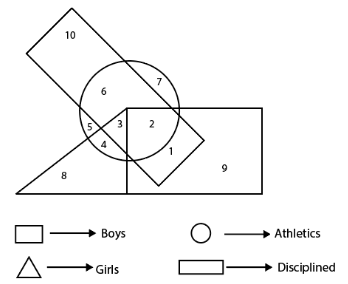
The question requires determining the total number of students in the class based on the given Venn diagram. The diagram uses geometric shapes to represent different categories of students: boys, girls, those involved in athletics, and disciplined students.
Correct Option: B) 55
This question tests the ability to identify implicit assumptions in a given statement. An assumption is something taken for granted or accepted as true without proof. When an argument is made, there are often underlying beliefs or conditions that must be true for the argument to hold. We need to evaluate each assumption in the context of the given argument.
A) Only assumption 1 is implicit. As explained above, the primary goal of offering a discount is to increase sales. Therefore, the company implicitly assumes that sales may increase. Assumption 2 is too strong and not necessarily implied by the announcement of a discount.