
The problem asks us to find the value of \(\tan x\) given the equation \(\sin x + \cos x = \sqrt{2} \sin x\). We will manipulate the given equation algebraically to isolate \(\tan x\).
Start with the given equation:
\[ \sin x + \cos x = \sqrt{2} \sin x \]Rearrange the terms to group \(\sin x\) terms together:
\[ \cos x = \sqrt{2} \sin x - \sin x \]Factor out \(\sin x\) from the right side of the equation:
\[ \cos x = (\sqrt{2} - 1) \sin x \]To find \(\tan x\), which is defined as \(\frac{\sin x}{\cos x}\), divide both sides of the equation by \(\cos x\). Assume \(\cos x \neq 0\).
\[ 1 = (\sqrt{2} - 1) \frac{\sin x}{\cos x} \]\[ 1 = (\sqrt{2} - 1) \tan x \]Now, isolate \(\tan x\):
\[ \tan x = \frac{1}{\sqrt{2} - 1} \]Rationalize the denominator by multiplying the numerator and denominator by the conjugate of the denominator, which is \(\sqrt{2} + 1\):
\[ \tan x = \frac{1}{\sqrt{2} - 1} \times \frac{\sqrt{2} + 1}{\sqrt{2} + 1} \]Apply the difference of squares formula \((a-b)(a+b) = a^2 - b^2\) to the denominator:
\[ \tan x = \frac{\sqrt{2} + 1}{(\sqrt{2})^2 - (1)^2} \]\[ \tan x = \frac{\sqrt{2} + 1}{2 - 1} \]\[ \tan x = \frac{\sqrt{2} + 1}{1} \]\[ \tan x = \sqrt{2} + 1 \]Correct Option: A) \(\sqrt{2} + 1\)
This is a blood relations problem. We need to trace the relationships described by Neena to determine her connection to the boy in the photograph. We will break down the statement into smaller parts to understand the familial connections.
Correct Option: A) Sister. If the boy is Neena's brother, then Neena is the boy's sister.
Select the figure that does NOT belong in the following group.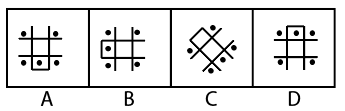
The task is to identify the figure that does not belong in the group based on a common pattern or characteristic shared by the other figures.
Correct Option: B) Figure B has an extra rectangular element that makes it different from the others.
The question asks to identify the odd one out from a list of terms. To solve this, we need to understand the context or field to which each term belongs. By categorizing the terms, we can find the one that doesn't fit with the others.
D) Bowler — 'Bowler' is a term associated with Cricket, while 'Super Tackle', 'Raider', and 'Defender' are all terms associated with Kabaddi.
The given Problem Figure is embedded in one of the given Answer Figures. Which is that Answer Figure?
Problem Figure: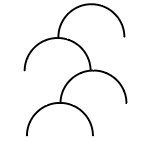
Answer Figures: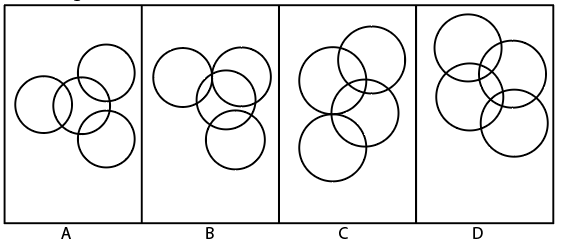
The task is to identify which of the Answer Figures contains the Problem Figure as an embedded part. This involves visually comparing the shapes and their arrangements.
Correct Option: A) The arrangement of semicircles in Answer Figure A matches the Problem Figure exactly.
If the total number of bikes sold in 2009 was 15000, how many more red bikes were sold than black ones?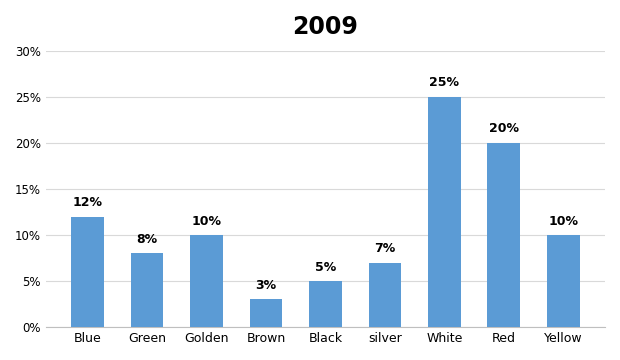
To find how many more red bikes were sold than black ones, we need to calculate the difference in the number of bikes sold for these two colors using the percentages provided in the diagram.
The difference is 2,250, which matches option C.
Correct Option: C) 2,250
The problem involves calculating the amount after a certain period when interest is compounded half-yearly. We need to adjust the annual rate and time period to reflect the half-yearly compounding frequency and then use the compound interest formula.
Since the interest is compounded half-yearly, the rate per compounding period will be half of the annual rate.
\[ \text{Rate per half-year} = \frac{\text{Annual Rate}}{2} = \frac{20\%}{2} = 10\% \]18 months is equal to 1.5 years. Since interest is compounded half-yearly, there will be two compounding periods in a year. So, for 1.5 years, the number of compounding periods (\(n\)) will be:
\[ n = \text{Time in years} \times 2 = 1.5 \times 2 = 3 \text{ half-years} \]The formula for the amount (\(A\)) when interest is compounded is:
\[ A = P \left(1 + \frac{r}{100}\right)^n \]where \(P\) is the principal, \(r\) is the rate per compounding period, and \(n\) is the number of compounding periods.A) ₹2,662 is the correct amount after 18 months when ₹2,000 is invested at 20% per annum compounded half-yearly.
This problem involves relating distance, speed, and time. We are given two scenarios with different speeds and corresponding differences in arrival times. We can set up equations based on the formula \(\text{Distance} = \text{Speed} \times \text{Time}\) and solve for the unknown distance.
Let \(D\) be the distance to the office (in km) and \(T\) be the usual time taken to reach the office (in hours).
Scenario 1: Driving at 45 km/h, the person reaches 1 minute early.
The time taken is \(T - 1 \text{ minute}\). Convert minutes to hours: \(1 \text{ minute} = \frac{1}{60} \text{ hour}\).
So, the time taken is \(T - \frac{1}{60}\) hours.
Using the formula \(D = S \times t\):
\[ D = 45 \left(T - \frac{1}{60}\right) \quad \ldots(1) \]Scenario 2: Driving at 40 km/h, the person reaches 4 minutes late.
The time taken is \(T + 4 \text{ minutes}\). Convert minutes to hours: \[4 \text{ minutes} = \frac{4}{60} = \frac{1}{15} \text{ hour}\].
So, the time taken is \(T + \frac{1}{15}\) hours.
Using the formula \(D = S \times t\):
\[ D = 40 \left(T + \frac{1}{15}\right) \quad \ldots(2) \]Now we have two expressions for \(D\). Equate them to solve for \(T\):
\[ 45 \left(T - \frac{1}{60}\right) = 40 \left(T + \frac{1}{15}\right) \] \[ 45T - \frac{45}{60} = 40T + \frac{40}{15} \] \[ 45T - \frac{3}{4} = 40T + \frac{8}{3} \]Rearrange the terms to solve for \(T\):
\[ 45T - 40T = \frac{8}{3} + \frac{3}{4} \] \[ 5T = \frac{32 + 9}{12} \] \[ 5T = \frac{41}{12} \] \[ T = \frac{41}{60} \text{ hours} \]Substitute the value of \(T\) back into either equation (1) or (2) to find \(D\). Using equation (1):
\[ D = 45 \left(\frac{41}{60} - \frac{1}{60}\right) \] \[ D = 45 \left(\frac{41 - 1}{60}\right) \] \[ D = 45 \left(\frac{40}{60}\right) \] \[ D = 45 \left(\frac{2}{3}\right) \] \[ D = 15 \times 2 \] \[ D = 30 \text{ km} \]Correct Option: A) 30
The given problem is a number series. We need to identify the pattern or rule governing the sequence of numbers and then apply that rule to find the missing term.
Correct Option: A) 1
The below table gives the details of the number of students in Class 10, section A and B who had taken mid-term and final exam. What is the total number of students in both, section A and B?
| Result | Sec A | Sec B |
| Total number of students who failed in both exams. | 28 | 23 |
| Total number of students who failed in mid-term but passed in finals. | 14 | 12 |
| Total number of students who passed in mid-term but failed in finals. | 6 | 17 |
| Total number of students who passed in both the exams. | 64 | 55 |
To find the total number of students in both sections A and B, we need to sum up the number of students in each category for Section A and Section B separately, and then add these two totals together.
Correct Option: C) 219