
This question tests fundamental properties of matter. We need to identify the statement that incorrectly describes the characteristics of particles of matter.
Correct Option: A) The particles of matter are in stationary state
The problem asks us to find a word pair that shares the same relationship as "Horse : Pony". We need to identify the relationship between a horse and a pony and then apply that same relationship to the given options.
Correct Option: A) Insect : Larva — A larva is the immature form of an insect, similar to how a pony can be considered a smaller or young horse.
The ratio of the areas of a square and a regular hexagon, both inscribed in a circle is?
2 : 3
3\(\sqrt{3}\) : 2
4 : 3\(\sqrt{3}\)
1 : \(\sqrt{3}\)
To find the ratio of the areas of a square and a regular hexagon inscribed in the same circle, we need to express the side lengths of both polygons in terms of the circle's radius. Then, we can calculate their respective areas and form the ratio.
Area of the Square:
Let the radius of the circle be \(R\). When a square is inscribed in a circle, the diagonal of the square is equal to the diameter of the circle. Let the side of the square be \(a\).
Diagonal of square \(d = 2R\).
Using the Pythagorean theorem for the square: \(a^2 + a^2 = d^2\)
\(2a^2 = (2R)^2\)
\(2a^2 = 4R^2\)
\(a^2 = 2R^2\)
The area of the square (\(A_{\text{square}}\)) is \(a^2\).
So, \(A_{\text{square}} = 2R^2\).
Area of the Regular Hexagon:
When a regular hexagon is inscribed in a circle, the side length of the hexagon is equal to the radius of the circle. Let the side of the hexagon be \(s\).
So, \(s = R\).
A regular hexagon can be divided into 6 equilateral triangles, each with side length \(s\).
The area of one equilateral triangle with side \(s\) is \(\frac{\sqrt{3}}{4}s^2\).
The area of the hexagon (\(A_{\text{hexagon}}\)) is \(6 \times \frac{\sqrt{3}}{4}s^2\).
Substitute \(s = R\):
\(A_{\text{hexagon}} = 6 \times \frac{\sqrt{3}}{4}R^2\)
\(A_{\text{hexagon}} = \frac{3\sqrt{3}}{2}R^2\).
Ratio of the Areas:
The ratio of the area of the square to the area of the regular hexagon is:
\[ \frac{A_{\text{square}}}{A_{\text{hexagon}}} = \frac{2R^2}{\frac{3\sqrt{3}}{2}R^2} \]Cancel \(R^2\) from numerator and denominator:
\[ \frac{A_{\text{square}}}{A_{\text{hexagon}}} = \frac{2}{\frac{3\sqrt{3}}{2}} \] \[ \frac{A_{\text{square}}}{A_{\text{hexagon}}} = 2 \times \frac{2}{3\sqrt{3}} \] \[ \frac{A_{\text{square}}}{A_{\text{hexagon}}} = \frac{4}{3\sqrt{3}} \]So, the ratio is \(4 : 3\sqrt{3}\).
Correct Option: C) 4 : \(3\sqrt{3}\)
We are given information about the average of three numbers, and the averages of the first two and last two numbers. We can use the definition of average to set up a system of equations and solve for the three unknown numbers.
Let the three numbers be \(a\), \(b\), and \(c\).
The average of the three numbers is 6. The formula for average is the sum of numbers divided by the count of numbers. So, we have:
\[ \frac{a + b + c}{3} = 6 \]\[ a + b + c = 6 \times 3 \]\[ a + b + c = 18 \quad \text{(Equation 1)} \]The average of the first two numbers (\(a\) and \(b\)) is 5. So:
\[ \frac{a + b}{2} = 5 \]\[ a + b = 5 \times 2 \]\[ a + b = 10 \quad \text{(Equation 2)} \]The average of the last two numbers (\(b\) and \(c\)) is 8. So:
\[ \frac{b + c}{2} = 8 \]\[ b + c = 8 \times 2 \]\[ b + c = 16 \quad \text{(Equation 3)} \]Now we have a system of three linear equations:
1) \(a + b + c = 18\)
2) \(a + b = 10\)
3) \(b + c = 16\)
Substitute Equation 2 into Equation 1 to find \(c\):
\[ (a + b) + c = 18 \]\[ 10 + c = 18 \]\[ c = 18 - 10 \]\[ c = 8 \]Substitute the value of \(c\) into Equation 3 to find \(b\):
\[ b + c = 16 \]\[ b + 8 = 16 \]\[ b = 16 - 8 \]\[ b = 8 \]Substitute the value of \(b\) into Equation 2 to find \(a\):
\[ a + b = 10 \]\[ a + 8 = 10 \]\[ a = 10 - 8 \]\[ a = 2 \]Thus, the three numbers are \(a=2\), \(b=8\), and \(c=8\).
Correct Option: C) 2, 8, 8
To find the time taken by the sound wave to travel a certain distance, we first need to calculate the speed of the sound wave. The speed of a wave can be determined using its frequency and wavelength. Once the speed is known, we can use the formula \(\text{Time} = \frac{\text{Distance}}{\text{Speed}}\) to find the required time.
The relationship between speed, frequency, and wavelength is given by:
\[ v = f \times \lambda \]Substitute the values:
\[ v = 4000 \text{ Hz} \times 0.4 \text{ m} \] \[ v = 1600 \text{ m/s} \]The time taken to travel a certain distance is given by:
\[ t = \frac{D}{v} \]Substitute the distance and speed:
\[ t = \frac{3200 \text{ m}}{1600 \text{ m/s}} \] \[ t = 2.0 \text{ s} \]Correct Option: A) 2.0 s
The question asks to identify the two rivers whose delta region hosts Kolleru Lake in Andhra Pradesh. This requires knowledge of the geography of major rivers and lakes in South India.
Correct Option: D) Godavari and Krishna. Kolleru Lake is located in the delta region formed by the Godavari and Krishna rivers.
Based on the given data, the percentage of literates in City A is ___.
| City | Population | Literate | Illiterate | % of literates |
| A | 200 | 150 | 50 | - |
| B | - | 200 | 100 | 66.6 |
| C | 150 | 50 | 100 | - |
| D | 120 | - | 90 | 25 |
To find the percentage of literates in City A, we need to use the formula for percentage, which is \[\frac{\text{Number of Literates}}{\text{Total Population}} \times 100\%\]. We are given the number of literates and the total population for City A directly in the table.
The percentage of literates is calculated as:
\[ \text{Percentage of Literates} = \frac{\text{Number of Literates}}{\text{Total Population}} \times 100\% \]Correct Option: A) 75
If each term in the given sequence is assigned number 1, 2, 3… according to their position from the left, then the sum of the numerical values of the positions of the symbols will be ___.
R+JM2$#QR?*O@7F3
The problem asks us to find the sum of the numerical values of the positions of the symbols in a given sequence. We need to first identify all the symbols in the sequence and then determine their respective positions, starting from 1 for the leftmost term.
R + J M 2 \( # Q R ? * O @ 7 F 3
R (1), + (2), J (3), M (4), 2 (5), \) (6), # (7), Q (8), R (9), ? (10), * (11), O (12), @ (13), 7 (14), F (15), 3 (16)
Symbols are special characters that are not letters or numbers. In this sequence, the symbols are: +, \(, #, ?, *, @.
Sum \( = 2 + 6 + 7 + 10 + 11 + 13 \)
Sum \( = 8 + 7 + 10 + 11 + 13 \)
Sum \( = 15 + 10 + 11 + 13 \)
Sum \( = 25 + 11 + 13 \)
Sum \( = 36 + 13 \)
Sum \( = 49 \)
C) 49 is the correct sum of the positions of the symbols.
Choose the correct mirror image of the problem figure when the mirror is held at AB line.
Problem Figure: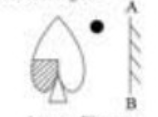
Answer Figures: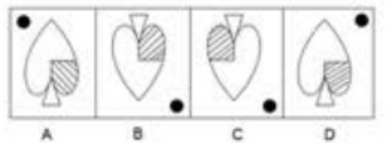
To find the correct mirror image of the given figure when the mirror is placed along the AB line, we need to visualize how the figure would appear if reflected across this line. The key is to observe the positions and orientations of each element relative to the mirror line.
Correct Option: C) The shaded section and black dot are correctly positioned as per the mirror image reflection.
To solve this problem, we need to follow the order of operations, often remembered by the acronym PEMDAS/BODMAS (Parentheses/Brackets, Exponents/Orders, Multiplication and Division (from left to right), Addition and Subtraction (from left to right)).
\[ 12 \div 3 = 4 \]
\[ 4 \times 8 = 32 \]
\[ 20 - 32 = -12 \]
\[ 24 \div (-12) \]
\[ 24 \div (-12) = -2 \]
D) The final result of the calculation is \(-2\).