
If 3x2 + ax + 4 is perfectly divisible by x – 5, then the value of a is:
When a polynomial \(P(x)\) is perfectly divisible by a linear factor \((x - k)\), it means that \(x = k\) is a root of the polynomial, and therefore, \(P(k) = 0\). This is based on the Factor Theorem. We will use this theorem to find the value of 'a'.
The given polynomial is \(P(x) = 3x^2 + ax + 4\).
The divisor is \((x - 5)\).
Since \(P(x)\) is perfectly divisible by \((x - 5)\), according to the Factor Theorem, \(P(5)\) must be equal to 0.
Correct Option: B) -15.8
The given data shows the registration of bikes and total vehicles (in thousands) for 6 months in 2017 in City X.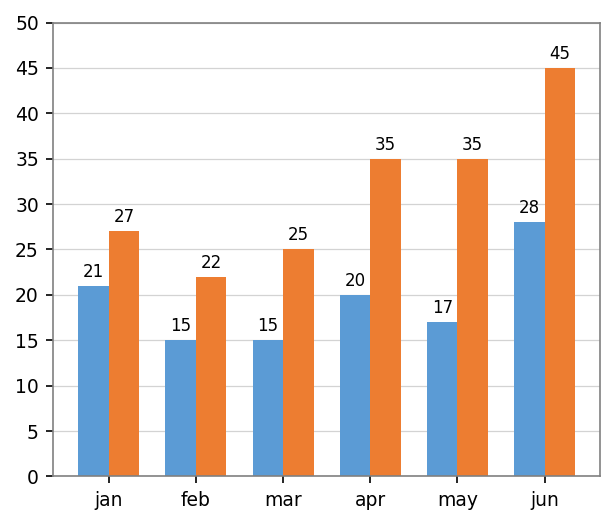
Note: In the chart, the first number represents bikes and the second number represents total vehicles.
Based on the given data, from January to April 2017, the increase in the registration of vehicles other than bikes is ______.
To find the increase in the registration of vehicles other than bikes from January to April 2017, we need to calculate the difference between the total vehicles and bikes for each month and find the increase over the period.
Correct Option: A) 9000
The question asks for the essential element required for the synthesis of thyroxin. This is a direct knowledge-based question related to human physiology and endocrinology.
Correct Option: C) Iodine is an essential trace element that is crucial for the synthesis of thyroid hormones, including thyroxin. The thyroid gland actively absorbs iodine from the bloodstream to produce these hormones.
Choose the correct water image of the problem figure.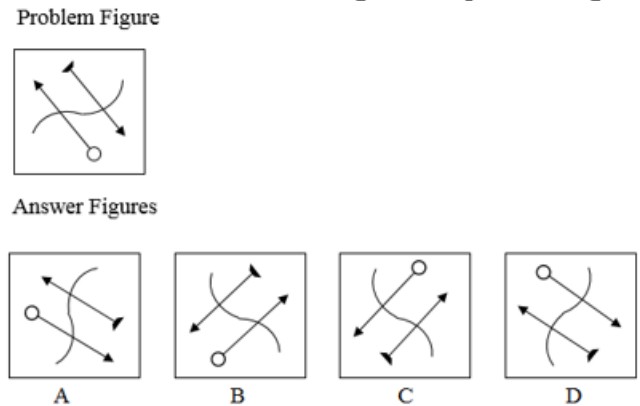
To solve this problem, we need to identify the correct water image of the given problem figure. A water image is a vertical reflection of the original figure.
Correct Option: B) Option B is the correct water image as it accurately reflects the vertical orientation of the problem figure.
The question asks to identify the first country to implement the Goods and Services Tax (GST) system. This is a factual question related to economic history and taxation systems.
D) France was the first country to introduce a Goods and Services Tax (GST) system, implementing it in 1954. It was initially known as Value Added Tax (VAT) and was introduced by Maurice Lauré, a joint director of the French tax authority.
To find the combined mean height, we need to calculate the total height of all boys and all girls, and then divide this sum by the total number of students. The total height for each group (boys and girls) can be found by multiplying their respective mean height by their number.
Calculate the total height of boys:
Number of boys = 25
Mean height of boys = 150 cm
Total height of boys = Number of boys \(\times\) Mean height of boys
Calculate the total height of girls:
Number of girls = 35
Mean height of girls = 145 cm
Total height of girls = Number of girls \(\times\) Mean height of girls
Calculate the total height of all students:
Total height of all students = Total height of boys + Total height of girls
Calculate the total number of students:
Total number of students = Number of boys + Number of girls
Calculate the combined mean height:
Combined mean height = \[\frac{\text{Total height of all students}}{\text{Total number of students}}\]
Approximate the result:
The combined mean height is approximately 147 cm.
A) 147 is the correct option because the calculated combined mean height is approximately 147.083 cm, which rounds to 147 cm.
The question asks to identify the scientist who laid the foundation of chemical sciences by establishing two important laws of chemical combination. This requires knowledge of the history of chemistry and the contributions of key figures to fundamental chemical laws.
Correct Option: C) Antoine L. Lavoisier is often referred to as the "Father of Modern Chemistry." He established the Law of Conservation of Mass, which states that matter cannot be created or destroyed in a chemical reaction. His meticulous quantitative experiments and systematic approach were crucial in transforming chemistry from an alchemical pursuit into a modern science. While Joseph L. Proust (Option D) established the Law of Definite Proportions, Lavoisier's work provided the broader framework and the first of the two fundamental laws, thus laying the foundation of chemical sciences.
\( \frac{2}{3} \) of a milk-water mixture was milk. There was 21 litres of the mixture. If 4 litres of water is added to it, the percentage of milk in the new mixture will be:
To solve this problem, we first need to determine the initial quantities of milk and water in the mixture. Then, we add the specified amount of water to find the new total volume and the new amount of water. Finally, we calculate the percentage of milk in the new mixture.
Calculate the initial quantity of milk:
The total mixture is 21 litres. Milk constitutes \( \frac{2}{3} \) of the mixture.
Calculate the initial quantity of water:
The remaining part of the mixture is water.
Add water to the mixture:
4 litres of water is added to the mixture. The quantity of milk remains unchanged.
Calculate the new total volume of the mixture:
\[ \text{New total mixture} = \text{Quantity of milk} + \text{New quantity of water} \]Calculate the percentage of milk in the new mixture:
\[ \text{Percentage of milk} = \left( \frac{\text{Quantity of milk}}{\text{New total mixture}} \right) \times 100 \% \]Correct Option: C) 56
Which of the Answer Figures is the correct water image for the given Problem figure?
Problem Figure: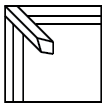
Answer Figures: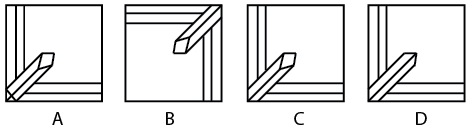
To find the correct water image of the given problem figure, we need to reflect the figure vertically as if it were mirrored on a horizontal axis.
In the problem figure, the diagonal lines start from the top left and move towards the bottom right. In the correct water image, these lines should start from the bottom left and move towards the top right.
Upon examining the options:
Correct Option: D) The lines are correctly mirrored, starting from the bottom left and moving towards the top right, matching the expected water image.
The following table gives the details of the number of students in Class 10 section A and B who had taken mid-term and final exam.
The percentage of students in section A is ______ (round to one decimal).
| Result | Sec A | Sec B |
| Total number of students who failed in both exams | 28 | 23 |
| Total number of students who failed in mid-term but passed in finals | 14 | 12 |
| Total number of students who passed in mid-term but failed in finals | 6 | 17 |
| Total number of students who passed in both the exams | 64 | 55 |
To find the percentage of students in Section A, we first need to calculate the total number of students in Section A. Then, we need to calculate the total number of students across both sections. Finally, we can determine the percentage of students in Section A by dividing the number of students in Section A by the total number of students and multiplying by 100.
B) 51.1 is the correct percentage of students in Section A when rounded to one decimal place.