
To determine which of the given numbers is a perfect square, we can use two main methods: checking the unit digit property of perfect squares and finding the square root of each number. A perfect square's unit digit can only be 0, 1, 4, 5, 6, or 9. If a number ends in 2, 3, 7, or 8, it cannot be a perfect square. For numbers that pass this initial check, we can attempt to find their square roots by estimation or prime factorization.
D) 441 is a perfect square because \(21^2 = 441\).
The problem asks us to identify the wrong number in the given series. We need to find a pattern or rule that governs the series and then check which number does not fit that rule.
D) 32 — The pattern for the series is \(n \times (n+1)\) where \(n\) starts from 2. The terms should be \(2 \times 3 = 6\), \(3 \times 4 = 12\), \(4 \times 5 = 20\), \(5 \times 6 = 30\), \(6 \times 7 = 42\), \(7 \times 8 = 56\), \(8 \times 9 = 72\). The number 32 deviates from this pattern, as it should be 30.
This question asks us to identify implicit assumptions based on a given statement. An implicit assumption is something that is taken for granted or presupposed by the statement, even if not explicitly stated. We need to evaluate each assumption to see if the statement logically depends on it.
Analyze the Statement: The statement is, "The train fares have increased by 25% with immediate effect." This is a factual announcement about a price hike in train travel.
Evaluate Assumption I: "People still prefer travelling by train despite the increase."
Evaluate Assumption II: "Other modes of commutation may also increase their fares."
C) Only assumption I is implicit. The decision to increase train fares implies that the service providers expect people to continue using trains, making the fare hike relevant. If no one was expected to travel by train, increasing fares would be pointless. Assumption II is not implicitly contained within the statement; it's an external possibility not directly assumed by the fare increase itself.
We need to find Veer's total monthly income. We are given information about his expenses as percentages of his income and the amount he saves. We can work backward from the savings to find the total income by calculating the remaining income after each expense.
Let Veer's total monthly income be \(I\).
Veer spends 15% of his monthly income on house rent.
\[ \text{House Rent} = 0.15 \times I \]The income remaining after paying house rent is:
\[ \text{Remaining Income}_1 = I - 0.15 \times I = (1 - 0.15) \times I = 0.85 \times I \]He spends 60% of the rest (which is \(\text{Remaining Income}_1\)) on household expenditure.
\[ \text{Household Expenditure} = 0.60 \times (0.85 \times I) \]The income remaining after household expenditure is his savings. This is 40% of the \(\text{Remaining Income}_1\) because he spent 60% of it.
\[ \text{Savings} = (1 - 0.60) \times (0.85 \times I) = 0.40 \times (0.85 \times I) \]We are given that his savings are ₹ 2210.
\[ 0.40 \times 0.85 \times I = 2210 \]First, multiply the percentages:
\[ 0.40 \times 0.85 = 0.34 \]\[ 0.34 \times I = 2210 \]\[ I = \frac{2210}{0.34} \]\[ I = 6500 \]Therefore, Veer's monthly income is ₹ 6,500.
C) ₹ 6,500 is the correct monthly income calculated based on the given expenditures and savings.
Mendeleev's periodic table was based on the chemical properties of elements, in addition to their atomic masses. To classify elements, he focused on how they reacted with specific elements to form compounds. The choice of these specific elements was crucial because they are highly reactive and form stable compounds with most other elements.
Correct Option: A) Hydrogen and Oxygen. Mendeleev concentrated on the compounds formed by elements with hydrogen and oxygen because they are highly reactive and form stable compounds with most other elements, which helped him in classifying elements based on their chemical properties.
The question asks to identify an organism that reproduces by multiple fission. We need to recall the different modes of asexual reproduction in the given options.
B) Plasmodium — Plasmodium, the parasite responsible for malaria, reproduces asexually by multiple fission (schizogony) within the host's liver cells and red blood cells. This process involves the nucleus dividing multiple times, followed by the cytoplasm dividing to form many merozoites.
To find the other decimal number, we need to divide the product of the two decimal numbers by the given decimal number. This is a straightforward division problem involving decimals.
Correct Option: B) The other decimal number is \(0.48\).
A lawn roller of radius 1 m makes 20 revolutions in one hour. How much distance (in m) will it cover in 25 minutes?
\( \frac{50π}{3} \)
\( \frac{150π}{7} \)
\( \frac{250π}{3} \)
\( \frac{50π}{7} \)
To find the distance covered by the lawn roller, we first need to determine the distance it covers in one revolution. This is equal to its circumference. Then, we calculate the total number of revolutions it makes in 25 minutes and multiply it by the distance per revolution.
The radius of the lawn roller is given as \(r = 1 \text{ m}\).
The circumference (\(C\)) of a circle is given by the formula \(C = 2\pi r\).
\[ C = 2 \times \pi \times 1 \text{ m} = 2\pi \text{ m} \]The roller makes 20 revolutions in 1 hour.
First, convert 1 hour to minutes: \(1 \text{ hour} = 60 \text{ minutes}\).
Number of revolutions per minute:
\[ \text{Revolutions per minute} = \frac{20 \text{ revolutions}}{60 \text{ minutes}} = \frac{1}{3} \text{ revolutions/minute} \]Now, calculate the total revolutions in 25 minutes:
\[ \text{Total revolutions} = \frac{1}{3} \text{ revolutions/minute} \times 25 \text{ minutes} = \frac{25}{3} \text{ revolutions} \]The distance covered in one revolution is \(2\pi \text{ m}\).
Total distance covered = Total revolutions \(\times\) Distance per revolution
\[ \text{Total distance} = \frac{25}{3} \times 2\pi \text{ m} \]\[ \text{Total distance} = \frac{50\pi}{3} \text{ m} \]A) \( \frac{50\pi}{3} \)
The calculations show that the total distance covered by the lawn roller in 25 minutes is \( \frac{50\pi}{3} \text{ m} \).
Select the odd character out of the following series.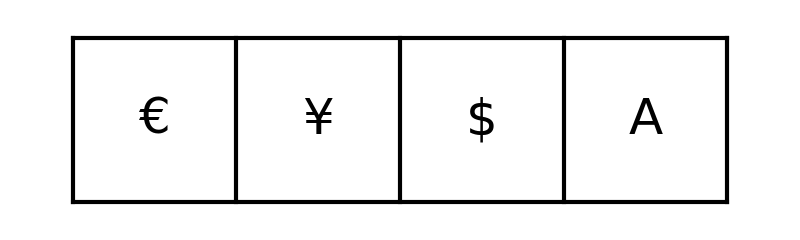
To identify the odd character out, examine the nature and category of each character in the series. The diagram shows four symbols: €, ¥, $, and A.
Correct Option: B) A
The problem presents a series of letter groups, and we need to identify the pattern to find the missing term. We will analyze the number of letters in each group and the sequence of letters within and between groups.
D) KLMNO — This option correctly follows both patterns: it has 5 letters, and these letters are the consecutive alphabetical sequence immediately following the last letter of the previous term (J).