
To determine the final direction of the man with respect to his starting position, we need to trace his path step-by-step, considering each turn and distance covered. We can visualize this on a coordinate plane or by drawing a simple diagram.
D) South east. The final position of the man is 16 km to the East and 8 km to the South of his starting point, which places him in the South-East direction.
This is a logical reasoning question where we need to determine which conclusions logically follow from the given statement. The key is to stick strictly to the information provided in the statement and avoid making assumptions or bringing in outside knowledge. We must evaluate if the conclusions are direct and necessary consequences of the statement.
D) Neither 1 nor 2 follows
The question asks to identify the gas used to prevent food material from getting oxidized. This relates to the concept of food preservation, specifically preventing rancidity, which is often caused by the oxidation of fats and oils in food. We need to choose a gas that is unreactive and can displace oxygen.
D) Nitrogen — Nitrogen gas is largely unreactive under normal conditions and is therefore used to create an inert atmosphere in food packaging. By displacing oxygen, it prevents the oxidation of fats and oils, which causes food to go rancid and spoil.
The question asks to identify the Indian author of the science fiction book 'The Extra-Terrestrial Delivery'. This requires knowledge of contemporary Indian authors and their works, specifically in the science fiction genre.
Correct Option: B) Sudipta Das is the author of the science fiction book 'The Extra-Terrestrial Delivery'. She is an Indian author recognized for her contributions to the genre.
The problem states that the product of two numbers is given, and one of the numbers is also given. To find the other number, we need to divide the product by the known number.
B) 0.27 is the correct answer, as calculated by dividing the product \(0.432\) by the given number \(1.6\).
Select the Answer Figure that fits in the blank space in the given Problem Figure.
Problem Figure: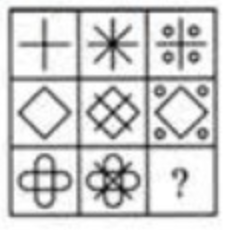
Answer Figures: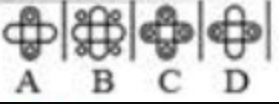
This question involves identifying the pattern in a sequence of figures and selecting the correct figure that completes the sequence.
Correct Option: C) The figure with an additional layer of circles around the central cross shape.
This is an analogy question where we need to find the relationship between the first pair of words and apply the same relationship to the second pair to find the missing word.
Correct Option: B) Comforter
The question asks to identify a metal that is soft enough to be cut with a knife. This property is related to the hardness and physical state of the metal at room temperature. We need to recall the general properties of the given metals.
Based on these properties, Sodium is the only metal among the options that can be cut with a knife.
Correct Option: A) Sodium is an alkali metal, which is known for its extreme softness. It can be easily cut with a knife, revealing a shiny surface that quickly tarnishes upon exposure to air.
The question asks for the maximum time Mr. Z has to wait for a train. To determine this, we need to know two pieces of information: when Mr. Z arrived at the station and when the trains are scheduled. We will evaluate each statement to see if it provides sufficient information, either alone or in combination with the other statement.
B) Both statement 1 and 2 are sufficient.
When combined, Statement 1 provides Mr. Z's arrival time (10 a.m.) and Statement 2 provides the train schedule (11 a.m. and 12 p.m.). With both pieces of information, we can calculate the waiting time for each train and thus determine the maximum waiting time Mr. Z might experience, which is 2 hours (if he waits for the 12 p.m. train). Therefore, both statements together are sufficient.
Use each of the below figures only once and form three groups. The three groups so formed are: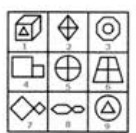
(1,3,8), (2,5,6), (4,7,9)
(1,5,9), (2,3,6), (4,7,8)
(1,3,9), (2,5,6), (4,7,8)
(1,3,6), (2,5,9), (4,7,8)
The goal is to group the figures based on common characteristics. Each group should have a distinct pattern or theme that differentiates it from the others.
In option C, the groups are:
This grouping is consistent with the characteristics observed in the figures.
Correct Option: C) (1,3,9), (2,5,6), (4,7,8)