
Select the figure which does NOT belong to the group.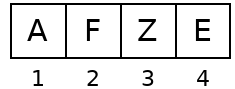
We need to identify the figure that does not belong to the group by analyzing the characteristics of each letter in the given figures.
Thus, option A (Z) does not belong to the group as it is the only letter that includes a diagonal line.
Correct Option: A) 4
To find the smallest square number divisible by 8, 15, and 20, we first need to find the Least Common Multiple (LCM) of these numbers. Then, we will express the LCM in its prime factorization form. For a number to be a perfect square, all the exponents in its prime factorization must be even. We will multiply the LCM by the smallest factor needed to make all exponents even, resulting in the smallest perfect square.
The LCM is found by taking the highest power of all prime factors present in the numbers.
\[ \text{LCM}(8, 15, 20) = 2^3 \times 3^1 \times 5^1 \]\[ \text{LCM}(8, 15, 20) = 8 \times 3 \times 5 = 120 \]For a number to be a perfect square, all the exponents in its prime factorization must be even. The prime factorization of the LCM is \(2^3 \times 3^1 \times 5^1\). To make all exponents even, we need to multiply by \(2^1 \times 3^1 \times 5^1\).
The smallest perfect square will be:
\[ (2^3 \times 3^1 \times 5^1) \times (2^1 \times 3^1 \times 5^1) \]\[ = 2^{(3+1)} \times 3^{(1+1)} \times 5^{(1+1)} \]\[ = 2^4 \times 3^2 \times 5^2 \]\[ = (2 \times 2 \times 2 \times 2) \times (3 \times 3) \times (5 \times 5) \]\[ = 16 \times 9 \times 25 \]\[ = 144 \times 25 \]\[ = 3600 \]Now we check which of the given options is 3600.
Correct Option: C) 3600 is the smallest square number divisible by 8, 15, and 20.
When a ball is dropped from a certain height, its potential energy at that height is converted into kinetic energy just before it strikes the ground. After collision, it rebounds to a new height, meaning some kinetic energy is lost during the inelastic collision. We can calculate the initial and final kinetic energies (or potential energies, which are equivalent at the start/end of the fall/rise) and then determine the percentage loss.
Correct Option: C) 75%
This problem involves calculating the time taken to empty a tank when two pipes, one emptying and one filling, operate alternately. We need to find the individual rates of the pipes, then calculate the net change in tank volume over a two-hour cycle, and finally determine how many cycles are needed to empty the tank, considering the tank starts full and the emptying pipe operates first.
Calculate the emptying rate of Pipe A:
Pipe A can empty the tank in 28 hours. So, in one hour, Pipe A empties \(\frac{1}{28}\) of the tank.
Calculate the filling rate of Pipe B:
Pipe B can fill the tank in 35 hours. So, in one hour, Pipe B fills \(\frac{1}{35}\) of the tank.
Calculate the net change in tank volume over a 2-hour cycle:
In the first hour, Pipe A empties \(\frac{1}{28}\) of the tank.
In the second hour, Pipe B fills \(\frac{1}{35}\) of the tank.
Net change in 2 hours (1 cycle) = Emptied by A - Filled by B
Determine the amount to be emptied before the last emptying turn:
The tank starts full (1 unit). Pipe A operates first. To ensure the tank is fully emptied, we need to consider the last turn of Pipe A. If the tank is emptied completely by Pipe A, Pipe B should not be allowed to fill it again. So, we need to empty a volume such that the remaining volume can be emptied by Pipe A in its last turn without any refilling by Pipe B.
The amount emptied by Pipe A in one hour is \(\frac{1}{28}\) of the tank.
So, we need to empty \[1 - \frac{1}{28} = \frac{27}{28}\] of the tank through the cycles of A and B.
Calculate the number of 2-hour cycles to empty \(\frac{27}{28}\) of the tank:
In 2 hours, \(\frac{1}{140}\) of the tank is emptied.
To empty \(\frac{27}{28}\) of the tank, the number of cycles will be:
Calculate the time taken for these cycles:
Each cycle is 2 hours. So, time taken = \(135 \times 2 = 270\) hours.
Calculate the remaining volume and the final emptying time:
After 270 hours, the amount of tank emptied is \(\frac{27}{28}\).
The remaining volume in the tank is \[1 - \frac{27}{28} = \frac{1}{28}\] of the tank.
Now, it's Pipe A's turn. Pipe A empties \(\frac{1}{28}\) of the tank in 1 hour.
Total time to empty the tank:
Total time = Time for cycles + Time for final emptying by A
Total time = \(270 \text{ hours} + 1 \text{ hour} = 271 \text{ hours}\).
A) 271 hours is the correct answer. This is derived by considering the net emptying rate over a 2-hour cycle and then accounting for the final emptying by Pipe A to prevent refilling.
The question asks for the city that hosted the 2017 Brahmaputra Literary Festival. This is a factual recall question related to current affairs or general knowledge about literary events in India.
The 2017 Brahmaputra Literary Festival was the first edition of this event and was hosted by Guwahati, the largest city in the Indian state of Assam. The festival aimed to celebrate literature, culture, and intellectual discourse in the North-Eastern region of India.
By what number should 10 \( \frac{2}{3} \) be divided to obtain 20?
\( \frac{6}{15} \)
\( \frac{7}{15} \)
\( \frac{8}{15} \)
\( \frac{9}{15} \)
To find the number by which \(10 \frac{2}{3}\) should be divided to obtain 20, we can set up an algebraic equation. First, convert the mixed fraction to an improper fraction. Then, solve for the unknown divisor.
Convert the mixed fraction to an improper fraction:
The given mixed fraction is \(10 \frac{2}{3}\).
To convert it to an improper fraction, multiply the whole number by the denominator and add the numerator. Keep the same denominator.
\[ 10 \frac{2}{3} = \frac{(10 \times 3) + 2}{3} = \frac{30 + 2}{3} = \frac{32}{3} \]Set up the equation:
Let the unknown number be \(x\). The problem states that \(10 \frac{2}{3}\) divided by \(x\) equals 20. So, we can write the equation as:
\[ \frac{32}{3} \div x = 20 \]This can also be written as:
\[ \frac{32}{3x} = 20 \]Solve for \(x\):
To isolate \(x\), we can rearrange the equation:
\[ \frac{32}{3} = 20 \times x \]Now, divide both sides by 20:
\[ x = \frac{32}{3 \times 20} \] \[ x = \frac{32}{60} \]Simplify the fraction:
Both the numerator and the denominator are divisible by 4.
\[ x = \frac{32 \div 4}{60 \div 4} = \frac{8}{15} \]C) \( \frac{8}{15} \) is the correct answer because when \(10 \frac{2}{3}\) (which is \( \frac{32}{3} \)) is divided by \( \frac{8}{15} \), the result is 20.
\[ \frac{32}{3} \div \frac{8}{15} = \frac{32}{3} \times \frac{15}{8} = \frac{32 \times 15}{3 \times 8} = \frac{4 \times 8 \times 5 \times 3}{3 \times 8} = 4 \times 5 = 20 \]This problem involves setting up an algebraic equation based on the given age information and the future age condition. We need to find the number of years after which Rathin's age will be 1.5 times his cousin's age.
Correct Option: D) 11
This problem involves applying a set of given symbol substitutions to a mathematical expression and then evaluating the new expression following the order of operations (BODMAS/PEMDAS).
The original expression is \(35 − 7 ∗ 14 ≈ 28\).
Applying the substitutions:
So, the new expression is \(35 ≈ 7 − 14 + 28\).
First, perform division:
\[ 35 ≈ 7 = 5 \]The expression becomes:
\[ 5 − 14 + 28 \]Next, perform addition and subtraction from left to right:
\[ 5 − 14 = -9 \]The expression becomes:
\[ -9 + 28 \]Finally, perform the last operation:
\[ -9 + 28 = 19 \]D) 19 is the correct value after applying the symbol changes and following the order of operations.
The task is to identify which assumptions are implicit in the given argument. An implicit assumption is something that is taken for granted or understood without being stated directly in the argument. We need to evaluate each assumption to see if the argument relies on it to be true.
Correct Option: D) Neither 1 nor 2 is implicit
Select the figure that does NOT belong in the following group.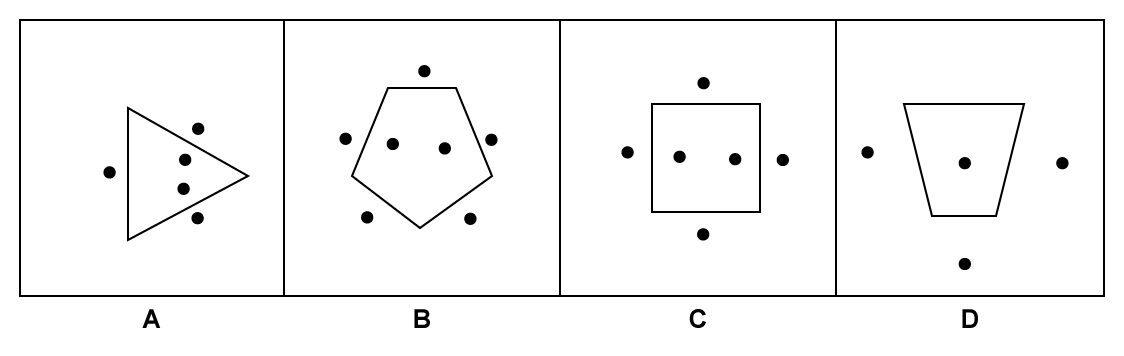
To determine which figure does not belong in the group, we examine the arrangement of shapes and dots in each option. The key is to identify a pattern or rule that three figures follow, which the fourth does not.
Thus, Option A is the odd one out because the placement of the dots differs from the others.
Correct Option: A) The dots are outside the shape.