
When two numbers are in a given ratio, and their H.C.F. (Highest Common Factor) is known, the numbers can be found by multiplying each term of the ratio by the H.C.F. This is because the H.C.F. is the largest common factor that divides both numbers, and the ratio represents the numbers after dividing by their H.C.F.
Correct Option: C) 195, 143
Read the given chart and answer the following question.
In south, what is the percentage of seats won by party A (round to one decimal)?
| Parties and Seats won | |||||
| Serial number | Party | South | East | West | North |
| 1 | A | 40 | 37 | 35 | 27 |
| 2 | B | 6 | 26 | 76 | 86 |
| 3 | C | 83 | 71 | 4 | 21 |
| 4 | D | 1 | 7 | 3 | 11 |
To find the percentage of seats won by Party A in the South, we need to first determine the total number of seats won by all parties in the South. Then, we will divide the seats won by Party A in the South by this total and multiply by 100 to get the percentage. Finally, we will round the result to one decimal place.
From the given chart, Party A won 40 seats in the South.
Add the seats won by all parties (A, B, C, D) in the South column:
\[ \text{Total seats in South} = \text{Seats (A)} + \text{Seats (B)} + \text{Seats (C)} + \text{Seats (D)} \] \[ \text{Total seats in South} = 40 + 6 + 83 + 1 = 130 \]Use the formula:
\[ \text{Percentage} = \left( \frac{\text{Seats won by Party A in South}}{\text{Total seats in South}} \right) \times 100 \] \[ \text{Percentage} = \left( \frac{40}{130} \right) \times 100 \] \[ \text{Percentage} = 0.30769... \times 100 \] \[ \text{Percentage} = 30.769...\% \]Rounding \(30.769...\%\) to one decimal place gives \(30.8\%\).
C) 30.8% is the correct answer, as calculated by dividing the seats won by Party A in the South (40) by the total seats in the South (130) and rounding to one decimal place.
This problem involves setting up and solving a system of linear equations based on the given information about the ages of Peter and Preeti at two different points in time: currently and 35 years ago. We will define variables for their current ages, then express their ages 35 years ago, and finally use the given conditions to find their current ages and their sum.
Define variables for current ages:
Let Peter's current age be \(P\) years.
Let Preeti's current age be \(R\) years.
Formulate the first equation based on the current age difference:
The difference between Peter and Preeti's ages is 5 years. Assuming Peter is older (as implied by the condition 35 years ago), we have:
\[ P - R = 5 \quad \text{(Equation 1)} \]Express their ages 35 years ago:
Peter's age 35 years ago was \(P - 35\) years.
Preeti's age 35 years ago was \(R - 35\) years.
Formulate the second equation based on their ages 35 years ago:
35 years ago, 4 times Peter's age was the same as 5 times Preeti's age:
\[ 4(P - 35) = 5(R - 35) \]Simplify and solve the second equation:
\[ 4P - 140 = 5R - 175 \] \[ 4P - 5R = -175 + 140 \] \[ 4P - 5R = -35 \quad \text{(Equation 2)} \]Solve the system of equations:
From Equation 1, we can express \(P\) in terms of \(R\):
\[ P = R + 5 \]Substitute this into Equation 2:
\[ 4(R + 5) - 5R = -35 \] \[ 4R + 20 - 5R = -35 \] \[ -R = -35 - 20 \] \[ -R = -55 \] \[ R = 55 \]So, Preeti's current age is 55 years.
Find Peter's current age:
Using \(P = R + 5\):
\[ P = 55 + 5 \] \[ P = 60 \]So, Peter's current age is 60 years.
Calculate the current sum of their ages:
Sum \( = P + R = 60 + 55 = 115 \) years.
C) 115 years
Use each of the below figures only once and form three groups. The three groups so formed are: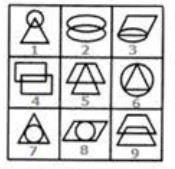
(1,3,5), (2,4,9), (6,7,8)
(1,3,5), (2,7,9), (6,4,8)
(1,3,5), (6,4,9), (2,7,8)
(1,3,5), (2,4,8), (6,7,9)
To solve this problem, we need to identify patterns or similarities among the figures and group them accordingly. Each group should consist of figures that share a common characteristic.
Correct Option: A) (1,3,5), (2,4,9), (6,7,8)
The question asks to identify the host country of the 2017 Asian Women's Boxing Championship where Mary Kom won a gold medal. This requires knowledge of specific sports events and their locations.
A) Vietnam. The 2017 Asian Women's Boxing Championship was held in Ho Chi Minh City, Vietnam, from November 2 to November 11, 2017. Mary Kom won her fifth gold medal at this event in the 48 kg category.
The question asks about the state Arun Jaitley represented in the Rajya Sabha during a specific period. This requires knowledge of the political careers of prominent Indian leaders.
Correct Option: A) Arun Jaitley represented Gujarat in the Rajya Sabha from 2000 to 2018. He was a prominent leader of the Bharatiya Janata Party (BJP) and served multiple terms as a Rajya Sabha MP from Gujarat before becoming India's Finance Minister.
The question asks to identify the type of medicine used to treat indigestion. Indigestion is often caused by an excess of stomach acid. Therefore, the medicine needed would be something that neutralizes this acid.
Correct Option: B) Antacids are medicines that neutralize stomach acid, providing relief from indigestion and heartburn.
The question asks to identify the specific type of asexual reproduction observed in Amoeba. We need to recall the different modes of asexual reproduction and which one is characteristic of Amoeba.
D) Binary fission — Amoeba reproduces by binary fission, where the parent cell divides into two identical daughter cells.
This problem involves work and time, where two individuals, A and B, work on a task. We are given two scenarios: first, when they work together, and second, when they work individually on half the task each. We need to find the time B would take to complete the entire work alone, given that B is more efficient than A.
Let the number of days A takes to complete the work alone be \(a\) days, and B takes \(b\) days to complete the work alone.
The work rate of A is \(\frac{1}{a}\) per day, and the work rate of B is \(\frac{1}{b}\) per day.
Scenario 1: A and B work together.
They complete the work in 12 days. So, their combined work rate is \(\frac{1}{12}\) per day.
Scenario 2: A completes half the job, then B completes the rest.
A completes half the job (\(\frac{1}{2}\) of the work). The time taken by A for this is \[\frac{1/2}{1/a} = \frac{a}{2}\] days.
B completes the remaining half of the job (\(\frac{1}{2}\) of the work). The time taken by B for this is \[\frac{1/2}{1/b} = \frac{b}{2}\] days.
The total time taken in this scenario is 25 days.
From equation (2), we can express \(a\) in terms of \(b\): \(a = 50 - b\).
Substitute this value of \(a\) into equation (1):
\[ \frac{1}{50 - b} + \frac{1}{b} = \frac{1}{12} \]Combine the fractions on the left side:
\[ \frac{b + (50 - b)}{b(50 - b)} = \frac{1}{12} \]\[ \frac{50}{50b - b^2} = \frac{1}{12} \]Cross-multiply to form a quadratic equation:
\[ 50 \times 12 = 50b - b^2 \]\[ 600 = 50b - b^2 \]\[ b^2 - 50b + 600 = 0 \]Solve the quadratic equation for \(b\). We can factorize it:
Find two numbers that multiply to 600 and add up to -50. These numbers are -20 and -30.
\[ (b - 20)(b - 30) = 0 \]This gives two possible values for \(b\): \(b = 20\) or \(b = 30\).
If \(b = 20\), then from \(a = 50 - b\), we get \(a = 50 - 20 = 30\).
If \(b = 30\), then from \(a = 50 - b\), we get \(a = 50 - 30 = 20\).
The problem states that B is more efficient than A. This means B takes less time to complete the work than A. So, \(b < a\).
Comparing the two pairs of solutions:
Therefore, the correct time for B to complete the work alone is 20 days.
B) 20
To determine the number of free electrons in diamond, we need to understand the bonding nature of carbon atoms in its crystalline structure. Diamond is a giant covalent structure where each carbon atom forms strong covalent bonds with four other carbon atoms.
Correct Option: B) zero