
To identify an unsaturated hydrocarbon, we need to understand the definition of saturated and unsaturated hydrocarbons. Saturated hydrocarbons contain only single bonds between carbon atoms, while unsaturated hydrocarbons contain at least one double or triple bond between carbon atoms. We will examine the structure or general formula of each given option.
A) Ethyne is an alkyne with the formula \(C_2H_2\). It contains a carbon-carbon triple bond, making it an unsaturated hydrocarbon.
Complete the series given in the Problem Figure with an appropriate option from the Answer Figures.
Problem Figure
Answer Figures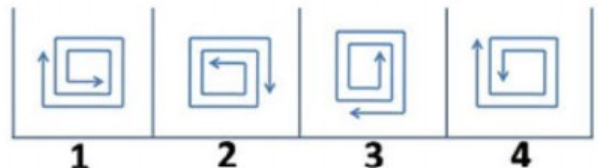
The problem involves identifying the pattern in a series of figures and selecting the correct figure that completes the series from the given options.
Correct Option: B) The pattern of the series is completed by Option 3, which continues the logical sequence of arrow directions.
To solve this problem, we need to first arrange the letters of the given word 'UNIVERSAL' in alphabetical order. Then, we assign numerical values to each letter based on its position. Finally, we identify the consonants and sum their assigned numerical values.
Thus, the sum of the numerical values of the position of the consonants is 31.
Correct Option: A) 31
Select the odd character out of the following series.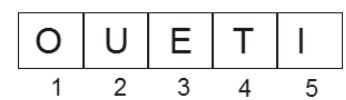
The question asks us to identify the odd character out from a series of letters. The diagram shows a sequence of letters arranged in boxes, each labeled with a number. We need to determine which character does not fit a pattern that the others follow.
Correct Option: A) 4
This problem involves analyzing logical statements and drawing valid conclusions. We will use Venn diagrams or logical deduction to represent the given statements and then check if the conclusions necessarily follow from these statements.
A) Neither 1 nor 2 follows. As analyzed in the step-by-step explanation, neither conclusion can be definitively drawn from the given statements.
One of the roots of the equation x2 - 4x + k = 0 is x = 3. The other root is:
The problem asks us to find the other root of a quadratic equation, given one root. We can solve this by first using the given root to find the value of the constant 'k' in the equation. Once 'k' is known, we can substitute it back into the quadratic equation and then find both roots, or use the property of the sum of roots of a quadratic equation.
Substitute the given root into the equation:
The given quadratic equation is \(x^2 - 4x + k = 0\).
One of the roots is \(x = 3\). Substitute \(x = 3\) into the equation:
Form the complete quadratic equation:
Now that we have the value of \(k\), substitute it back into the original equation:
Find the roots of the complete quadratic equation:
We can factorize the quadratic equation or use the quadratic formula. Factoring is simpler here:
We need two numbers that multiply to 3 and add up to -4. These numbers are -1 and -3.
Identify the roots:
From the factored form, the roots are:
Determine the other root:
Since one root is given as \(x = 3\), the other root is \(x = 1\).
Alternative Method (Using sum of roots):
Identify coefficients:
For a quadratic equation \(ax^2 + bx + c = 0\), the sum of the roots is given by \(-b/a\).
In our equation \(x^2 - 4x + k = 0\), we have \(a = 1\), \(b = -4\), and \(c = k\).
Calculate the sum of roots:
Sum of roots \(= -(-4)/1 = 4\).
Use the given root to find the other root:
Let the two roots be \(\alpha\) and \(\beta\). We are given one root, say \(\alpha = 3\).
We know that \(\alpha + \beta = 4\).
Substitute \(\alpha = 3\):
The other root is 1.
D) x = 1
Which component of the blood transports food, CO2 and nitrogenous waste?
The question asks to identify the component of blood responsible for transporting food, carbon dioxide (CO2), and nitrogenous waste. We need to recall the functions of the different components of blood.
Correct Option: C) Plasma is the yellowish liquid component of blood that holds the blood cells in suspension. It transports nutrients, hormones, proteins, waste products, and gases like CO2 throughout the body.
This problem involves the relationship between kinetic energy and linear momentum. We need to establish the formula connecting these two quantities and then use the given information about the change in kinetic energy to find the corresponding change in linear momentum.
Recall the formulas for kinetic energy and linear momentum:
Establish the relationship between kinetic energy and linear momentum:
We can express \(v\) from the momentum equation as \(v = \frac{p}{m}\). Substitute this into the kinetic energy equation:
\[ K = \frac{1}{2}m\left(\frac{p}{m}\right)^2 = \frac{1}{2}m\frac{p^2}{m^2} = \frac{p^2}{2m} \]From this, we can express momentum in terms of kinetic energy:
\[ p^2 = 2mK \implies p = \sqrt{2mK} \]Apply the given condition:
Let the initial kinetic energy be \(K_1\) and the initial linear momentum be \(p_1\). So, \(p_1 = \sqrt{2mK_1}\).
The new kinetic energy \(K_2\) is 256 times the initial kinetic energy: \(K_2 = 256 K_1\).
Let the new linear momentum be \(p_2\). Then:
\[ p_2 = \sqrt{2mK_2} \]Substitute \(K_2 = 256 K_1\) into the equation for \(p_2\):
\[ p_2 = \sqrt{2m(256 K_1)} = \sqrt{256 \cdot (2mK_1)} \] \[ p_2 = \sqrt{256} \cdot \sqrt{2mK_1} \]Calculate the new linear momentum:
Since \(\sqrt{256} = 16\) and \(p_1 = \sqrt{2mK_1}\), we have:
\[ p_2 = 16 p_1 \]Thus, the new linear momentum will be 16 times the initial value.
Correct Option: C) 16 times the initial value
To find the time taken by a train to cross a man standing on a platform, we need to consider the distance the train travels and its speed. When a train crosses a man (or a pole, or a point object), the distance covered is equal to the length of the train itself. The speed of the train is given, but it needs to be converted from km/h to m/s to be consistent with the length of the train given in meters.
To convert km/h to m/s, multiply by the conversion factor \(\frac{5}{18}\).
\[ S_{\text{m/s}} = 54 \times \frac{5}{18} \text{ m/s} \]\[ S_{\text{m/s}} = 3 \times 5 \text{ m/s} \]\[ S_{\text{m/s}} = 15 \text{ m/s} \]When a train crosses a man (a point object), the distance it needs to cover is equal to its own length.
\[ \text{Distance} = \text{Length of the train} = 180 \text{ m} \]Using the formula \(\text{Time} = \frac{\text{Distance}}{\text{Speed}}\):
\[ \text{Time} = \frac{180 \text{ m}}{15 \text{ m/s}} \]\[ \text{Time} = 12 \text{ seconds} \]Correct Option: A) 12 sec
This problem involves trigonometry, specifically the tangent function, to relate angles of elevation, heights, and distances. We will set up two right-angled triangles based on the given information and use the tangent function to find the unknown height of the hill.
Let the height of the hill be \(h\) meters and the height of the tower be \(H\) meters. We are given \(H = 50 \text{ m}\).
Let the horizontal distance between the foot of the hill and the foot of the tower be \(x\) meters.
Consider the angle of elevation of the top of the hill from the foot of the tower. This forms a right-angled triangle where the height is \(h\), the base is \(x\), and the angle is \(60^\circ\).
Using the tangent function:
Consider the angle of elevation of the top of the tower from the foot of the hill. This forms another right-angled triangle where the height is \(H\) (height of the tower), the base is \(x\), and the angle is \(30^\circ\).
Using the tangent function:
Now, substitute the value of \(x\) from equation (2) into equation (1):
\[ h = (50\sqrt{3})\sqrt{3} \]\[ h = 50 \times 3 \]\[ h = 150 \text{ m} \]Thus, the height of the hill is 150 meters.
D) 150 m is the correct height of the hill, calculated by using the tangent function for both scenarios and solving the resulting system of equations.