
To find the square root of 576, we can use either the prime factorization method or estimation by checking the squares of the given options.
First, we find the prime factors of 576:
So, the prime factorization of 576 is \(2 \times 2 \times 2 \times 2 \times 2 \times 2 \times 3 \times 3\), which can be written as \(2^6 \times 3^2\).
To find the square root, we take half of the exponents:
\[ \sqrt{576} = \sqrt{2^6 \times 3^2} = 2^{6/2} \times 3^{2/2} = 2^3 \times 3^1 \]Now, calculate the value:
\[ 2^3 \times 3^1 = 8 \times 3 = 24 \]We can also check the square of each option:
From this, we can see that \(24^2\) equals 576.
Correct Option: A) 24
The Party which won the highest number of seats is ______.
| Parties and seats won | |||||
| Serial No. | Party | South | East | West | North |
| 1 | A | 40 | 37 | 35 | 27 |
| 2 | B | 6 | 26 | 76 | 86 |
| 3 | C | 83 | 71 | 4 | 21 |
| 4 | D | 1 | 7 | 3 | 11 |
To find the party that won the highest number of seats, we need to calculate the total number of seats won by each party across all regions (South, East, West, North) and then compare these totals.
Correct Option: C) B
To determine if a salt is basic, acidic, or neutral, we need to consider the strength of the acid and base from which it is formed. A salt formed from a strong base and a weak acid will be basic. A salt formed from a strong acid and a weak base will be acidic. A salt formed from a strong acid and a strong base will be neutral. A salt formed from a weak acid and a weak base can be acidic, basic, or neutral depending on the relative strengths of the acid and base.
A) Sodium Carbonate is formed from a strong base (\(\text{NaOH}\)) and a weak acid (\(\text{H}_2\text{CO}_3\)), making its aqueous solution basic.
To find the rate of discount, we first need to calculate the actual discount amount. The discount is the difference between the marked price and the selling price. Once we have the discount amount, we can express it as a percentage of the marked price.
Identify the given values:
Calculate the discount amount:
Discount = Marked Price - Selling Price
\[ \text{Discount} = \text{Rs. } 170 - \text{Rs. } 130 = \text{Rs. } 40 \]Calculate the rate of discount (discount percentage):
The rate of discount is calculated as a percentage of the marked price.
\[ \text{Rate of Discount} = \left( \frac{\text{Discount}}{\text{Marked Price}} \right) \times 100\% \] \[ \text{Rate of Discount} = \left( \frac{40}{170} \right) \times 100\% \] \[ \text{Rate of Discount} = \left( \frac{4}{17} \right) \times 100\% \] \[ \text{Rate of Discount} \approx 0.23529 \times 100\% \] \[ \text{Rate of Discount} \approx 23.53\% \]Correct Option: C) 23.53%
This is a question on logical reasoning, specifically involving syllogisms and Venn diagrams. We need to determine which conclusions logically follow from the given statements. The key principle here is that "Some A are B" implies "Some B are A".
This statement establishes a partial overlap between the set of carpenters and the set of plumbers. If some carpenters are plumbers, it logically follows that some plumbers must also be carpenters. This is a direct inference from the nature of the "some" relationship.
Similarly, this statement establishes a partial overlap between the set of plumbers and the set of daily wage labourers. If some plumbers are daily wage labourers, it logically follows that some daily wage labourers must also be plumbers.
From Statement 1 ("Some carpenters are plumbers"), we can directly infer that "Some plumbers are carpenters." This conclusion logically follows.
From Statement 2 ("Some plumbers are daily wage labourers"), we can directly infer that "Some daily wage labourers are plumbers." This conclusion also logically follows.
B) Both 1 and 2 follow
As established in the step-by-step analysis, both Conclusion 1 and Conclusion 2 are direct and valid inferences from the given statements. The relationship "Some A are B" is symmetrical, meaning if some members of set A are also members of set B, then some members of set B must also be members of set A.
The question asks to identify the odd one out from the given options. This typically involves classifying the options based on a common scientific property or definition. In this case, we need to distinguish between pure substances and mixtures.
Correct Option: D) Water is a pure substance (a compound), whereas air, alloy, and milk are all mixtures.
This problem involves the fundamental relationship between electric current, charge, and time. We need to recall the definition of electric current and the concept of charge quantization to determine the number of electrons.
This formula gives the number of electrons crossing in time \(t\) when a current \(I\) flows and \(e\) is the charge of an electron.
C) \( \frac{It}{e} \) is the correct expression for the number of electrons crossing in \(t\) seconds, derived directly from the definition of current and charge quantization.
Select the correct set that represents the following Venn diagram. 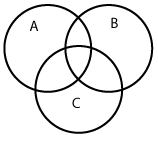
Doctors, human beings, cows
Males, fathers, doctors
Cat, toys, girl
Office boys, government employees, educated person
The Venn diagram consists of three intersecting circles labeled A, B, and C. Each circle represents a different category, and their intersections represent elements common to multiple categories. The task is to match this diagram to the correct set of categories from the given options.
Correct Option: D) Office boys, government employees, educated person
Select the letter which does NOT belong to the group.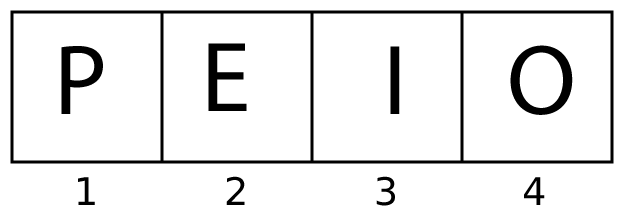
The question requires identifying which letter does not belong to the group based on a specific pattern or characteristic. Observing the diagram can help determine the odd one out.
Correct Option: B) 1
To solve this problem, we need to translate the given statement into a mathematical equation. We will first calculate 15% of 60 and then set this value equal to 45% of an unknown number, which we will solve for.
Correct Option: C) 20