
This question asks about the form of energy stored in a dry cell. Dry cells, like all batteries, function by converting one form of energy into electrical energy. Understanding the fundamental principle of how batteries work will lead to the correct answer.
Correct Option: D) Chemical energy
Select the option that represents the number of triangles in the following figure.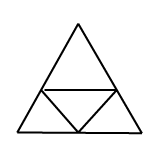
To find the number of triangles in the given figure, we need to identify all possible triangles formed by the intersecting lines.
Thus, there are a total of 5 triangles in the figure.
Correct Option: D) 5
The question asks for the definition of one Watt in terms of fundamental SI units or derived units. Watt is the SI unit of power. Power is defined as the rate at which work is done or energy is transferred.
Correct Option: D) 1 Joule/sec. This option correctly defines one Watt as one Joule per second, which is the SI unit of power.
The question asks to identify the scientist credited with classifying elements based on their atomic masses. This refers to the early attempts at organizing elements into a periodic table, a significant milestone in chemistry.
A) Dmitri Mendeleev — Dmitri Mendeleev is widely recognized for publishing the first widely accepted periodic table in 1869. He arranged the elements primarily on the basis of increasing atomic mass and observed periodic trends in their properties. Crucially, he left gaps for undiscovered elements and predicted their properties, which were later confirmed, solidifying his contribution.
To calculate the force of attraction between two bodies, we use Newton's Law of Universal Gravitation. This law states that every particle attracts every other particle in the universe with a force that is directly proportional to the product of their masses and inversely proportional to the square of the distance between their centers.
The formula for gravitational force \(F\) is:
\[ F = G \frac{m_1 m_2}{r^2} \]To match option B, we can rewrite \(1667.5 \times 10^{-11}\) as \(166.75 \times 10^{-10}\) by dividing 1667.5 by 10 and multiplying \(10^{-11}\) by 10.
\[ F = 166.75 \times 10^{-10} \text{ N} \]Correct Option: B) 166.75 × 10⁻¹⁰ N
To determine Mr. Rajesh's birth year, we need to find his current age. We will analyze each statement individually and then combine them if necessary to see if they provide enough information to calculate his age or birth year.
Correct Option: C) Both statements 1 and 2 are sufficient
The problem asks for the smallest positive integer 'P' such that any integer 'N' greater than 'P' can be expressed as the sum of two composite numbers. We need to identify composite numbers and then test sums to find the threshold 'P'.
A) 11 is the smallest positive integer such that every positive integer N greater than 'P' can be written as a sum of two composite numbers. Numbers 9 and 11 cannot be expressed as a sum of two composite numbers, but all integers \(N > 11\) can be.
The question asks to identify the individual who was NOT one of the 'Nine Gems' (Navaratnas) of Emperor Akbar's court. This requires knowledge of the prominent figures associated with Akbar's reign.
Correct Option: A) Osman Ali Khan was the last Nizam of Hyderabad and lived much later than Emperor Akbar. He was not one of Akbar's 'Nine Gems'.
A pipe can fill a sump with water in 2 hours. Because of a leak, it took 2 \( \frac{2}{3} \) hours to fill the sump. The leak can drain all the water of the sump in:
This problem involves the concept of work and time, specifically related to pipes and cisterns. We need to determine the rate at which the leak drains water from the sump. We can calculate the filling rate of the pipe and the effective filling rate when the leak is present. The difference between these rates will give us the draining rate of the leak.
Calculate the filling rate of the pipe:
The pipe can fill the sump in 2 hours. Therefore, in 1 hour, the pipe fills \( \frac{1}{2} \) of the sump.
Calculate the effective filling rate with the leak:
Due to the leak, it takes \( 2 \frac{2}{3} \) hours to fill the sump. Convert this mixed fraction to an improper fraction:
So, with the leak, in 1 hour, \[\frac{1}{\frac{8}{3}} = \frac{3}{8}\] of the sump is filled.
Determine the draining rate of the leak:
The effective filling rate is the filling rate of the pipe minus the draining rate of the leak. Let \( x \) be the time (in hours) the leak takes to drain the entire sump. Then, in 1 hour, the leak drains \( \frac{1}{x} \) of the sump.
The equation representing the rates is:
\[ \text{Pipe's filling rate} - \text{Leak's draining rate} = \text{Effective filling rate} \]\[ \frac{1}{2} - \frac{1}{x} = \frac{3}{8} \]Solve for \( x \):
Rearrange the equation to isolate \( \frac{1}{x} \):
Find a common denominator, which is 8:
\[ \frac{1}{x} = \frac{4}{8} - \frac{3}{8} \]\[ \frac{1}{x} = \frac{1}{8} \]Therefore, \( x = 8 \) hours.
C) 8 hours is the time the leak alone would take to drain all the water from the sump.