This question tests the understanding of energy transformation, specifically in the context of a stretched bow and arrow. When a bow is stretched, it stores potential energy. When the arrow is released, this stored energy is converted into another form of energy that allows the arrow to move.
Correct Option: B) Kinetic energy
The problem asks us to determine if the given statements are sufficient to find the code for the word "HABITS". We are given an initial coding: "LIKE GOOD HABITS" is coded as 126. This implies that each word corresponds to a unique digit in the code. We need to find the code for "HABITS" by analyzing the common words and their corresponding digits across the given statements.
"LIKE GOOD HABITS" \(\rightarrow\) 126
This means that the words LIKE, GOOD, and HABITS are mapped to the digits 1, 2, and 6 in some order. We don't know the exact mapping yet.
"I LOVE PICTURES" \(\rightarrow\) 785
This statement introduces new words (I, LOVE, PICTURES) and new digits (7, 8, 5). There are no common words between the initial coding ("LIKE GOOD HABITS") and Statement 1. Therefore, Statement 1 alone does not help us find the code for "HABITS".
"THOUGHT BECOMES HABITS" \(\rightarrow\) 856
Let's compare this with the initial coding: "LIKE GOOD HABITS" \(\rightarrow\) 126.
The common word between "LIKE GOOD HABITS" and "THOUGHT BECOMES HABITS" is "HABITS".
The common digit between their codes (126 and 856) is 6.
Since "HABITS" is the only common word and 6 is the only common digit, we can conclude that the code for "HABITS" is 6.
Therefore, Statement 2 alone is sufficient to answer the question.
Since Statement 2 alone is sufficient, we don't need to combine both statements.
B) 2 alone is sufficient while 1 alone is not sufficient to answer the given question.
As determined in the step-by-step analysis, Statement 2 allows us to uniquely identify the code for "HABITS" by finding the common word and common digit between the initial coding and Statement 2. Statement 1 does not share any common words with the initial coding, so it is not sufficient.
The question asks for a substance used to relieve the sting of a honeybee. This requires knowledge of the chemical nature of a honeybee sting and the appropriate neutralizing agent.
The chemical reaction for neutralization would be:
\[ \text{Formic acid (from sting)} + \text{Sodium bicarbonate (baking soda)} \rightarrow \text{Salt} + \text{Water} + \text{Carbon dioxide} \]
\[ \text{HCOOH} + \text{NaHCO}_3 \rightarrow \text{HCOONa} + \text{H}_2\text{O} + \text{CO}_2 \]
B) Baking soda is a mild base (sodium bicarbonate) that neutralizes the acidic venom of a honeybee sting, thereby providing relief from pain and swelling.
If \( \frac{2}{3} \) of a pizza costs ₹300, then \( \frac{3}{5} \) of a pizza will cost:
To solve this problem, we first need to find the cost of a full pizza. We are given the cost of a fraction of a pizza. Once we know the cost of a full pizza, we can then calculate the cost of any other fraction of the pizza.
Determine the cost of a full pizza:
We are given that \( \frac{2}{3} \) of a pizza costs ₹300.
Let the cost of a full pizza be \( C \).
Then, we can write the equation:
\[ \frac{2}{3} \times C = 300 \]To find \( C \), multiply both sides by \( \frac{3}{2} \):
\[ C = 300 \times \frac{3}{2} \] \[ C = \frac{900}{2} \] \[ C = 450 \]So, the cost of a full pizza is ₹450.
Calculate the cost of \( \frac{3}{5} \) of a pizza:
Now that we know the cost of a full pizza is ₹450, we can find the cost of \( \frac{3}{5} \) of a pizza.
Cost of \( \frac{3}{5} \) of a pizza \( = \frac{3}{5} \times C \)
\[ \text{Cost} = \frac{3}{5} \times 450 \] \[ \text{Cost} = 3 \times \frac{450}{5} \] \[ \text{Cost} = 3 \times 90 \] \[ \text{Cost} = 270 \]Therefore, \( \frac{3}{5} \) of a pizza will cost ₹270.
D) ₹270 is the correct answer, as calculated in the step-by-step solution.
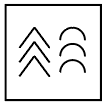
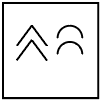
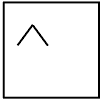
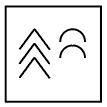
Select the option that will correctly fit in the blank space in the given figure series.
To solve this problem, we need to identify the pattern in the given figure series and determine which option correctly fits in the blank space.
Correct Option: B) Option B correctly fits the pattern by continuing the decrement in upward arcs.
The question asks to identify the river on whose bank Panaji, the capital of Goa, is located. This is a factual question related to the geography of India, specifically the state of Goa. Recalling the geographical location of Panaji and the major rivers of Goa is key to answering this question.
Correct Option: A) Mandovi — Panaji, the capital city of Goa, is located on the banks of the Mandovi River. The river is a significant lifeline for the state, supporting various economic activities and serving as a major tourist attraction.
To find the number, we need to set up an equation where 72% of the unknown number is equal to 90. We can then solve for the unknown number.
Correct Option: B) The number is 125.
We need to analyze the given statement and each assumption to determine which assumption is implicitly made when the statement is considered true. An implicit assumption is something that must be true for the statement to make sense or be valid.
Correct Option: D) Only assumption 1 is implicit.
We need to find three numbers in an Arithmetic Progression (A.P.) that sum up to 69, and the product of their two smaller parts is 483. We can represent the three parts of the A.P. using a common difference and then form equations based on the given conditions. Alternatively, we can test the given options to see which one satisfies both conditions.
Choose the correct figure from the answer figures to replace the question mark.
Question Figures: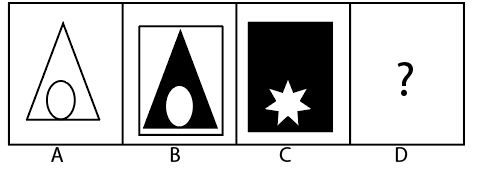
Answer Figures: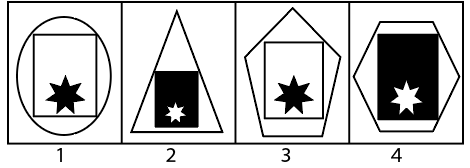
This question involves identifying patterns in a sequence of figures and selecting the correct figure that logically follows the sequence.
Correct Option: A) Option 1