
To find the sum of the lengths of the diagonals of a rhombus, we will use the properties of a rhombus, specifically the relationship between its side length, diagonals, and area. The key properties are that the diagonals bisect each other at right angles, and the area of a rhombus is half the product of its diagonals.
Let the side length of the rhombus be \(a\). We are given \(a = 49 \text{ cm}\).
Let the lengths of the diagonals be \(d_1\) and \(d_2\). The area of the rhombus (\(A\)) is given by the formula:
\[ A = \frac{1}{2} d_1 d_2 \]We are given the area \(A = 1320 \text{ cm}^2\). So, we have:
\[ 1320 = \frac{1}{2} d_1 d_2 \]\[ d_1 d_2 = 2 \times 1320 \]\[ d_1 d_2 = 2640 \quad \text{(Equation 1)} \]Another important property of a rhombus is that its diagonals bisect each other at right angles. If the diagonals are \(d_1\) and \(d_2\), then the half-diagonals are \(\frac{d_1}{2}\) and \(\frac{d_2}{2}\). These half-diagonals form a right-angled triangle with the side of the rhombus as the hypotenuse. By the Pythagorean theorem:
\[ \left(\frac{d_1}{2}\right)^2 + \left(\frac{d_2}{2}\right)^2 = a^2 \]\[ \frac{d_1^2}{4} + \frac{d_2^2}{4} = a^2 \]\[ d_1^2 + d_2^2 = 4a^2 \]Substitute the given side length \(a = 49 \text{ cm}\):
\[ d_1^2 + d_2^2 = 4 \times (49)^2 \]\[ d_1^2 + d_2^2 = 4 \times 2401 \]\[ d_1^2 + d_2^2 = 9604 \quad \text{(Equation 2)} \]We need to find the sum of the lengths of its diagonals, which is \(d_1 + d_2\). We know the algebraic identity:
\[ (d_1 + d_2)^2 = d_1^2 + d_2^2 + 2d_1 d_2 \]Substitute the values from Equation 1 and Equation 2 into this identity:
\[ (d_1 + d_2)^2 = 9604 + 2 \times 2640 \]\[ (d_1 + d_2)^2 = 9604 + 5280 \]\[ (d_1 + d_2)^2 = 14884 \]Now, take the square root of both sides to find \(d_1 + d_2\):
\[ d_1 + d_2 = \sqrt{14884} \]To find the square root of 14884:
So,
\[ d_1 + d_2 = 122 \text{ cm} \]B) 122 cm — The sum of the lengths of the diagonals is 122 cm, as calculated using the area and side length properties of the rhombus.
The question asks to identify the Indian scientist who received the Living Legend Award from the International Union of Nutritional Sciences (IUNS) in 2017 for contributions to nutrition. This requires knowledge of prominent Indian scientists and their specific achievements and awards.
Correct Option: C) Mahtab Bamji was honored with the Living Legend Award by the International Union of Nutritional Sciences (IUNS) in 2017 for her outstanding contributions to the field of nutrition, particularly her work on public health nutrition and micronutrient deficiencies in India.
The given chart shows men's and women's average daily earning in Company X. Based on the depicted data, in which year was the percentage increase of the average daily earning of men maximum over the preceding year?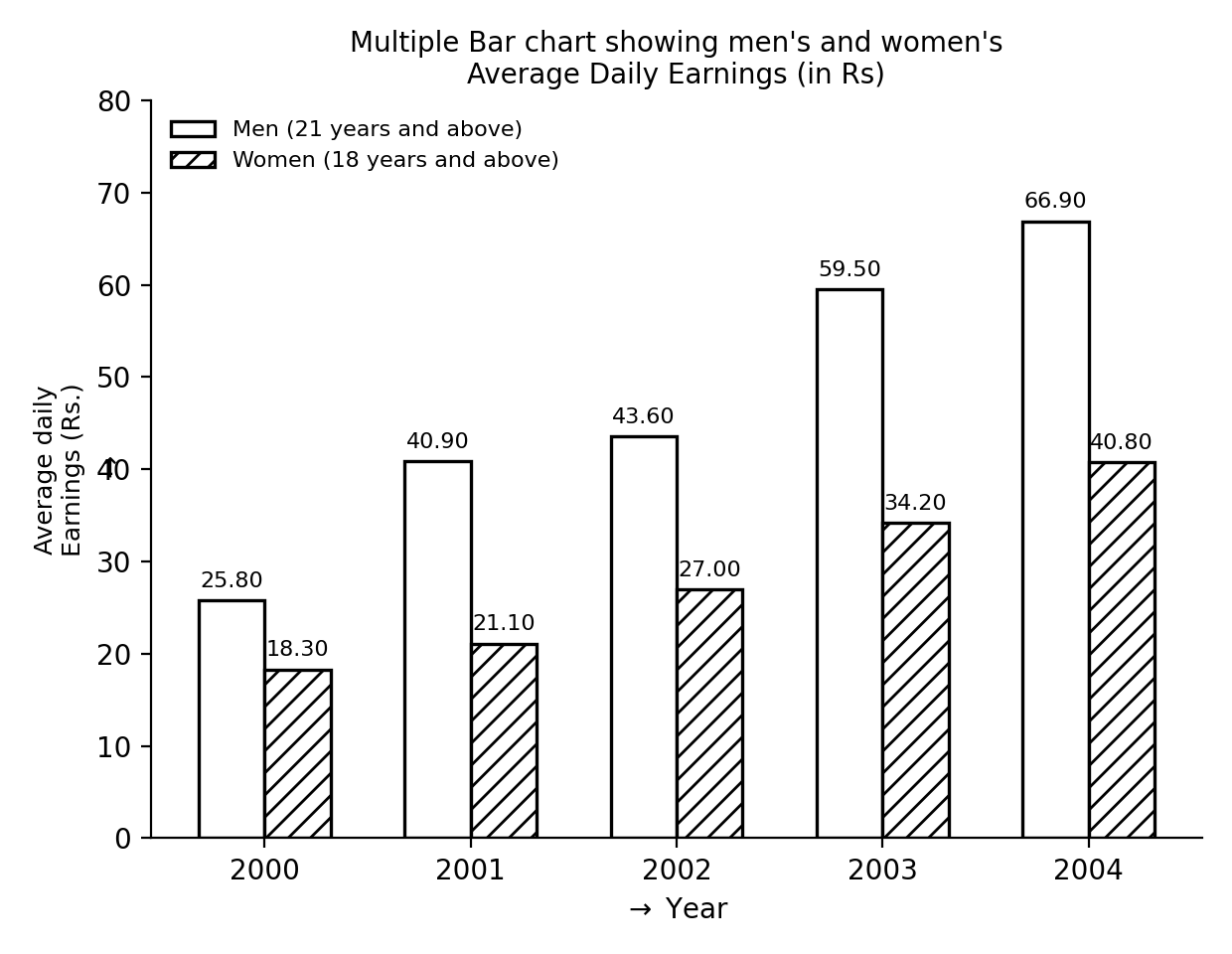
To find the year with the maximum percentage increase in men's average daily earnings over the preceding year, we need to calculate the percentage increase for each year and compare them.
Correct Option: A) 2003
The question asks for the range of frequencies of sound waves that are audible to human beings. This is a standard piece of scientific knowledge related to human perception of sound.
C) 16 Hz to 20 kHz — This option states the audible frequency range as 16 Hz to 20 kHz. While 20 Hz is the more commonly cited lower limit, 16 Hz is also considered within the very low end of human hearing, particularly for some individuals, and 20 kHz (20,000 Hz) is the widely accepted upper limit for young adults. This option best represents the full spectrum of human hearing.
The problem states that Charan secured 54 marks, which is equivalent to 72% of the total marks. We need to find the total marks the test was out of. We can set up a proportion or a simple equation to solve this.
Let the total marks of the test be \(T\).
According to the problem, 54 marks represent 72% of the total marks. We can write this as an equation:
\[ 72\% \text{ of } T = 54 \]Convert the percentage to a decimal or fraction:
\[ \frac{72}{100} \times T = 54 \]Now, solve for \(T\):
\[ T = \frac{54 \times 100}{72} \]Simplify the expression. We can divide both 54 and 72 by their common factors. Both are divisible by 9:
\[ T = \frac{6 \times 100}{8} \]Further simplify by dividing 6 and 8 by 2:
\[ T = \frac{3 \times 100}{4} \]Now, perform the multiplication and division:
\[ T = \frac{300}{4} \] \[ T = 75 \]So, the test was out of 75 marks.
Correct Option: A) 75
Select the odd term out of the following.
0.02, 0.020, \( \frac{2}{100} \), 0.002
To find the odd term, we need to convert all given numbers into a common format, preferably decimal, and then compare their values. The odd term will be the one that has a different value from the others.
Correct Option: A) 0.002 is the odd term because its value is two thousandths, while the other terms represent two hundredths.
This problem involves deductive reasoning based on given statements. We will use Venn diagrams or logical deduction to determine which conclusions necessarily follow from the statements.
C) Both 1 and 2 can be drawn
To find the number of boys, we need to calculate the fraction of boys from the total number of students. The problem states that three-fifths of the students are boys, and the total number of students is 45. We will multiply the total number of students by the given fraction to find the number of boys.
The total number of students in the class is 45.
\[ \text{Total students} = 45 \]The problem states that three-fifths of the students are boys.
\[ \text{Fraction of boys} = \frac{3}{5} \]To find the number of boys, multiply the total number of students by the fraction of boys.
\[ \text{Number of boys} = \text{Total students} \times \text{Fraction of boys} \]\[ \text{Number of boys} = 45 \times \frac{3}{5} \]First, divide 45 by 5, then multiply the result by 3.
\[ \text{Number of boys} = \frac{45}{5} \times 3 \]\[ \text{Number of boys} = 9 \times 3 \]\[ \text{Number of boys} = 27 \]Therefore, there are 27 boys in the class.
Correct Option: C) 27
The problem asks us to identify implicit assumptions based on a given statement. We need to analyze the statement and each assumption to determine if the assumption is a necessary underlying belief or condition for the statement to be made or to make sense.
Correct Option: A) Both assumptions 1 and 2 are implicit.