
The question asks to identify which statement is NOT a property of acids. We need to recall the common characteristics of acids and compare them with the given options.
D) Acids have bitter taste. This statement is incorrect because acids are characterized by a sour taste, while bitter taste is a property of bases.
If three groups could be formed using the given figures only once, these groups would be ______.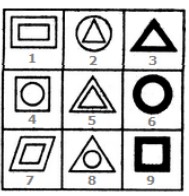
(1,5,7), (2,6,8) and (3,4,9)
(1,5,7), (2,4,9) and (3,6,8)
(1,5,7), (2,4,8) and (3,6,9)
(1,5,8), (2,4,7) and (3,6,9)
The task is to form three groups using the figures in the diagram such that each group follows a logical pattern or rule.
Correct Option: C) (1,5,7), (2,4,8) and (3,6,9)
To calculate the percentage of loss, we first need to determine the actual loss incurred. The loss is the difference between the cost price and the selling price. Once the loss amount is found, the percentage of loss is calculated by dividing the loss by the cost price and multiplying by 100.
Loss occurs when the Selling Price is less than the Cost Price.
\[ \text{Loss} = \text{CP} - \text{SP} \] \[ \text{Loss} = \text{₹}375 - \text{₹}345 \] \[ \text{Loss} = \text{₹}30 \]The formula for percentage loss is:
\[ \text{Percentage of Loss} = \left( \frac{\text{Loss}}{\text{CP}} \right) \times 100 \% \]Substitute the values:
\[ \text{Percentage of Loss} = \left( \frac{30}{375} \right) \times 100 \% \]Simplify the fraction:
\[ \text{Percentage of Loss} = \left( \frac{2 \times 15}{25 \times 15} \right) \times 100 \% \] \[ \text{Percentage of Loss} = \left( \frac{2}{25} \right) \times 100 \% \] \[ \text{Percentage of Loss} = 2 \times 4 \% \] \[ \text{Percentage of Loss} = 8 \% \]Correct Option: B) 8
The problem asks us to identify which of the given assumptions are implicit in the argument. An implicit assumption is something that is not explicitly stated but must be true for the argument to hold. We need to analyze each assumption in the context of the given statement.
D) Only assumption 1 is implicit.
Assumption 1 is implicit because the authority would not issue an advisory to reduce water consumption unless it believed that citizens might actually reduce their consumption. The very act of issuing such an advisory implies an expectation of compliance, at least from some people. Assumption 2 is not implicit because the authority's decision to issue the advisory does not depend on the expectation of protests. Protests are a possible reaction, but not a necessary underlying belief for the advisory to be issued.
The question asks to identify the common passage for both urine and sperm in human males. This requires knowledge of the anatomy and physiology of the male reproductive and urinary systems.
A) Urethra — In human males, the urethra serves as a common duct for the passage of both urine from the urinary bladder and semen (containing sperm) from the ejaculatory ducts to the outside of the body. This dual function is why it is often referred to as the urinogenital duct in males.
The question asks for the maximum number of electrons that can be accommodated in the M shell. This requires knowledge of atomic structure, specifically the principal energy shells and the formula used to calculate the maximum electron capacity of a given shell.
Therefore, the M shell can accommodate a maximum of 18 electrons.
Correct Option: A) 18 is the correct answer because the M shell corresponds to \(n=3\), and using the formula \(2n^2\), the maximum number of electrons is \(2 \times 3^2 = 18\).
The question asks to identify an amphoteric oxide from the given options. An amphoteric oxide is an oxide that exhibits both acidic and basic properties, meaning it can react with both acids and bases to form salt and water.
D) Aluminium oxide is an amphoteric oxide because it reacts with both acids and bases to form salt and water.
The fraction from the ones listed below that will NOT lead to a recurring decimal is:
\(\frac{4}{56}\)
\(\frac{7}{56}\)
\(\frac{6}{56}\)
\(\frac{8}{56}\)
A fraction will result in a terminating decimal (not a recurring decimal) if, after simplifying the fraction to its lowest terms, the prime factors of its denominator contain only 2s and/or 5s. We will simplify each given fraction and check the prime factors of its denominator.
The fraction is \(\frac{4}{56}\).
Simplify the fraction:
\[ \frac{4}{56} = \frac{4 \div 4}{56 \div 4} = \frac{1}{14} \]
The denominator is 14. The prime factors of 14 are \(2 \times 7\). Since 7 is a prime factor, this will lead to a recurring decimal.
The fraction is \(\frac{7}{56}\).
Simplify the fraction:
\[ \frac{7}{56} = \frac{7 \div 7}{56 \div 7} = \frac{1}{8} \]
The denominator is 8. The prime factors of 8 are \(2 \times 2 \times 2 = 2^3\). Since the prime factors only include 2s, this will lead to a terminating decimal.
The fraction is \(\frac{6}{56}\).
Simplify the fraction:
\[ \frac{6}{56} = \frac{6 \div 2}{56 \div 2} = \frac{3}{28} \]
The denominator is 28. The prime factors of 28 are \(2 \times 2 \times 7 = 2^2 \times 7\). Since 7 is a prime factor, this will lead to a recurring decimal.
The fraction is \(\frac{8}{56}\).
Simplify the fraction:
\[ \frac{8}{56} = \frac{8 \div 8}{56 \div 8} = \frac{1}{7} \]
The denominator is 7. The prime factors of 7 are just 7. Since 7 is a prime factor, this will lead to a recurring decimal.
Only option B results in a fraction whose simplified denominator has only 2s and/or 5s as prime factors.
Correct Option: B) \(\frac{7}{56}\) will not lead to a recurring decimal because it simplifies to \(\frac{1}{8}\), and the prime factors of the denominator (8) are only 2s (i.e., \(2^3\)).
The question asks about the trend in atomic structure as we move down a group in the periodic table. We need to recall the fundamental principles of periodic trends, specifically how the number of electron shells and valence electrons change within a group.
C) The number of shells increases. As explained in the step-by-step analysis, moving down a group introduces a new principal energy level (electron shell) for each subsequent element. This directly leads to an increase in the number of electron shells.
The question asks for the definition of a tissue. We need to recall the biological definition of a tissue, which involves groups of cells working together.
B) Cells which are similar in origin, form and function
This option accurately describes a tissue. A tissue is a collection of cells that are structurally similar (form), have a common developmental history (origin), and cooperate to perform a specialized task (function). This coordinated effort is fundamental to the organization of multicellular organisms.